from Chinatown
Jake Gittes: I just want to know what you're worth. Over ten million?
Noah Cross: Oh my, yes.
Jake Gittes: Why are you doing it? How much better can you eat? What can you buy that you can't already afford?
Noah Cross: The future, Mr. Gitts, the future.
Thursday, February 09, 2006
Julian Sanchez writes about the NSA warrantless spying program.
He links to an interesting Washington Post piece and a New Republic piece by Richard Posner.
I caught the Attorney General on Charlie Rose's show tonight and he brought up a new justification beyond the Force Resolution (AUMF) of 2001. He wasn't clear, but he said something about the President's power to act in national security matters. He also argued again that there's a clause in FISA that says Congress may give the President greater powers - or take away oversight - in future cases, but critics continue to argue FISA has the word "exclusive" in it.
He links to an interesting Washington Post piece and a New Republic piece by Richard Posner.
I caught the Attorney General on Charlie Rose's show tonight and he brought up a new justification beyond the Force Resolution (AUMF) of 2001. He wasn't clear, but he said something about the President's power to act in national security matters. He also argued again that there's a clause in FISA that says Congress may give the President greater powers - or take away oversight - in future cases, but critics continue to argue FISA has the word "exclusive" in it.
Tuesday, February 07, 2006
Equilibrium, i.e. non-dictatorial
(or the Domestic Spying/Terrorist Surveillance Program)
I recorded the entire Senate Judiciary Committee hearing with Attorney General Gonzalez about the administration's NSA domestic spying program and watched the entire thing.
The hearing focused on a program Bush authorized for the NSA that allows it to use warrantless electronic surveillance on international communications from Al Qaeda or affiliated groups with American citizens within the "homeland." Warrantless means the other two branches of government have no oversight or "check" on what the administration is doing in regards to the domestic half of the international communication being spied upon.
Justice Jackson's concurring opinion in the "Youngstown Sheet & Tube Co. v. Sawyer" Supreme Court decision was referred to by some because of its discussion of the limits of the Executive branch's powers.
The 1978 Foreign Intelligence Surveillance Act (FISA) was Congress's response to the abuses of wiretapping by previous administrations. Apparently, according to this law the government needs a warrant from a special Foreign Intelligence Surveillance court in order to perform certain electronic surveillance. Shortly after 9-11 and the 2001 resolution, the Authorization of the Use of Military Force (AUMF, against al Qaeda) given to the President by Congress, the administration decided that it didn't need to go to this court to get warrants for NSA spying on international communications from al Qaeda or related groups to American citizens in the US.
The issue is that half of the communication is within the US and hence domestic. Attorney General Gonzalez told the hearing the President didn't authorize a warrantless domestic to domestic communications surveillance program, because of the politics, essentially. However, he didn't say whether or not the AUMF, or the Constitution, gave the Executive that power.
It looks like politics, the media and the public will decide this issue. It came to light because of a leak and, outside the Executive branch, only the top 8 members of Congress regarding intelligence issues had been informed of the program. (Gonzalez said because of the AUMF and the Executive's constitutional powers, it wasn't required to inform anyone else.)
However, after 9-11 Congress changed FISA to make it easier to use. Someone elsewhere on the Internet wrote
Interestingly, Gonzalez noted that the AUMF is *not* a declaration of war by Congress, but simply what it states: a Congressional authorization of the use of military force.
Republican Senators Specter, Graham, DeWine and Brownback all questioned the administration's use of the AUMF to back up the legality of the NSA/al Qaeda-domestic spying program. As the New York Times reports
Those who subscribe to the Vic Mackey* theory of law enforcement wonder what the big deal is. They should study the domestic spying abuses which led to the encactment of the 1978 FISA law and consider the experience of other countries which don't value a system of checks and balances. Senator Specter spoke of the equlibrium amongst the various branches of govenment and warned that the administration may be disturbing it. All he recommended, though, was that the administration bring the program before the FISA court and see what it had to say. Perhaps there's a chance Congress will do something if Gonzalez doesn't follow his advice, but it looks like this will be decided by the public and politics rather than the law and Constitution.
Emily Bazelon writing in Slate on the hearings.
blogger Glenn Greenwald
Noah Feldman writing in the New York Times Magazine
*character on the television show The Shield
(or the Domestic Spying/Terrorist Surveillance Program)
I recorded the entire Senate Judiciary Committee hearing with Attorney General Gonzalez about the administration's NSA domestic spying program and watched the entire thing.
The hearing focused on a program Bush authorized for the NSA that allows it to use warrantless electronic surveillance on international communications from Al Qaeda or affiliated groups with American citizens within the "homeland." Warrantless means the other two branches of government have no oversight or "check" on what the administration is doing in regards to the domestic half of the international communication being spied upon.
Justice Jackson's concurring opinion in the "Youngstown Sheet & Tube Co. v. Sawyer" Supreme Court decision was referred to by some because of its discussion of the limits of the Executive branch's powers.
The 1978 Foreign Intelligence Surveillance Act (FISA) was Congress's response to the abuses of wiretapping by previous administrations. Apparently, according to this law the government needs a warrant from a special Foreign Intelligence Surveillance court in order to perform certain electronic surveillance. Shortly after 9-11 and the 2001 resolution, the Authorization of the Use of Military Force (AUMF, against al Qaeda) given to the President by Congress, the administration decided that it didn't need to go to this court to get warrants for NSA spying on international communications from al Qaeda or related groups to American citizens in the US.
The issue is that half of the communication is within the US and hence domestic. Attorney General Gonzalez told the hearing the President didn't authorize a warrantless domestic to domestic communications surveillance program, because of the politics, essentially. However, he didn't say whether or not the AUMF, or the Constitution, gave the Executive that power.
It looks like politics, the media and the public will decide this issue. It came to light because of a leak and, outside the Executive branch, only the top 8 members of Congress regarding intelligence issues had been informed of the program. (Gonzalez said because of the AUMF and the Executive's constitutional powers, it wasn't required to inform anyone else.)
However, after 9-11 Congress changed FISA to make it easier to use. Someone elsewhere on the Internet wrote
While Feinstein touched on it, what is the explanation of the Administration for the clause in FISA allowing the President warrantless wiretapping for 15 days after Congress declares war? According to Gonzalez, FISA is Constitutional, he just doesn't think it applies in time of war. So what was the point of that clause? According to him, wouldn't that clause be unconstitutional because it appears to limit Presidential powers in wartime?Gonzalez told the hearing that the AUMF superceded FISA - or did he? - plus FISA is too burdensome. Well if FISA doesn't apply because of the AUMF, how is it burdensome? And how come this program wasn't mentioned when FISA was altered after 9-11?
Interestingly, Gonzalez noted that the AUMF is *not* a declaration of war by Congress, but simply what it states: a Congressional authorization of the use of military force.
Republican Senators Specter, Graham, DeWine and Brownback all questioned the administration's use of the AUMF to back up the legality of the NSA/al Qaeda-domestic spying program. As the New York Times reports
Mr. Gonzales also clarified again a statement he made on Dec. 19, a few days after the spying program was disclosed by The New York Times. At the time, he said the administration had not sought an amendment to the 1978 law because "certain members of Congress" had "advised that that would be difficult, if not impossible." Since then Mr. Gonzales has said the real problem is that such legislation could not be enacted without compromising the program.So it sounds like they knew the other branches of government would see it as a power grab.
Those who subscribe to the Vic Mackey* theory of law enforcement wonder what the big deal is. They should study the domestic spying abuses which led to the encactment of the 1978 FISA law and consider the experience of other countries which don't value a system of checks and balances. Senator Specter spoke of the equlibrium amongst the various branches of govenment and warned that the administration may be disturbing it. All he recommended, though, was that the administration bring the program before the FISA court and see what it had to say. Perhaps there's a chance Congress will do something if Gonzalez doesn't follow his advice, but it looks like this will be decided by the public and politics rather than the law and Constitution.
Emily Bazelon writing in Slate on the hearings.
blogger Glenn Greenwald
Noah Feldman writing in the New York Times Magazine
*character on the television show The Shield
Saturday, February 04, 2006
Thursday, February 02, 2006
The Market System and Shifting Alliances
President Bush, who was well-known for not travelling outside the country much at all, spoke a great deal in his state of the union on America's need to globalize and mix it up with the rest of the world. In fact, in his opinion it's America's duty to lead all other nations.
I haven't seen the film Syriana but from what I hear it portrays the US government's foreign policy as highly cynical and mercantilist, the very opposite of what a global leader should be. Or does it?
The plot involves an oil-rich Middle Eastern nation whose leader has made contracts with China to sell its oil at much higher prices than the US is currently paying. This leader is a genuine reformer who wants to use the increase in government revenue to benefit his citizens. The market system at work, in a sense. The CIA assassinates this leader so that his pro-American brother can assume power and continue the preferential treatment of America.
So, yes the Americans behave badly on the international stage. But what about the Chinese? In the real world, they back the genocidal regime of Sudan because of oil. They back the klepto-theocratic rogue regime of Iran because of oil. And they keep the American government and economy afloat via massive loans. But they need the American consumer to keep their economy growing.
I'm in the middle of reading Steve Coll's Ghost Wars which is partly about the CIA's support of the Afghan rebels in their war with the Soviet Union's invading force. Most of the weapons the CIA initially supplied to the rebels came from Communist China, a mortal enemy of the Soviet Union.
So, first the US formed an alliance with the Soviet Union against fascist Germany. Then it allied with radical Islam, a defeated Germany and Communist China against the Soviet Union. Now it's allied with Germany, Russia and China against radical Islam.
President Bush, who was well-known for not travelling outside the country much at all, spoke a great deal in his state of the union on America's need to globalize and mix it up with the rest of the world. In fact, in his opinion it's America's duty to lead all other nations.
I haven't seen the film Syriana but from what I hear it portrays the US government's foreign policy as highly cynical and mercantilist, the very opposite of what a global leader should be. Or does it?
The plot involves an oil-rich Middle Eastern nation whose leader has made contracts with China to sell its oil at much higher prices than the US is currently paying. This leader is a genuine reformer who wants to use the increase in government revenue to benefit his citizens. The market system at work, in a sense. The CIA assassinates this leader so that his pro-American brother can assume power and continue the preferential treatment of America.
So, yes the Americans behave badly on the international stage. But what about the Chinese? In the real world, they back the genocidal regime of Sudan because of oil. They back the klepto-theocratic rogue regime of Iran because of oil. And they keep the American government and economy afloat via massive loans. But they need the American consumer to keep their economy growing.
I'm in the middle of reading Steve Coll's Ghost Wars which is partly about the CIA's support of the Afghan rebels in their war with the Soviet Union's invading force. Most of the weapons the CIA initially supplied to the rebels came from Communist China, a mortal enemy of the Soviet Union.
So, first the US formed an alliance with the Soviet Union against fascist Germany. Then it allied with radical Islam, a defeated Germany and Communist China against the Soviet Union. Now it's allied with Germany, Russia and China against radical Islam.
"Gameness" (or man's best friend)
Malcolm Gladwell, about whom I know nothing, writes:
Malcolm Gladwell, about whom I know nothing, writes:
Pit bulls, descendants of the bulldogs used in the nineteenth century for bull baiting and dogfighting, have been bred for “gameness,” and thus a lowered inhibition to aggression. Most dogs fight as a last resort, when staring and growling fail. A pit bull is willing to fight with little or no provocation. Pit bulls seem to have a high tolerance for pain, making it possible for them to fight to the point of exhaustion. Whereas guard dogs like German shepherds usually attempt to restrain those they perceive to be threats by biting and holding, pit bulls try to inflict the maximum amount of damage on an opponent. They bite, hold, shake, and tear. They don’t growl or assume an aggressive facial expression as warning. They just attack. “They are often insensitive to behaviors that usually stop aggression,” one scientific review of the breed states. “For example, dogs not bred for fighting usually display defeat in combat by rolling over and exposing a light underside. On several occasions, pit bulls have been reported to disembowel dogs offering this signal of submission.” In epidemiological studies of dog bites, the pit bull is overrepresented among dogs known to have seriously injured or killed human beings, and, as a result, pit bulls have been banned or restricted in several Western European countries, China, and numerous cities and municipalities across North America. Pit bulls are dangerous.
Monday, January 23, 2006
Hitchens continues his war on cliche in a review of a Flaubert book:
This made me laugh:
"Still, it is a trope to rival that of Proust's Mme. Verdurin, who loved nothing better than 'to frolic in her billow of stock expressions.'"
This made me laugh:
"Still, it is a trope to rival that of Proust's Mme. Verdurin, who loved nothing better than 'to frolic in her billow of stock expressions.'"
Sunday, January 15, 2006
Julian Sanchez interview with Russell Tice, one of the NSA leakers. Reminds of that cheesy movie Sneakers, which starred Ben Kingsley, Mary McDonnell, Dan Aykroyd, Sidney Pointier, David Strathairn, Robert Redford, and River Phoenix, deceased brother of Joaquin.
Monday, November 28, 2005
Saturday, November 19, 2005
Sunday, November 06, 2005
Monday, October 31, 2005
I noticed the same thing Neal Pollack did:
As the Sox cruised toward their destiny tonight, with one out in the 9th, Mr. Buck started naming off South Side neighborhoods. He got them right: Bridgeport, Hyde Park, Back Of The Yards, and a couple of others. He then mentioned how the South Side is home to many different ethnic groups: Irish-American, Polish, Lithuanian....and then he stopped.
How in the world can a grown man in the sports business talk about the South Side of Chicago and possibly not mention that black people live there? Or hundreds of thousands of Mexicans? Or, you know, people from non-Caucasian ethnic groups.
Lakshmi Chaudhry takes issue with some of the themes of Ariel Levy's new book which I brought up here.
(via Doug Ireland.)
(via Doug Ireland.)
Wednesday, October 26, 2005
Iran vs. Israel
I don't know the significance of this, but Iran's hardline President said today that Israel must be "wiped off the map." The New York Times reports
The Iranian mullahs' bluster may reflect their growing weakness in Iran itself. (See Timothy Garton Ash's piece in the New York Review of Books.) But this also may be a result of Iran's growing influence in Iraq. Unfortunately, Iran's likely to get nuclear weapons in the near-to-mid term, despite the West's efforts.
I don't know the significance of this, but Iran's hardline President said today that Israel must be "wiped off the map." The New York Times reports
Senior officials had avoided provocative language over the past decade, but Mr. Ahmadinejad appears to be taking a more confrontational tone.Hamas in the Palestinian territories and Hezbollah in Lebanon both have the same goal. Even so, it's good policy to draw them into the democratic, political process in their respective governments, just as it was good to draw the IRA, another terrorist organization, into the political process via Sinn Fein in Northern Ireland. The IRA recently made a historic step by disarming. Hopefully one day, Hamas and Hezbollah will do the same, and change into organizations (or merge with others) that recognize Israel.
...
France's foreign minister, Philippe Douste-Blazy, learning of Mr. Admadinejad's comments, said "I condemn them very forcefully," adding that he will summon Iran's ambassador to Paris to ask for an explanation, Agence France-Presse reported.
The Iranian mullahs' bluster may reflect their growing weakness in Iran itself. (See Timothy Garton Ash's piece in the New York Review of Books.) But this also may be a result of Iran's growing influence in Iraq. Unfortunately, Iran's likely to get nuclear weapons in the near-to-mid term, despite the West's efforts.
Monday, October 24, 2005
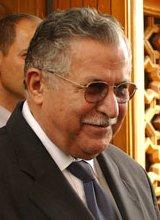
Democratizing the Middle East
The NYTimes reports:
The NYTimes reports:
Israel began on Sunday to back away from its opposition to participation of the armed Islamic group Hamas in Palestinian elections, having failed to persuade President Bush to offer public support for its stance.
..
Mr. Sharon contends that Mr. Abbas must disarm Hamas immediately. Last month, on a visit to New York, Mr. Sharon said that "we will make every effort not to help" the Palestinians hold elections if Hamas took part.
His comments were interpreted as part of a campaign to get Mr. Bush to side with Israel. But Mr. Abbas told Agence France-Presse that he had persuaded Mr. Bush last week in Washington "that we have a democracy, and the movements of all political colors must be allowed to participate in the elections."
"The modern conservative is engaged in one of man's oldest exercises in moral philosophy; that is, the search for a superior moral justification for selfishness."
-John Kenneth Galbraith
(via Matthew Yglesias)
-John Kenneth Galbraith
(via Matthew Yglesias)

Sheep go to Heaven, goats go to Hell
Came across this succinct description of Hume and his thought:
Came across this succinct description of Hume and his thought:
As he lay dying at home in his native city of Edinburgh, David Hume entertained a visitor by conjuring up, with characteristic cheerfulness, a scenario in the afterlife. He imagined himself begging the fatal ferryman Charon for a little more time: "Have a little patience, good Charon, I have been endeavoring to open the eyes of the public. If I live a few years longer, I may have the satisfaction of seeing the downfall of some of the prevailing systems of superstition." The "prevailing system" which Hume had become most notorious for attacking was the Christian religion, whose favorite tenets-providence, miracles, the argument from design, the afterlife itself-he had called into question, with increasing audacity, over the course of his work. But he had also done much damage to newer systems of thought, notably Locke's. Locke had regarded personal identity as coherent and continuous, the consequence of lifelong experiences and ideas accumulated in the memory. Hume, in his early, massive Treatise of Human Nature (1739-1740), waived all this away as an arrant fiction-though perhaps a necessary one, since empiricism properly pursued reveals so radical an incoherence in mortal minds that empiricists themselves must intermittently abandon philosophy in order to go about their daily lives. Like many of his empiric predecessors, Hume argued that knowledge of the real world "must be founded entirely on experience"; more than any predecessor he was willing to entertain (and to entertain with) the doubts and demolitions arising from that premise. In his own lifetime, his skepticism did not prove as contagious as he had hoped. The Treatise, he recalled wryly, "fell deadborn from the press, without reaching such distinction as even to excite a murmur among the zealots." Though his attempt to recast his chief arguments more succinctly in An Enquiry Concerning Human Understanding (1748) prompted a somewhat livelier response, he eventually made his fortune not as a philosopher but as author of the highly successful History of England (1754-1763). He faced the general indifference or hostility to his arguments as blithely as he later greeted death, continually refining his views and revising his prose. He knew himself out of sync with his times. When, in his fantasy, he forecasts to Charon the imminent downfall of superstition, the ferryman responds, "You loitering rogue, that will not happen these many hundred years. Do you fancy I will grant you a lease for so long a term? Get into the boat this instant, you lazy loitering rogue." More than two hundred years later, the artful mischief of Hume's work has secured him some such lease. His writings, lucid and elusive, forthright and sly, demand (and receive) continual reassessment; his skepticism has proven more powerful than his contemporaries suspected, and he figures as perhaps the wittiest and most self-possessed philosophical troublemaker since Socrates.
Subscribe to:
Posts (Atom)