Saturday, September 15, 2012

Bernanke's sudden turn towards Woodfordian open-ended policy was genuinely surprising, just as John Roberts ruling on Obamacare was.

Rahm Emanuel seems to have caved as I hear reports that the Chicago teachers strike will end with the teachers feeling victorious.

Yglesias writes about poverty.

This post to DeLong seems to be response to Binyamin Appelbaum's piece today in the New York Times - which I liked to below - where apparently he says that the Fed's focus on unemployment is somehow new.

THE OBJECTIVES OF THE FEDERAL RESERVE: MEMORANDUM FROM GOVERNOR MARRINER ECCLES TO SENATORS GLASS, FLETCHER, AND BULKLEY ON JUNE 6, 1935 by DeLong

Woodford on Optimal Monetary Policy Rules by Mark Thoma
Baltimore Ravens linebacker Brendon Ayanbadejo

Standing Up at an Early Age by Adam Himmelsbach


Charles Evans could be the one who laid the groundwork and created the space for Bernanke's change of direction towards open-ended commitments. I know he mentioned Woodford in a recent speech (this year?) and will look it up.

Reserve Bank Presidents' Speeches, 2007-2012

The Inflation that Concerns the Fed Does Not First Affect Food and Energy Prices by Dean Baker

Fed Responds to a Grim Reality by Binyamin Appelbaum
... Under the leadership of Mr. Bernanke - with considerable prodding and support from a board almost entirely appointed by President Obama - the central bank has gradually concluded that it has a responsibility to act more forcefully, and, equally important, that it has the ability to spur job creation directly.  
Mitt Romney, Liquidationist by Krugman
How times have changed. Back in 2004, Greg Mankiw declared, in the Economic Report of the President, that
Aggressive monetary policy can reduce the depth of a recession.
But now, after the Fed has finally moved a bit in the direction of doing something about the Lesser Depression, Mitt Romney – supposedly advised by Mankiw among others – is outraged:
[T]he American economy doesn’t need more artificial and ineffective measures. We should be creating wealth, not printing dollars.
That word “artificial” caught my eye, because it’s the same word liquidationists used to denounce any efforts to fight the Great Depression with monetary policy. Schumpeter declared that
Any revival which is merely due to artificial stimulus leaves part of the work of depressions undone
Hayek similarly decried any recovery led by the “creation of artificial demand”.
Milton Friedman – who thought he had liberated conservatism from this kind of nonsense –must be spinning in his grave. 
The Romney/liquidationist view only makes sense if you believe that the problem with our economy lies on the supply side – that workers lack the incentive to work, or are stuck with the wrong skills, or something. And that’s just not what the evidence says; instead, it points overwhelmingly to an insufficient overall level of demand.*
When dealing with ordinary, garden-variety recessions, we deal with inadequate demand through conventional monetary policy, namely by cutting short-term interest rates. Until recently even Republicans were OK with this. 
Now we face a more severe slump, probably driven by deleveraging, in which even a zero rate isn’t low enough, so monetary policy has to work in unconventional ways – in particular, by changing expectations about future inflation, so as to reduce real interest rates. This is no more “artificial” than conventional monetary policy – harder, yes, but it’s still about trying to get the market rate aligned with the “natural” rate consistent with full employment. 
So where are Romney and his party coming from? Basically, they’ve thrown out 80 years of economic analysis and evidence because it doesn’t fit their ideological preconceptions, and they’re resorting to dubious metaphors – “sugar high” and all that – as a substitute for clear thinking. 
What you really have to wonder about is all the not-stupid economists who have aligned themselves with this guy and that crew. Probably they imagine that once the election is past sensible economics will return. But the odds are that they are wrong, and that they’re sacrificing their own credibility to put charlatans and cranks in the driver’s seat.
--------------------
* Mishmash Not
Props to Eddie Lazear; he’s a loyal Republican who’s been saying a lot of things I consider totally wrong lately, but his paper for Jackson Hole (pdf) is a professional, well-done piece that offers little aid and comfort to his political allies.
 

Friday, September 14, 2012

Bernankeapalooza


An Internet Success Story. Chicago Fed President Charles Evans should feel vindicated for all of his hard work and for sticking his neck out.

A Quick Note on the Fed by Krugman
In effect, the Fed seems to be trying to “credibly promise to be irresponsible”, which is what I advocated way back when in this kind of situation. 
3. That’s all good. However, it’s kind of vague. No clear target, whether nominal GDP or some kind of inflation/unemployment mix. Put it this way: you could imagine a future Fed chairman tightening policy in line with the same Taylor rule that seemed to describe policy before the crisis — a rule that suggests that interest rates wouldn’t start to go up until unemployment was below, say, 7 percent — and still being able to claim that he had not violated any promise Bernanke made. In other words, it’s not totally clear that we really do have a shift in future policy. And since the whole point is to move expectations, leaving this kind of wiggle room is not a good thing. 
To paraphrase an old joke: what do you get when you cross a Godfather with a central banker? Someone who makes you an offer you can’t understand. 
4. Romney is talking destructive nonsense.
The Scott Summer Rally by Yglesias

It Is What It Is by Scott Sumner
On a lighter note, yesterday was “Scott Sumner day” and yet I had to go to work.  That doesn’t seem fair!  I’d also note that Cardiff Garcia at FT Alphavillementioned David Beckworth and I (along with Woodford), in their discussion of economists who had played a role in the debate. Don’t get me wrong, I realize that Woodford’s 100 times more influential than I am.  But I also think we’ve had some impact, mostly by putting out ideas that other more famous people have discussed and/or advocated (Christy Romer, Krugman, DeLong, Jeffrey Frankel, Jan Hatzius, etc.)  So it’s a good day for market monetarism.
Why QE3 Matters by Yglesias

Federal Reserve Finally Working Expectations Channel With Open-Ended QE by Yglesias

Other fiscal measures have more reliable job-creation chains.  Increasing unemployment benefits or food stamps helps because those folks typically spend the money.  And new infrastructure is a pretty direct way to go.  Same with state fiscal relief.  I remember during the Recovery Act, mayors cancelling planned layoffs the day they received Recovery Act funds.
The punch line is a simple one, but it’s one that seems to have been forgotten amidst our increasing love affair in America with laissez-faire economics: the more direct the policy measure—i.e., the fewer links in the chain between the policy and the job—the better it will work.
There Will Be Meglomania: "The Master," from Paul Thomas Anderson by A.O. Scott


Thursday, September 13, 2012

Will is a founding member of my Rogues Gallery.
How the Fed Boosts the Economy: Lessons for George Will by Dean Baker

In his column today George Will notes the Fed's responsibility to maintain price stability and high employment and tells readers:

"Achieving the former is the best thing the Fed can do for the latter."

Apparently Will has not been following what has happened in the economy recently. While inflation has remained low and relatively stable, unemployment has soared. He also apparently does not recognize how the Fed hopes to boost economic growth through quantitative easing.

The biggest impact from lower interest rates is probably from mortgage refinancing. This both directly generates economic activity through people employed in the process (e.g. banking staff, appraisers etc.) and indirectly by reducing payments and freeing up money for other consumption.

The second biggest impact is on lowering the value of the dollar relative to other currencies, which will reduce the trade deficit. Anyone who does not want a large budget deficit and/or negative private savings (like we had at the peak of the housing bubble) must want to see the trade deficit move closer to balance. This is an accounting identity -- there is no way around it. And, there is no plausible mechanism to get the trade deficit closer to balance except by reducing the value of the dollar.

For some reason Will fails to mention either the impact of quantitative easing on mortgage refinancing or the impact on the trade deficit. There is also zero evidence of the hyper-inflation that he and other opponents of more aggressive Fed actions have been warning about for years.
Yglesias seems to be flip-flopping here. First he posted how much teachers were getting paid as if it was excessive. Now he says they should get paid. I do think the financial industry has more of problem with rent-seeking than inner city teachers. As Kristof says, in the Chicago Public Schools "86 percent of the children are black or Hispanic and 87 percent come from low-income families."

Chicago's Teachers Are Pretty Well-Paid (As They Should Be) by Yglesias

Students over Unions by Nicholas Kristof


Wednesday, September 12, 2012

Matt Yglesias is not one of those union-hating liberals, he swears! by Doug Henwood

The Pay of Chicago School Teachers and Selected Others by Dean Baker

The New York Times Editorial Page and Yglesias harped on Chicago school teacher's pay.

Does It Pay to Become a Teacher? by Catherine Rampbell

Tuesday, September 11, 2012


This should lend some certainty to "job creators" and campaign contributors.

BEYOND THE MATRIX: The Wachowskis travel to even more mind-bending realms. by Aleksandar Hemon
Usually, I experience an erosion of confidence around famous people—an inescapable conviction that they know more than I do, because the world is somehow more available to them. But I got along splendidly with the Wachowskis. Seemingly untouched by Hollywood, they did not project the jadedness that is a common symptom of stardom. Lana was one of the best-read people I’d ever met; Andy had a wry sense of humor; they were both devout Bulls fans. We also shared a militant belief in the art of narration and a passionate love for Chicago. 
Eventually, I asked them to consider letting me write about the making of “Cloud Atlas.” They talked it over and decided to do it. By then, they’d sent the script to every major studio, after Warner Bros. had declined to exercise its option. Everyone passed. “Cloud Atlas” seemed too challenging, too complex. The Wachowskis reminded Warner Bros. that “The Matrix” had also been deemed too demanding, and that it had taken them nearly three years to get the green light on it. But the best the studio could do for “Cloud Atlas” was to keep open the possibility of buying the North American distribution rights, payment for which would cover a portion of the projected budget.
...
“The problem with market-driven art-making is that movies are green-lit based on past movies,” Lana told me. “So, as nature abhors a vacuum, the system abhors originality. Originality cannot be economically modelled.” The template for “The Matrix,” the Wachowskis recalled, had been “Johnny Mnemonic,” a 1995 Keanu Reeves flop. 

In the parking lot outside Hanks’s office, the Wachowskis and Tykwer shook off the bad news before going in. Hanks had read the screenplay, though not the book. “The script was not user-friendly,” he told me. “The demands it put upon the audience and everybody, the business risk, were off the scale.” But he was interested in working with the directors and intrigued by the challenge of playing six different roles in one film. Hanks was in the middle of reading “Moby-Dick” and, when the filmmakers sat down, he engaged them in a discussion of Melville’s masterpiece. Lana pointed at a poster for “2001: A Space Odyssey,” which was serendipitously hanging on the wall of Hanks’s office, and said, “ ‘Moby-Dick’ and this—that’s what we want to do.” “I’m in,” Hanks said. “When do we start?” Looking back at that meeting, Hanks told me that he had been particularly impressed that the Wachowskis “were not ashamed to say, ‘We make art!’ ” 

With Hanks on board, the directors went back to Warner Bros. to plead their case. They insisted that a project as narratively complex as “Cloud Atlas” had no precedent and therefore no template. They presented the overarching story as a tale of redemption, of the continuity of essential human goodness, whereby individual acts of kindness have unforeseeable repercussions. They broke the story down into a simple progression: “Tom Hanks starts off as a bad person,” they said, “but evolves over centuries into a good person.” Warner Bros. was convinced, and the studio was in for distribution, but with a lower offer than the directors had hoped for.


Did Education Secretary Arne Duncan Really Leave Chicago Schools a Mess? by Dean Baker
That might be a good question for reporters to pose to Chicago Mayor Rahm Emanuel given his strong stand against Chicago's public school teachers. (It is appropriate to refer to this as a battle between Emanuel and the teachers. Almost 90 percent of the members of the bargaining unit voted to authorize a strike. This is clearly not a case of a union imposing its will on its members.) Emanuel has insisted that the schools need a major overhaul because they are badly failing Chicago's students. 
Emanual's position is striking because Chicago's schools had been run for seven and half years, from June of 2001 until January of 2009, by Arne Duncan. Duncan then went on to become education secretary for President Obama, based on his performance as head of the Chicago public school system. Apparently Emanuel does not believe that Duncan was very successful in improving Chicago's schools since he claims that they are still in very bad shape. 
There is no dispute that students in Chicago public schools are not faring well. Only a bit over 60 percent graduate high school in five years or less. However, this doesn't mean that the reforms that Emanuel wants to impose will improve outcomes, just as Duncan's reforms apparently did not have much impact, if Emanuel is to be believed. 
As Diana Ravitch, a one-time leading school "reformer" and assistant education secretary in the Bush administration, argues that charter schools on average perform no better than the public schools they replace. The main determinants of childrens' performance continues to be the socioeconomic conditions of their parents. Those unwilling to take the steps necessary to address the latter (e.g. promote full employment) are the ones who do not care about our children.
Seems like a confused article.


some repeat videos


Barack Obama to Michael Lewis on a Presidential Loss of Freedom: “You Don’t Get Used to It—At Least, I Don’t”

It's notable that Obama as the first black President of a nation founded upon slavery and white supremacy doesn't really discuss race at all. He did move a bust of MLK to the Oval office as Lewis reports. It's also funny that Lewis's Vanity Fair article on Iceland painted a picture of Icelanders that was a caricature if not racist. Iceland, like Australia and Argentina, followed some wise macroeconomic polices that allowed its economy to bounce back well after a financial crisis/Minsky moment. Lewis should do a follow up. It does say alot that Obama allowed him access. 

I'll be interest to see if he's on Charlie Rose and to read about Obama's decision to go into Libya. 

Saturday, September 08, 2012

Friday, September 07, 2012

The New Normal

The Employment Situation by Krugman

Review of End This Depression Now! and The Price of Inequality: How Today’s Divided Society Endangers Our Future:

What Krugman & Stiglitz Can Tell Us by Jacob Hacker and Paul Pierson

Not, mind you, that I think David is a better monetary economist than Mike Woodford--I do find I learn more from paying careful attention to Mike than to David. But I can't think of anybody else I reliably learn more from paying careful attention to… 
David Glasner:
 John Cochrane Misunderestimates the Fed
In my previous post, I criticized Ben Bernanke’s speech last week at the annual symposium on monetary policy at Jackson Hole, Wyoming. It turns out that the big event at the symposium was not Bernanke’s speech but a 98-page paper by Michael Woodford, of Columbia University. Woodford’s paper was important, because he is widely considered the world’s top monetary theorist, and he endorsed the idea proposed by the intrepid, indefatigable and indispensable Scott Sumner that the Fed stop targeting inflation and instead target a steady growth path of nominal GDP. That endorsement constitutes a rather stunning turn of events in which Sumner’s idea (OK, Scott didn’t invent the idea, but he made a big deal out of it when nobody else was paying any attention) has gone from being a fringe idea to the newly emerging orthodoxy in monetary economics. 
John Cochrane, however, is definitely not with the program, registering his displeasure in a blog post earlier this week. In this post, I am going to challenge two assertions that Cochrane makes. These aren’t the only ones that could be challenged, but it’s getting late.  The first assertion is that inflation can never bring about an increase in output. 
Mike [Woodford]‘s enthusiasm for deliberate inflation is even more puzzling to me.  Mike uses the word “stimulus,” never differentiating between real and nominal stimulus. Surely, we don’t want to cook up some inflation just for its own sake — we want to cook up some inflation because we think it will goose output. But why? Why especially will increasing expected inflation help? Because that is the aim of all the policies under discussion here — promising to keep rates low even once inflation rises, adopting “nominal GDP targets,” helicopter drops, or similar policies such as raising the inflation target. 
I don’t put much faith in Phillips curves to start with  – the idea that deliberate inflation raises output. I put less faith in the idea floating around Jackson hole that a little inflation will set us permanently back on the trend line, not just be a little sugar rush and then back to sclerosis. 
But it’s a rare Phillips curve in which raising expected inflation is a good thing.  It just gives you more inflation, with if anything less output and employment. 
Cochrane is simply asserting that expected inflation cannot increase output and employment. The theoretical basis for that proposition is an argument, generally attributed to Milton Friedman and Edward Phelps, but advanced by others before them, that an increase in inflation cannot generate a permanent increase in employment. The problem with that theoretical argument is that it is a comparative statics result, thus, by assumption, starting from an initial equilibrium with zero inflation and positing an increase in the inflation parameter. The Friedman-Phelps argument shows that a new equilibrium corresponding to the higher rate of inflation has the same level of output and employment as the initial zero-inflation equilibrium, so that derivatives of output and employment with respect to inflation are both zero. That comparative-statics exercise is fine, but it’s irrelevant to the situation we have been in since 2008. We are not starting from equilibrium; we are starting from a disequlibrium in which output and employment are well below their equilibrium levels. The question is whether an increase in inflation, starting from an under-employment disequilibrium, would increase output and employment. The Friedman/Phelps argument tells us exactly nothing about that issue. 
And aside from the irrelevance of the theoretical argument on which Cochrane is relying to the question whether inflation can reduce unemployment when employment is below its equilibrium level – I am here positing that it is possible for employment to be persistently below its equilibrium level – there is also the clear historical evidence that in 1933 a sharp increase in the US price level, precipitated by FDR’s devaluation of the dollar, produced a spectacular increase in output and employment between April and July of 1933 — the fastest four-month expansion of output and employment, combined with a doubling of the Dow-Jones Industrial Average, in US history. The increase in the price level, since it was directly tied to a very public devaluation of the dollar, and an explicit policy objective, announced by FDR, of raising the US price level back to where it had been in 1926, could hardly have been unanticipated. 
The second assertion made by Cochrane that I want to challenge is the following. 
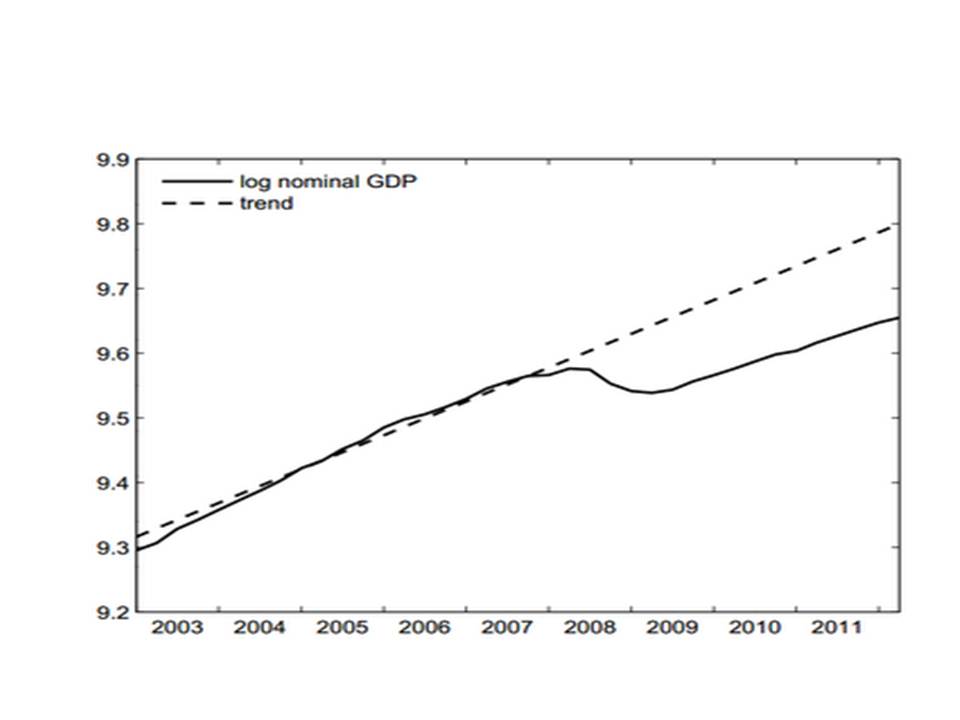
Nothing communicates like a graph. Here’s Mike [Woodford]‘s, which will help me to explain the view:


The graph is nominal GDP and the trend through 2007 extrapolated. (Nominal GDP is price times quantity, so goes up with either inflation or larger real output.) 
Now, let’s be clear what a nominal GDP target is and is and is not. Many people (and a few persistent commenters on this blog!) urge nominal GDP targeting by looking at a graph like this and saying “see, if the Fed had kept nominal GDP on trend, we wouldn’t have had  such a huge recession. Sure, part of it might have been more inflation, but surely part of a steady nominal GDP would have been less recession.” This is NOT what Mike is talking about.
Mike recognizes, as I do, that the Fed can do nothing more to raise nominal GDP today. Rates are at zero. The Fed has did [sic] what it could. The trend line was not achievable. 
Nick Rowe, in his uniquely simple and elegant style, has identified the fallacy at work in Woodford’s and Cochrane’s view of monetary policy which views the short-term interest rate as the exclusive channel by which monetary policy can work. Thus, when you reach the zero lower bound, you (i.e., the central bank) have become impotent. That’s just wrong, as Nick demonstrates. 
Rather than restate Nick’s argument, let me add some historical context. The discovery that the short-term interest rate set by the central bank is the primary tool of monetary policy was not made by Michael Woodford; it goes back to Henry Thornton, at least. It was a commonplace of nineteenth-century monetary orthodoxy. Except that in those days, the bank rate, as the English called it, was viewed as the instrument by which the Bank of England could control the level of its gold reserves, not the overall state of the economy, for which the Bank of England had no legal responsibility. It was Knut Wicksell who, at the end of the nineteenth century, first advocated using the bank rate as a tool for controlling the price level and thus the business cycle. J. M. Keynes and Dennis Robertson also advocated using the bank rate as an instrument for controlling the price level and the business cycle, but the most outspoken and emphatic exponent of using the bank rate as an instrument of macroeconomic control was Ralph Hawtrey. Keynes continued to advocate using the bank rate until the early 1930s, but he then began to advocate fiscal policy and public works spending as the primary weapon against unemployment. Hawtrey never wavered in his advocacy of the bank rate as a control mechanism, but even he acknowledged that could be circumstances under which reducing the bank rate might not be effective in stimulating the economy. Here’s how R. D. C. Black, in a biographical essay on Hawtrey, described Hawtrey’s position: 
It was always a corollary of Hawtrey’s analysis that the economy, although lacking any automatic stabilizer, could nevertheless be effectively stabilized by the proper use of credit policy; it followed that fiscal policy in general and public works in particular constituted an unnecessary and inappropriate control mechanism. Yet Hawtrey was always prepared to admit that there could be circumstances in which no conceivable easing of credit would induce traders to borrow more and that in such a case government expenditure might be the only means of increasing employment. 
This possibility of such a “credit deadlock” was admitted in all Hawtrey’s writings from Good and Bad Trade onwards, but treated as a most unlikely exceptional case. ln Capital and Emþloyment, however, he admitted “that unfortunately since 1930 it has come to plague the world, and has confronted us with problems which have threatened the fabric of civilisation with destruction.” 
So indeed it had, and in the years that followed opinion, both academic and political, became increasingly convinced that the solution lay in the methods of stabilization by fiscal policy which followed from Keynes’s theories rather that in those of stabilization by credit policy which followed from Hawtrey’s. 
However, a few paragraphs later, Black observes that Hawtrey understood that monetary policy could be effective even in a credit deadlock when reducing the bank rate would accomplish nothing. 
Hawtrey was inclined to be sympathetic when Roosevelt adopted the so-called “Warren plan” and raised the domestic price of gold. Despairing of seeing effective international cooperation to raise and stabilize the world price level, Hawtrey now envisaged exchange depreciation as the only way in which a country like the United States could “break the credit deadlock by making some branches of economic activity remunerative.” Not unnaturally there were those, like Per Jacobsson of the Bank for International Settlements, who found it hard to reconcile this apparent enthusiasm for exchange depreciation with Hawtrey’s previous support for international stabilization schemes. To them his repiy was “the difference between what I now advocate and the programme of monetary stability is the difference between measures for treating a disease and measures for maintaining health when re-established. It is no use trying to stabilise a price ievel which leaves industry under-employed and working at a loss and makes half the debtors bankrupt.” Here, as always, Hawtrey was faithful to the logic of his system, which implied that if international central bank co-operation could not be achieved, each individual central bank must be free to pursue its own credit policy, without the constraint of fixed exchange rates.  [See my posts, "Hawtrey on Competitive Devaluations:  Bring It On, and "Hawtrey on the Short, but Sweet, 1933 Recovery."
Cochrane asserts that the Fed has no power to raise nominal income. Does he believe that the Fed is unable to depreciate the dollar relative to other currencies? If so, does he believe that the Fed is less able to control the exchange rate of the dollar in relation to, say, the euro than the Swiss National Bank is able to control the value of the Swiss franc in relation to the euro? Just by coincidence, I wrote about the Swiss National Bank exactly one year ago in a post I called “The Swiss Naitonal Bank Teaches Us a Lesson.”  The Swiss National Bank, faced with a huge demand for Swiss francs, was in imminent danger of presiding over a disastrous deflation caused by the rapid appreciation of the Swiss franc against the euro. The Swiss National Bank could not fight deflation by cutting its bank rate, so it announced that it would sell unlimited quantities of Swiss francs at an exchange rate of 1.20 francs per euro, thereby preventing the Swiss franc from appreciating against the euro, and preventing domestic deflation in Switzerland. The action confounded those who claimed that the Swiss National Bank was powerless to prevent the franc from appreciating against the euro. 
If the Fed wants domestic prices to rise, it can debauch the dollar by selling unlimited quantities of dollars in exchange for other currencies at exchange rates below their current levels. This worked for the US under FDR in 1933, and it worked for the Swiss National Bank in 2011. It has worked countless times for other central banks. What I would like to know is why Cochrane thinks that today’s Fed is less capable of debauching the currency today than FDR was in 1933 or the Swiss National Bank was in 2011?
Obama gives up on demand by Yglesias