A Cautious Case for economic Nationalism by JW Mason
Saturday, October 21, 2017
Friday, October 20, 2017
Thursday, October 19, 2017
Monday, October 16, 2017
Sandbu on macro fail
Bolder rethinking needed on macroeconomic policy by Martin Sandbu
The Peterson Institute conference on “Rethinking Macroeconomic Policy”, which we alerted readers to last week, was well worth watching. The marvel of the internet is that virtuous event organisers such as Peterson can give global access by posting online the agenda, papers and recordings of the presentations, including the panel discussions, which were as interesting as the presentations themselves.
I recommend everyone to take a look — but with a disappointment spoiler up front. For while some of the world’s most brilliant economists took part, which alone makes it worth a view, the promised “rethinking” was often more incremental (even marginal) than radical.
The opening paper and presentation by Olivier Blanchard and Larry Summers is a tour de force in terms of stating where the debate stands today in a range of key policy areas. They were followed by former Federal Reserve chair Ben Bernanke, who headlined the panel on monetary policy (here is his paper and video recording of his presentation).
I will focus here on monetary policy issues (the conference covered many other things as well).
As my colleague Chris Giles expertly laid out last week, there is a crisis in central bank theory and practice, which can be briefly summarised as follows: western economies are far from where central bankers thought they would have been by now, still either below capacity or not convincingly at full capacity. Worse yet, they do not understand why. In this context, one might have hoped for some deep soul-searching in a conference of this calibre.
In terms of concrete “deliverables”, there were few new proposals for how to do monetary policy differently. The main contribution was Bernanke’s discussion of complementing the current framework of targeting inflation rates by targeting price levels. Targeting levels rather than rates of change has the advantage of built-in “memory”: in a situation where prices have fallen short of expectations, like today, price level targeting (PLT) would have the central bank aim to make up for lost ground, and thus command more aggressive monetary policy.
But as Bernanke pointed out, in the reverse situation of an inflation overshoot — say, because of a one-off rise in commodity prices or a fall in the exchange rate — PLT would require the central bank to slow down economic activity to keep inflation below target for a while. That would be neither desirable nor credible. His conclusion is that the current framework should be complemented with an announcement in normal times that PLT would be introduced if, and for as long as, interest rates were at zero, and suspended otherwise. This would no doubt improve on the current situation. But it feels little more than a tweak.
There was surprisingly little discussion of national income level targeting — where a central bank targets a path for the nominal size of an economy rather than prices — which does not have the same problem as PLT. Nor was there much engagement with the problem with all proposals for new targets that would be more stimulative, which is that central banks have failed to meet the targets they currently have. If they cannot engineer 2 per cent inflation rates today, why should their commitment to achieve a price level or national income target be any more credible?
Another disappointment on the discussion was how the top of the economics profession takes for granted the impossibility of more negative nominal interest rates. Blanchard and Summers capture the professional consensus when they write that “there is little question that the binding lower bound on short-term nominal interest rates (zero, or slightly negative) limited the scope of monetary policy to sustain demand during the recovery”.
But the fact is that those central banks that have tried to go negative have had no problems doing so, and that techniques for limiting a rush into physical cash exist. There is so far no empirical basis for believing in a near-zero lower bound on central bank interest rates. One would have hoped the luminaries of the field would have been more adventurous in exploring the use of more steeply negative rates.
Most profoundly, there was little sense of urgency that more radical rethinking was needed. Adam Posen, who convened the conference, was one of few who made a point out of this. He suggested that it was both ahistorical to think of asset purchases by central banks as unconventional (which implies that central bank action has been less innovative since the financial crisis than central bankers like to claim) and that more radical policy change was needed.
The closest to a proposal for how to do monetary policy differently was Bernanke’s proposal for pre-announced PLT in predefined exceptional times. But when Blanchard asked panellists whether, if conditions are “back to normal” 10 years from now, they thought central banks would think any differently about monetary policy, the shared expectation seemed to be that a normalisation of the economy would and should lead to a normalisation of policy thinking too, but with a preparedness for a possible return to abnormal situations.
That view is oddly forgetful of recent history. It does not acknowledge that the failure to forecast the crisis could indicate that something is deeply wrong in how we think about monetary policy even in normal times. Even if one tacks on a precommitment to do things differently should a new deflationary crisis occur, à la Bernanke’s proposal or some other readiness to return to “unconventional” tools, that largely presupposes that we have by now figured out how to deal with protracted slow demand growth with very low interest rates.
In other words, expecting future monetary policy to be largely as before, with some newly exploited crisis tools in the toolbox, rather takes as given that monetary policy has performed close to the best it could have done both before and after the crisis. That is, if nothing else, a self-flattering view for monetary policymakers to take. But it is not very reassuring. For central bankers, as for everyone else, admitting one has got things badly wrong is a prerequisite for doing better.
Sunday, October 15, 2017
Atrios on recovery
Dustbowl
I think it will be the forgotten depression. The triumphalism of neoliberal capitalism and Fed independence made this unpossible, and the unquestionable stewardship of Obama/Geithner rendered it moot. I'm not sure that even historians - decades later, as is their privilege - will grapple with this fact.
Empires fall.
THURSDAY, OCTOBER 12, 2017
Dustbowl
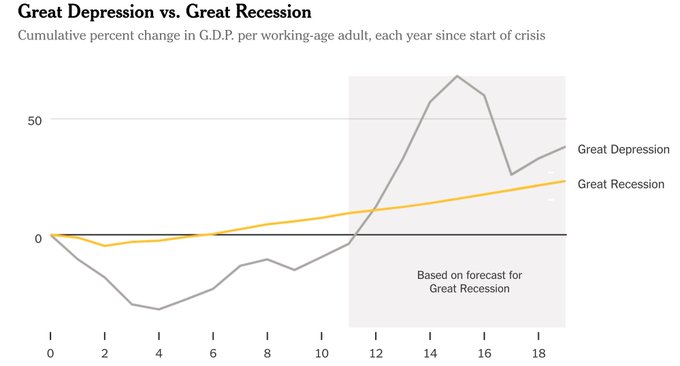
A decade later, it looks like the Great Recession may be worse than the Great Depression nyti.ms/2kJUSnd

I think it will be the forgotten depression. The triumphalism of neoliberal capitalism and Fed independence made this unpossible, and the unquestionable stewardship of Obama/Geithner rendered it moot. I'm not sure that even historians - decades later, as is their privilege - will grapple with this fact.
Empires fall.
Saturday, October 14, 2017
socialism versus neoliberalism
government interference in economy. neoliberalism = one dollar one vote; socialism = rising living standards for everyone. socialism = tight labor markets neoliberals open up to foreign investment and foreign trade, cut taxes on businesses, prioritize corporations, corporate trade agreements, patents and copyrights, monopolies and oligopolies,
Friday, October 13, 2017
this week on Twitter: I didn't really get
I did get that Neera Tanden, Joy Reid and the Eight Percenters went after the Women's March convention in Detroit for asking Sanders to speak the first night.
Women's March on making Bernie opening speaker: “We all know how busy women leaders are”
Women's March on making Bernie opening speaker: “We all know how busy women leaders are”
Chapo Trap House guys made a joke that upset people. They apologized and I still don't know what it was. Something about rape and Bill Cosby within the context of Harvey Weinstein. They deleted it.
Dan Harmon got pilloried for something he tweeted after some of his fans rioted over McDonalds running out of their Szechuan sauce during a one day promotion. Genius marketing on their part. All that money they don't pay their workers well spent on marketing. Packets from McDonalds going for a grand on eBay. Late capitalism culture at its finest.
Thursday, October 12, 2017
Monday, October 09, 2017
Sunday, October 08, 2017
Friday, October 06, 2017
Krugman on Fed; Corbyn
Get Ready for Prime Minister Jeremy Corbyn by Rachel Shabi
Will Trump Trumpify the Fed? by Krugman
For more than a decade the Fed chair has been a distinguished academic economist — first Ben Bernanke, then Janet Yellen. You might wonder how such people, who have never been in the business world, who have never met a payroll, would deal with real-world economic problems; the answer, in both cases: superbly.
In particular, both Bernanke and Yellen responded effectively to a once-in-three-generations economic crisis despite constant heckling from back-seat drivers in Congress and on the political right in general. And their intellectual and moral courage has been completely vindicated by events.
Monday, October 02, 2017
The Disastrous Decline of the European Center-Left
The Disastrous Decline of the European Center-Left
Among the many worrying outcomes of the recent German elections was the further collapse of the main center-left party, the Social Democrats, which received only 20.5 percent of the vote, its worst performance since World War II.
Across Europe, social democratic or center-left parties are in decline. In elections this year in France and the Netherlands, the socialist and labor parties did so poorly that many question their future existence. Even in Scandinavia, considered the world’s social democratic stronghold, long-dominant parties have been reduced to vote shares in the high 20s and low 30s.
Even if you don’t support the left, this should be cause for concern. Social democratic parties were crucial to rebuilding democracy in Western Europe after 1945. They remain essential to democracy on the Continent today.
During the postwar years, social democratic parties acknowledged capitalism’s upsides and downsides. In contrast to Communists, center-left parties recognized that markets were the most effective engine for producing economic growth and prosperity. But in contrast to classical liberals and many conservatives, social democrats did not embrace markets wholeheartedly. Instead, the center-left insisted that it was possible — indeed, necessary — for governments to cushion markets’ most destabilizing effects. Capitalism would be kept subservient to the goals of social stability and solidarity, rather than the other way around.
By the late 20th century, this distinctive message had been mostly discarded. Instead, the left became dominated by two camps.
The first was epitomized by Tony Blair of Britain and Gerhard Schröder of Germany. These new center-left politicians celebrated the market’s upsides but ignored its downsides. They differed from classical liberals and conservatives by supporting a social safety net to buffer markets’ worst effects, but they didn’t offer a fundamental critique of capitalism or any sense that market forces should be redirected to protect social needs. When the financial crisis hit in 2008, this attitude repelled those who viewed globalization as the cause of their suffering and wanted not merely renewed growth, but also less inequality and instability.
The second camp is an anti-globalization far left, represented by the Occupy movement, Jeremy Corbyn’s wing of Britain’s Labour Party and Syriza in Greece. This camp took seriously the market’s downsides but saw few upsides. Lacking a conviction that capitalism can and should be reformed, these parties generally offer an impractical mishmash of attacks on the wealthy, protectionism, increased welfare spending and high taxes. These policies may appeal to the angry and frustrated, but they turn off voters looking for viable policy and a progressive, rather than utopian, view of the future.
During the postwar decades, social democracy promoted solidarity and a sense of shared national purpose so as to avoid the fractures that undermined European democracy during the late 19th and early 20th centuries. In contrast to Communists, who exclusively focused on class conflict, the center-left built bridges between workers and others. And in contrast to the individualism of classical liberals and many conservatives, the center-left’s emphasis was on citizens’ obligations to one another and the government’s duty to promote the good of society.
By the late 20th century, however, this understanding of social democracy’s goals had been largely abandoned. Some failed to address concerns generated by social and cultural change, either out of lack of understanding or out of a hope that solving economic problems would make them disappear. Others uncritically embraced these changes, promoting both cosmopolitanism and the interests and cultural distinctiveness of minority groups. This camp became associated with the politically deadly idea that strong national identities were anachronistic, even dangerous, and citizens made uneasy by their erosion were bigots.
These attitudes have fragmented the left’s constituency and made it impossible to rebuild the social solidarity or sense of shared national purpose necessary to support high taxes, robust welfare programs and activist governments.
But the decline of the center-left has larger implications. Most obviously, it has created a space for a populist right whose commitment to liberalism, and even democracy, is questionable. In many European countries, now including Germany, these parties have succeeded in part by attracting groups that have historically supported the center-left, like workers and the uneducated, by forthrightly addressing the economic fears generated by globalization as well as those generated by social and cultural change.
During the postwar period, European politics was dominated by competition between a center-left and center-right that offered real policy differences but agreed on the basic framework of liberal, capitalist democracy. These parties were large enough to form governments, set agendas and get policies enacted. But as the outcome of the recent German elections makes clear, the center-left’s electoral demise has rendered it unable to form stable, coherent governments — which makes it more difficult to solve problems and leaves voters more frustrated with traditional parties and institutions.
This is one part of what has allowed populists to make inroads, as was clear during the German elections, where the far-right Alternative for Germany party promoted itself as the true “alternative” to the status quo. Even many within the Social Democrats acknowledged their party lacked a vision of where it wanted Germany to go.
by Sheri Berman (10.2.17)
Across Europe, social democratic or center-left parties are in decline. In elections this year in France and the Netherlands, the socialist and labor parties did so poorly that many question their future existence. Even in Scandinavia, considered the world’s social democratic stronghold, long-dominant parties have been reduced to vote shares in the high 20s and low 30s.
Even if you don’t support the left, this should be cause for concern. Social democratic parties were crucial to rebuilding democracy in Western Europe after 1945. They remain essential to democracy on the Continent today.
During the postwar years, social democratic parties acknowledged capitalism’s upsides and downsides. In contrast to Communists, center-left parties recognized that markets were the most effective engine for producing economic growth and prosperity. But in contrast to classical liberals and many conservatives, social democrats did not embrace markets wholeheartedly. Instead, the center-left insisted that it was possible — indeed, necessary — for governments to cushion markets’ most destabilizing effects. Capitalism would be kept subservient to the goals of social stability and solidarity, rather than the other way around.
By the late 20th century, this distinctive message had been mostly discarded. Instead, the left became dominated by two camps.
During the postwar decades, social democracy promoted solidarity and a sense of shared national purpose so as to avoid the fractures that undermined European democracy during the late 19th and early 20th centuries. In contrast to Communists, who exclusively focused on class conflict, the center-left built bridges between workers and others. And in contrast to the individualism of classical liberals and many conservatives, the center-left’s emphasis was on citizens’ obligations to one another and the government’s duty to promote the good of society.
By the late 20th century, however, this understanding of social democracy’s goals had been largely abandoned. Some failed to address concerns generated by social and cultural change, either out of lack of understanding or out of a hope that solving economic problems would make them disappear. Others uncritically embraced these changes, promoting both cosmopolitanism and the interests and cultural distinctiveness of minority groups. This camp became associated with the politically deadly idea that strong national identities were anachronistic, even dangerous, and citizens made uneasy by their erosion were bigots.
These attitudes have fragmented the left’s constituency and made it impossible to rebuild the social solidarity or sense of shared national purpose necessary to support high taxes, robust welfare programs and activist governments.
During the postwar period, European politics was dominated by competition between a center-left and center-right that offered real policy differences but agreed on the basic framework of liberal, capitalist democracy. These parties were large enough to form governments, set agendas and get policies enacted. But as the outcome of the recent German elections makes clear, the center-left’s electoral demise has rendered it unable to form stable, coherent governments — which makes it more difficult to solve problems and leaves voters more frustrated with traditional parties and institutions.
This is one part of what has allowed populists to make inroads, as was clear during the German elections, where the far-right Alternative for Germany party promoted itself as the true “alternative” to the status quo. Even many within the Social Democrats acknowledged their party lacked a vision of where it wanted Germany to go.
If the Social Democrats and other center-left parties are unable once again to offer voters solutions to the challenges their countries face, their decline will continue, populism will flourish and democracy will decay.
Subscribe to:
Posts (Atom)