Saturday, November 04, 2017

On Safari in Trump's America by Molly Ball

On Safari in Trump's America by Molly Ball
Politics, though, was not the focus of the Third Way interviewers, who believed there was more to be gained by asking neutral, open-ended questions. In accordance with Third Way’s ideology, they believed that political partisanship was not most people’s primary concern. But sometimes the Wisconsinites brought up politics anyway. 
At the Labor Temple Lounge in Eau Claire, nine gruff, tough-looking union men sat around a table. One had the acronym of his guild, the Laborers International Union of North America, tattooed on a bulging bicep. The men pinned the blame for most of their problems squarely on Republicans, from Trump to Governor Scott Walker. School funding, the minimum wage, college debt, income inequality, gerrymandering, health care, union rights: It was all, in their view, the GOP’s fault. A member of the bricklayers’ union lamented Walker’s cuts to public services: “If we can’t help each other,” he said, “what are we, a pack of wolves—we eat the weakest one? It’s shameful.” 
But their negativity toward Republicans didn’t translate to rosy feelings for the Democrats, who, they said, too frequently ignored working-class people. And some of the blame, they said, fell on their fellow workers, many of whom supported Republicans against their own interests. “The membership”—the union rank-and-file—“voted for these Republicans because of them damn guns,” a Laborers Union official said. “You cannot push it out of their head. A lot of ‘em loved it when Walker kicked our ass.”
(h/t Chapo Trap House)

Monday, October 30, 2017

Fed on potential GDP

The Fed Chair Should Be a ‘Principled Populist’ By STEPHANIE KELTON and PAUL MCCULLEY
McCulley: I think it should be a collaborative venture between the Fed and Congress. Yes, I used the word “collaborative,” which I think applies in a more general way to the relationship between Congress and the Fed.

The Fed’s operational independence is grounded in the thesis that the legislature cannot be trusted with monetary policy, as the electoral process is inherently biased to inflation, of overstimulating the economy with too much spending relative to taxation, running inflationary budget deficits.

That simply has not been the case for a long, long time. Yes, we’ve had large deficits, but inflation has been too low, not too high. Thus, I’m not convinced by the argument that strict Fed independence is always and everywhere needed to discipline the fiscal authorities’ inflationary bias.

Kelton: What about policy today?

McCulley: If President Trump wants to try to boost real growth from 2 percent to 3 percent, there is no reason that the Fed should actively push back. That doesn’t mean that the Fed shouldn’t or wouldn’t respond if such an acceleration in growth were to finally drive unemployment low enough to generate a loud wage and inflationary response.

My point is that there is no reason for the Fed to prevent the “experiment,” if Mr. Trump and the Republican Congress want to run it.

Thursday, October 26, 2017

Mike the Mad Biologist

You Can’t Be Intersectional Without An Economic Plan

Matt Levine on Marxist indexing

Bitcoin Dividends and Marxist Indexing by Matt Levine

Should index funds be illegal / Are index funds Marxist?
Here is a Jacobin interview with leftist economist J.W. Mason about "finance's role in capitalist society" that is fascinating throughout. Mason endorses a "functional view of finance, as the enforcement arm of the capitalist class as a whole":
There are people and institutions whose job it is to ensure that corporations remain within capitalist logic, that they remain oriented towards production for sale and for profit. On some level, this is the fundamental role of shareholders and their advocates, and of institutions like private equity.
I think that a lot of quite mainstream financial people would agree that one thing that shareholders do is ensure that the corporations they own "remain within capitalist logic," sure. But Mason also points to the rise of index funds as undercutting capitalist logic: If all the companies are owned by the same handful of big diversified investing institutions, and if those institutions have no interest in competition between the companies they own, then what is the point of capitalism?
If you take competition out of the mix, it’s unclear what function private ownership is supposed to accomplish. If the evolution of finance gets you to a situation where you have a single set of institutions — or in the long run, maybe a single institution — that owns all of these firms, then pressure from shareholders is going to be against competition. They don’t want to see these firms trying to gain market share or anything else at each other’s expense.
Seth Ackerman, the Jacobin interviewer, responds:
It’s hard to listen to what you just said without thinking of the debates that took place in the late nineteenth and early twentieth centuries, where many people — arguably including Marx — predicted either that firms would be consolidated into the hand of a very small number of controllers or that the underlying wealth would be concentrated into the hands of fewer and fewer people. And in either case, it would undermine the basic logic that made capitalism an economically and politically successful system in the first place.
Virtually no one that I talk to in or around the financial industry really believes the "common ownership of companies by mutual funds undercuts competition" theory. It just seems too attenuated: Sure, it might be in BlackRock's and Vanguard's interests if the companies they own don't slash prices to compete with each other, but it's not (usually) like they call up executives to tell them that. Plus "competition" is usually a more nebulous concept than price-cutting: It might be in shareholders' interests to keep prices high, but it is also in shareholders' interests to see more innovation and more competition on quality. If you own the entire economic pie, your interest is in growing that pie, not in keeping each company's slices the same. And the way the pie grows is through the normal capitalist processes of innovation and competition and creative destruction and so forth.
Still I am so desperately fond of this theory. What I love -- what is made so clear in Jacobin's discussion -- is how it wraps capitalism all the way around to socialism. Index funds are in many ways a perfection of financial capitalism: Not only are they the result of scientific finance (modern portfolio theory, the efficient markets hypothesis, etc.) replacing earlier and less rigorous forms of investing, but they also concentrate and align shareholders with each other, and corporate managers with shareholders, in a way that seems like it would be well suited to "ensure that corporations remain within capitalist logic." And the result is something that both Marxists and also financial analysts think is quasi-communist, that "undermines the basic logic that made capitalism an economically and politically successful system in the first place." What if Marx was right that capitalism would ultimately destroy itself, but the way that it does so is through index funds? 
Anyway, happy 100th anniversary of Red October, I guess.
Elsewhere: "David Einhorn Is Wondering If Value Investing Even Works Anymore." And here is an excerpt from his letter to Greenlight Capital investors:
What if equity value has nothing to do with current or future profits and instead is derived from a company’s ability to be disruptive, to provide social change, or to advance new beneficial technologies, even when doing so results in current and future economic loss? It’s clear that a number of companies provide products and services to customers that come with a subsidy from equity holders. And yet, on a mark-to-market basis, the equity holders are doing just fine.
That is an alternative perfection of capitalism, I guess, if the capitalist class is subsidizing consumers without actually losing any money. 
---------------------
Emphasized: Mason disagrees with the "but" in that sentence. Marx was right all along.
Monday, October 16, 2017

Sandbu on macro fail

Bolder rethinking needed on macroeconomic policy by Martin Sandbu

The Peterson Institute conference on “Rethinking Macroeconomic Policy”, which we alerted readers to last week, was well worth watching. The marvel of the internet is that virtuous event organisers such as Peterson can give global access by posting online the agenda, papers and recordings of the presentations, including the panel discussions, which were as interesting as the presentations themselves.
I recommend everyone to take a look — but with a disappointment spoiler up front. For while some of the world’s most brilliant economists took part, which alone makes it worth a view, the promised “rethinking” was often more incremental (even marginal) than radical. 
The opening paper and presentation by Olivier Blanchard and Larry Summers is a tour de force in terms of stating where the debate stands today in a range of key policy areas. They were followed by former Federal Reserve chair Ben Bernanke, who headlined the panel on monetary policy (here is his paper and video recording of his presentation). 
I will focus here on monetary policy issues (the conference covered many other things as well). 
As my colleague Chris Giles expertly laid out last week, there is a crisis in central bank theory and practice, which can be briefly summarised as follows: western economies are far from where central bankers thought they would have been by now, still either below capacity or not convincingly at full capacity. Worse yet, they do not understand why. In this context, one might have hoped for some deep soul-searching in a conference of this calibre. 
In terms of concrete “deliverables”, there were few new proposals for how to do monetary policy differently. The main contribution was Bernanke’s discussion of complementing the current framework of targeting inflation rates by targeting price levels. Targeting levels rather than rates of change has the advantage of built-in “memory”: in a situation where prices have fallen short of expectations, like today, price level targeting (PLT) would have the central bank aim to make up for lost ground, and thus command more aggressive monetary policy. 
But as Bernanke pointed out, in the reverse situation of an inflation overshoot — say, because of a one-off rise in commodity prices or a fall in the exchange rate — PLT would require the central bank to slow down economic activity to keep inflation below target for a while. That would be neither desirable nor credible. His conclusion is that the current framework should be complemented with an announcement in normal times that PLT would be introduced if, and for as long as, interest rates were at zero, and suspended otherwise. This would no doubt improve on the current situation. But it feels little more than a tweak. 
There was surprisingly little discussion of national income level targeting — where a central bank targets a path for the nominal size of an economy rather than prices — which does not have the same problem as PLT. Nor was there much engagement with the problem with all proposals for new targets that would be more stimulative, which is that central banks have failed to meet the targets they currently have. If they cannot engineer 2 per cent inflation rates today, why should their commitment to achieve a price level or national income target be any more credible? 
Another disappointment on the discussion was how the top of the economics profession takes for granted the impossibility of more negative nominal interest rates. Blanchard and Summers capture the professional consensus when they write that “there is little question that the binding lower bound on short-term nominal interest rates (zero, or slightly negative) limited the scope of monetary policy to sustain demand during the recovery”. 
But the fact is that those central banks that have tried to go negative have had no problems doing so, and that techniques for limiting a rush into physical cash exist. There is so far no empirical basis for believing in a near-zero lower bound on central bank interest rates. One would have hoped the luminaries of the field would have been more adventurous in exploring the use of more steeply negative rates. 
Most profoundly, there was little sense of urgency that more radical rethinking was needed. Adam Posen, who convened the conference, was one of few who made a point out of this. He suggested that it was both ahistorical to think of asset purchases by central banks as unconventional (which implies that central bank action has been less innovative since the financial crisis than central bankers like to claim) and that more radical policy change was needed. 
The closest to a proposal for how to do monetary policy differently was Bernanke’s proposal for pre-announced PLT in predefined exceptional times. But when Blanchard asked panellists whether, if conditions are “back to normal” 10 years from now, they thought central banks would think any differently about monetary policy, the shared expectation seemed to be that a normalisation of the economy would and should lead to a normalisation of policy thinking too, but with a preparedness for a possible return to abnormal situations. 
That view is oddly forgetful of recent history. It does not acknowledge that the failure to forecast the crisis could indicate that something is deeply wrong in how we think about monetary policy even in normal times. Even if one tacks on a precommitment to do things differently should a new deflationary crisis occur, à la Bernanke’s proposal or some other readiness to return to “unconventional” tools, that largely presupposes that we have by now figured out how to deal with protracted slow demand growth with very low interest rates. 
In other words, expecting future monetary policy to be largely as before, with some newly exploited crisis tools in the toolbox, rather takes as given that monetary policy has performed close to the best it could have done both before and after the crisis. That is, if nothing else, a self-flattering view for monetary policymakers to take. But it is not very reassuring. For central bankers, as for everyone else, admitting one has got things badly wrong is a prerequisite for doing better.

Sunday, October 15, 2017

Atrios on recovery

Dustbowl

THURSDAY, OCTOBER 12, 2017

Dustbowl


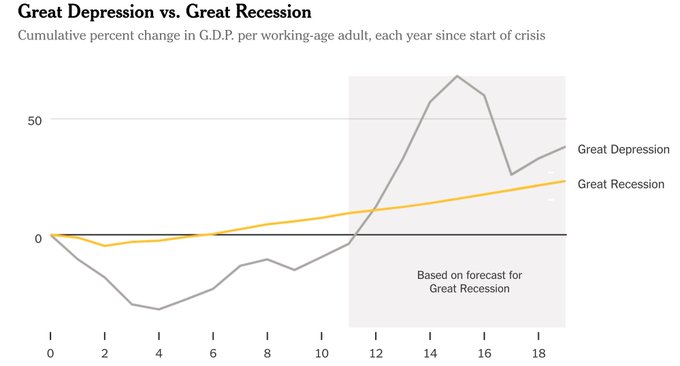
I think it will be the forgotten depression. The triumphalism of neoliberal capitalism and Fed independence made this unpossible, and the unquestionable stewardship of Obama/Geithner rendered it moot. I'm not sure that even historians - decades later, as is their privilege - will grapple with this fact.

Empires fall.