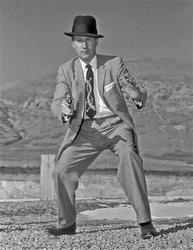
Two of my favorite actors. I recommend Victor Navasky's new book about his life. One can't overestimate how Joseph McCarthy influenced that generation of the Left.
"But clearly Simon Wiesenthal haunted his quarry. One of Mengele's fanatical Nazi protectors in Brazil, Wolfgang Gerhard, said he had dreamed of hitching Mr. Wiesenthal to an automobile and dragging him to his death."
"It was a matter of pride and satisfaction, he said in 1995, as he approached his 87th birthday, that old Nazis who get into quarrels threaten one another with a vow to go to Simon Wiesenthal."

U.S. Says It Has Killed No. 2 Qaeda Operative in Iraq
BAGHDAD, Iraq, Sept. 27 - ...
As insurgent attacks continued across Iraq today, American and Iraqi officials offered further details about the killing on Sunday of Abu Azzam, whom they described as the top lieutenant of Abu Musab al Zarqawi, the leader of Al Qaeda in Mesopotamia.
Also today, the renegade Shiite cleric Moktada al Sadr issued an unusual public request for guidance on how to deal with Mr. Zarqawi, who declared a "full-scale war" on all of Iraq's Shiites two weeks ago.
Days after his declaration of war, Mr. Zarqawi issued a qualifier, exempting certain groups including followers of Mr. Sadr, who has sometimes allied with Sunni fighters in his resistance to the American presence here.
Seemingly embarrassed by that exemption, Mr. Sadr publicly sought guidance on how to fight Mr. Zarqawi's attacks from Grand Ayatollah Ali al-Sistani, Iraq's most revered Shiite cleric.
The ayatollah responded in an unusually lengthy statement, in which he repeated his previous counsel to Iraqis to "continue in their self restraint, along with more caution and alertness." Mr. Sistani also said that the insurgents' purpose was to "start the fire of civil war in this beloved country," and that Iraqis must not allow them to succeed. He called on the government to protect Iraqis, and on the courts to speed up their work in trying and sentencing those accused of murder.


On February 1, 2005, Lieutenant General Mattis, speaking to a forum in San Diego, apparently said "You go into Afghanistan, you got guys who slap women around for five years because they didn't wear a veil. You know, guys like that ain't got no manhood left anyway. So it's a hell of a lot of fun to shoot them." "Actually, it's a lot of fun to fight. You know, it's a hell of a hoot. It's fun to shoot some people. I'll be right upfront with you, I like brawling." Mattis' remarks sparked controversy, and General Michael W. Hagee, Commandant of the Marine Corps, issued a statement suggesting that Mattis should have chosen his words more carefully, but would not be disciplined.
General Mattis popularized the slogan "no better friend, no worse enemy" among his command. This phrase became central in the investigation into the conduct of Lieutenant Ilario Pantano, a platoon commander serving under General Mattis. Lieutenant Pantano shot a pair of prisoners on April 15, 2004. He said that he thought they represented a threat. Lieutenant Pantano emptied two entire magazines into their bodies, because he wanted "to leave a message". He then scrawled General Mattis's slogan over the bodies.
EDIT: He is portrayed by Robert John Burke in the HBO miniseries Generation Kill.

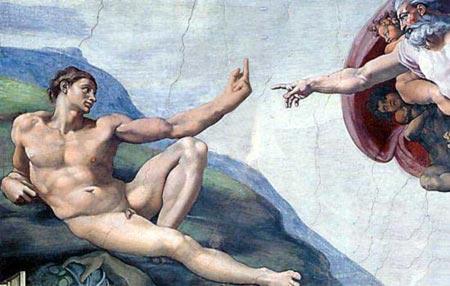
The secret of Dahl's charm, and Wonka's, is that neither one seems to be an entirely nice person. Or, rather, neither has much use for the condescending sweetness that some adults adopt in the belief that children will mistake it for niceness. Dahl's sensibility was gleefully punitive; he was a scourge of bullies, brats and scolds, and a champion of unfussy decency against all manner of beastliness.
...
Mr. Depp, in a recent interview, has dropped the name of the Vogue editor Anna Wintour. To me, the lilting, curiously accented voice sounded like an unholy mash-up of Mr. Rogers and Truman Capote, but really, who knows?
Early Russian literature was intimately connected to the Europeanizing and liberal tendency of the "Decembrist" revolution of 1825, which was enthusiastically supported by Pushkin and his inheritor Lermontov. And the debt of those rebels to Byron's inspiration was almost cultish in its depth and degree.Speaking of cultish worship, Che Guevara is quoted as an authority in a New York Times piece on the peculiar nature of the Iraqi "insurgency":
If the insurgency is trying to overthrow this regime, it is contending with a formidable obstacle that successful rebels of the 20th century generally did not face: A democratically elected government. One of the last century's most celebrated theorists and practitioners of revolution, Che Guevara, called that obstacle insurmountable.The Decembrists of course weren't facing an elected government and the revolution they fought for wouldn't happen for almost another century. Of Lermontov's death by duel, Hitchens writes,
"Where a government has come to power through some form of popular vote, fraudulent or not, and maintains at least an appearance of constitutional legality," he wrote, "the guerrilla outbreak cannot be promoted, since the possibilities of peaceful struggle have not yet been exhausted."
When Lermontov was brought to the field of honor he apparently declined to fire on the fool who had provoked the duel. Slain on the spot, he never heard the czar's reported comment: "A dog's death for a dog." His unflinching indifferece on the occasion, however, drew on two well-rehearsed nineteenth-century scenarios: The contemptious aristocrat on the scaffold, and the stoic revolutionary in front of the firing squad. The Decembrists, in their way, admired and emulated both models.The anti-American revolt in Iraq, which mainly targets Iraqis, is a nihilistic, sectarian variation on the unflinching indifference of the classic revolutionary.
Chappelle may be America's most incisive and original comic mind on issues of class and race, but that's not what frat boys are thinking about when they buy his DVDs. It's "I'm Rick James, bitch," all the time. Chappelle made his own choices, and, like the rest of us, he has to live with the consequences, even if he is better funded. It's not our fault.Pollack does recognize Chappelle's unique talent, but he's hinting that Chappelle is sort of a sell-out and that his current troubles may be a result of that "choice." I don't see Chappelle as a sell-out at all. Anyone who can include "incisive and original" bits on race, class and politics in their comedy in today's America isn't.
I mention Hitchens often because he's so knowledgeable and knows how to think, a potent mixture."Thou knowest the commandments, Do not commit adultery, Do not kill, Do not steal, Do not bear false witness, Honor thy father and thy mother." And he said, "All these have I kept from my youth up." Now when Jesus heard these things, he said unto him, "Yet lackest thou one thing: sell all that thou hast, and distribute unto the poor, and thou shalt have treasure in heaven: and come, follow me." (Luke 18:20-22)...It turns out that the Eleventh Commandment is not "Thou shalt speak no ill of fellow Republicans," but is, rather, a demand for the most extreme kind of leveling and redistribution.
I have never understood why conservative entrepreneurs are so all-fired pious and Bible-thumping, let alone why so many of them claim Jesus as their best friend and personal savior. The Old Testament is bad enough: The commandments forbid us even to envy or covet our neighbor's goods, and thus condemn the very spirit of emulation and ambition that makes enterprise possible. But the New Testament is worse: It tells us to forget thrift and saving, to take no thought for the morrow, and to throw away our hard-earned wealth on the shiftless and the losers."
Bin Laden and most militant Islamists [are] motivated by . . . their hatred for a few, specific US policies and actions they believe are damaging - and threatening to destroy - the things they love. Theirs is a war against a specific target and for specific, limited purposes. While they will use whatever weapon comes to hand - including weapons of mass destruction - their goal is not to wipe out our secular democracy, but to deter us by military means from attacking the things they love. Bin Laden et al are not eternal warriors; there is no evidence that they are fighting for fighting's sake, or that they would be lost for things to do without a war to wage. . . . To understand the perspective of the [tens or hundreds of millions of] supporters of Bin Laden, we must accept that there are many Muslims in the world who believe that US foreign policy is irretrievably biased in favor of Israel, trigger happy in attacking the poor and ill-defended Muslim countries, Sudan, Iraq, Afghanistan, Somalia, and so forth; rapacious in controlling and consuming the Islamic world's energy resources; blasphemous in allowing Israel to occupy Jerusalem and US troops to be based in Saudi Arabia; and hypocritical and cruel in its denial of Palestinian rights, use of economic sanctions against the Muslim people of Iraq, and support for the Muslim world's absolutist kings and dictators.This is the mentality Hitchens has been fighting against and why he gets so nasty. As bad as America's foreign policy can be, there are a number of distortions in the seemingly reasonable paragraph above. America's foreign policy should be better for its own sake, not because Al Qaeda hit us and threatens to do worse.
One doesn't have to read the manuscript terribly closely to see how it provides some benefit to the CIA. Critical as Anonymous [Scheuer] is of his own organization - as well as of the Bush and Clinton administrations - he absolutely blasts the FBI on pages 185 through 192. Many progressives may not cotton to the broad notion he advances here - namely, that the US should simply dispense with any sort of legalistic, law-enforcement approach to combating Al Qaeda and leave it entirely to the covert operators. But in the context of Washington's political postmortems on 9/11-related intelligence failures, this is stuff that at least makes the FBI look worse than the CIA.The irony perhaps is that Hitchens has argued strenuously against torture and disregarding what makes the West more defensible in leftists' eyes than, say, the Taliban or Saddam Hussein or the genocidaires of Sudan.
Ten years ago Mayor Daley in a little City Hall ceremony gave me a five hundred dollar check on behalf of the Midland Authors' Society. 'Mr. Mayor, have you read Herzog?' asked one of the reporters standing by. 'I've looked into it.' said Daley, yielding no ground. Art is not the Mayor's dish. But then why should it be? I much prefer his neglect to the sort of interest Stalin took in poetry, phoning Pasternak to chat with him about Mandelstam and, shortly afterwards, sending Mandelstam to die.Well, yeah. But no doubt this is a reason "Crony Capitalism" outlived "Communism."
I can't resist adding two more themes from Bellow's triumph in 1953. One is a hatred of workhouse condescension towards the underclass: 'Something in his person argued what the community that contributed the money wanted us poor bastards to be: sober, dutiful, buttoned, clean, sad, moderate.Hence his appreciation of grifters, conartists, and fixers in all their complexity. (Quote from a Hitchens review of Ravelstein.)
He believed in the individual's quest for integrity and love, guided by the great writers but not overwhelmed by them, learning from the swindlers but not driven to despair by them.