Sunday, September 25, 2011

Come Down to My Level

Whatever Happened to the American Left by Michael Kazin

But who's the real criminal? It's me, isn't it? by Daniel Davies

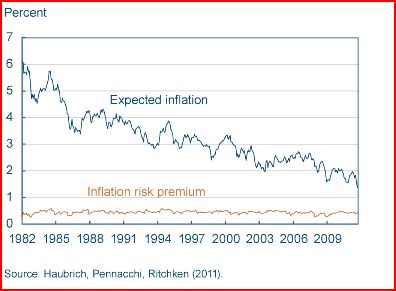
The Era of Ever-Falling Inflation Expectations by Yglesias


Looks like the chart of the decline of organized labor or of the influence of the Left.

Saturday, September 24, 2011


I guess I'm confused over the housing sector. Here's some confusion from the other day. DeLong discusses it here in the context of the 3 Fed dissenters. 

Philadelphia Fed Presiendt Charles Plosser said in an interview that " This mess was caused by over-investment in housing, and bringing down unemployment will be a gradual process."

DeLong responds:
It is, I must say, remarkable that Plosser has managed to avoid learning that the housing bust since 2007 has been much larger than the mid-2000s housing boom, and that there is no overhang of overbuilt houses, rather the reverse:

FRED Graph  St Louis Fed 97 2
The story goes:

1) boom in residential construction (in blue)

2) spawns a bubble which takes on a life of its own

3) consumers use houses like ATM machines

In a comment at Crooked Timber Daniel Davies writes
The fact that houses became so expensive is hardly unrelated to the fact that financial means were created which then allowed people to bid the prices up further.
I don’t really agree, (surprisingly) – the price bubble was policy-caused. In the early 00s, when I started covering the UK banking industry in serious depth, the main upward driver of house prices was simply the fact that (as base rate plummeted to the historically low level of 4%!) they were so, so damn affordable – remember that mortgage rates went from nearly 10% to about 5% on a simple, vanilla standard variable rate mortgage, basically halving the monthly payment. The product innovations were a response to, not a cause of, the housing boom (in Spain, where financial regulation was and is very strict, they still had a housing boom on 100% vanilla products).
Is what Davies says related to the Global Savings Glut? After witnessing the 1997 East Asian financial crisis, the Chinese - who avoided the worst because of capital controls - decided they would never ever be put in a position to be forced to go to the IMF and so built up their reserves. This caused mortgage rates to drop.

In 2005 what happens? Housing bubble deflates. Exports and business investment continue to grow. Unemployment level remains unchanged and people lose jobs and others are hired. Then in 2008 as the bubble deflates, financial institutions are put under pressure. Bear Stearns is bailed out. Lehman isn't and there's a panic, a run on the shadow banking system and a credit crunch. All sectors decline. Fiscal stimulus by the White House and Congress and monetary stimulus by the Federal Reserve stops the credit crunch and causes the economy to recover although growth is at a painfully slow pace and far from catching up to trend levels.


Spain's Banking Mess by Floyd Norris

Friday, September 23, 2011

The Myth of Cash on the Sidelines


Bubblicious
(or This Time It's Different)

NY Fed's Duddley: Financial Stability and Economic Growth by Calculated Risk
"[W]hen [bubbles] are underway, [they] are typically enjoyable. As a result, regulatory interventions that temper booms normally are going to be unpopular."

From NY Fed President William Dudley: Financial Stability and Economic Growth. Dudley makes several interesting comments. I've long argued that the primary causes of the housing bubble were rapid innovation in the mortgage market combined with a lack of regulatory oversight.
Ron Suskind's Larry Summers problem by Ezra Klein

Good piece by Klein. From what I've heard, the book makes Summers and Obama look better a little bit. (Summers argued for more stimulus. Obama leaned towards the Swedish model and was impressed with Elizabeth Warren.) It makes Orszag look worse. Regarding nationalization of the banks, I thought Obama was undecided but apparently he had the right instincts. At the time I leaned slightly towards the Geithner view that given the fragile state of things, a nationalization could bring about a panic like Lehman Brothers or a Greek default. Better to err on the side of caution but proponents of nationalization had some good points. In hindsight I've changed my view especially given the behavior of bank CEOs and their lobbyists since then.

Was the timing of the release of the book with its portrayal of a mildly frat-house-like White House and the historic ending of DADT a coincidence?

I don't understand why everyone in the book is saying they were misquoted. Maybe at the the time they gave quotes they thought Obama was shoe-in for re-election and now they feel Obama could lose and are feeling disloyal?
Martin Scorsese documetary on George Harrison
review of Moneyball by Manohla Dargis
Like “The Social Network,” which is about the creation of Facebook and yet so much more (it was also written by Mr. Sorkin) “Moneyball” is about a fundamental cultural shift and the rise of the information elite. Instead of going by instinct, Peter knows what he knows because he’s a disciple of Bill James, a once-marginal figure who, starting in 1977, began publishing an abstract that offered a new, rationalized way of looking at the game. In a nutshell, Mr. James looked at baseball statistics in a different light, less by breaking the numbers down in another way but by seeing that what appeared to be objective facts, like fielding statistics, were, as he wrote, “a record of opinions.” And these numbers didn’t just describe baseball; they gave the game its language, its “fiction and drama and poetry.”
Like a linguist Mr. James studied that language, looked at its form, context, meaning, and called his new approach sabermetrics. Among other things he could see value in underappreciated, often underpaid and ignored players whom conventional thinkers saw as destined for the minors. In the movie Peter preaches this new gospel to Billy, who embraces it with born-again fervor, partly because it clarifies the mystery of why he never became the player he was drafted to be: he had the tools, as the scouts like to say, but they just didn’t work in the majors. (In reality it was a former general manager of the A’s, Sandy Alderson, now with the Mets, who introduced Mr. Beane to Mr. James’s work.)
Reminds me of progressives like Yglesias and Ezra Klein and their recourse to data and charts, especially during the health care debate. In macroeconomics, though freshwater economists lost their way by focusing too much on models and equations.
Origins of the Euro Crisis by Krugman

Reminds me of the 1997 East Asian financial crisis and others have pointed to the Latin American debt crisis of the 1980s.
U Mad Bro? 
(or why so serious?)

Krauthammer in Full Rant Mode by Dean Baker

Krauthammer is a longstanding member of my rogues gallery so it's good to see Obama's rhetoric sending him into fits of rage.

Thursday, September 22, 2011

Young Adults Make Gains in Health Insurance Coverage

Housing Boom / Housing Bubble

Be Warned: Mr. Bubble is Worried Again by David Leonhardt (August 21, 2005)


Robert Shiller's graph of housing prices ending in 2005 or so.

This post is sort of free-floating working-out of my ideas on the issues. The context of this is series of back and forth blog posts between Matt Yglesias and Doug Henwood. Yglesias's first post is a reaction to a piece by Jeffrey Sachs published in the Huffington Post. Right off the bat, I'm distrustful of Sachs and more trusting that Yglesias will be correct. They're both liberals so they both want the same things or ends, but Sachs can be all over the place and became famous after putting the Russian people through the wringer via "Shock Therapy." My view is that he had sort of a crisis of conscience over the experience and became more liberal if not really that rigorous in his thinking. I could be wrong. Also, Huffington Post will publish good stuff, but also will run hokey stuff. So my BS detector is on high alert. Anyway Sachs writes:
The housing boom between 1998 and 2008 was an indirect reaction to the loss of manufacturing. As the US shed manufacturing jobs in the 1980s and 1990s, the Federal Government and Federal Reserve tried to compensate by boosting jobs in construction and other sectors shielded from international competition (so-called non-traded sectors). The Fed cut interest rates and the White House and Congress promoted housing finance, including through reckless deregulation and irresponsible behavior by government-backed entities like Fannie Mae. These efforts produced a temporary boom in housing, followed by the bust in 2008.
Obama and his advisors have believed, in effect, that they can reignite the housing boom. Rather than reacting to the underlying problem -- the loss of manufacturing competitiveness -- they have acted as if a bit of pump priming and the passage of time will recreate consumer-led growth in housing, autos, and other sectors.
Yet this approach has been doomed to fail, and continues to do so. Consumers will not return quickly to buying houses, cars, and other big-ticket items in large numbers. They are exhausted and in debt, and in no mood to repeat the earlier disasters of over-borrowing.

Ygelsias argues there wasn't a boom in housing, but a boom in prices or a bubble. Doug Henwood responds to this. He's usually pretty good, but can bitchy towards others like Yglesias. Henwood's response is that there was a boom, along with a bubble. A bubble starts with a boom and then takes on a life of its own. And then as far a I can tell Yglesias responds and agrees there was a boom but that it wasn't that big. Henwood says it was pretty big:
To reprise a couple of points from yesterday’s post: 1) As a share of GDP, residential investment—that is, the building of new houses and work done on older ones—hit a peak of almost 60% above its long-term trend in the mid-00s. And, 2) between 2001 and 2006, residential investment accounted for 12% of GDP growth, twice its share of the economy. If “60%” and “twice” don’t sound like big numbers, then I don’t know what does.
See where I'm confused is where inflated prices work into the equation of residential investment. Is the bubble reflected in the numbers? And when working with fractions and percentages it gets kind of tricky. My guess is that Yglesias doesn't want to admit there was a boom of any sort in the Bush years, but maybe that's not fair or true.

Calculated Risk* has had some interesting posts on the housing market. The construction industry builds a certain number of houses a year to keep up with new housing formation. Because of the crisis and bust, there's a big overhang of available housing. Once that is worked through, which will be slower than the past because of a slowdown in household formation, the construction industry will start building again to meet demand and create jobs and more demand. New construction won't be at the boom level of the past though because there won't be the boom level of demand in new housing formation. Dean Baker repeatedly points out at his blog that housing prices need to come down to their trend before the market can turnaround. I admittedly don't have a handle on it.

But back to Sach's long history. It interesting that Sachs says the boom is from 1998-2008 whereas Henwood says 2001-2006. There was an Interent bubble in the late Nineties and then a mild crash. Sachs says the US shed manufacturing jobs in the 1980s and 1990s and I guess it's true, although the 1990s had a period of growing wages and full employment during the Clinton years right before the Internet bubble burst. Sachs asserts that the government created the housing boom through design and I don't know if that's quite true. There was the Global Savings Glut which lowered mortgage rates and the Bush tax cuts and the weakening of loan restrictions so that more people could pile on debt. Was this a housing boom policy or more accidental? Growth would have been worse with out these things. I agree that Clinton and Bush both pushed "the American Dream" with more access to housing with the Bush administration probably inflicting more unintended consecquenses.

Sachs says this "artificial" housing boom demand won't be replaced so the Obama administration's "pump-priming" is futile. He argues they need to address the long-term structural problems of "competitiveness" and the loss of demand caused by the loss of manufacturing jobs. Dean Baker has pointed to the trade deficit.

Maybe after priming the economy won't pick back up to its previous boom levels, but after financial crises economies do usually come back (except Japan of course). The world economies came back after the Great Depression but only because of the pump-priming of war time spending and moentary policies.

In sum, I agree that there's a lack of demand because consumers were relying on credit during the boom years and they are not now. Plus the loss of demand cause by job losses and government budget cuts. But it's also the case that the fear caused by the crisis and recession is making credit and spending less than they need be. The Fed and White House pump-priming are trying to get people to be less cautious and help them deleverage. There's no reason why corporations and people with money are sitting on it, demanding safe places to park it and low returns, other than the fact that they are anxious and see years of slow growth ahead.
---------------------
*This might be wrong. It's not that there's an overhang, it's that prices are too high and demand is too low. Anyway I'm confused.


Greece might default.
For the moment, Greek officials are adamant that neither a default nor a euro exit and devaluation is in the cards. One senior policy maker in Greece’s Finance Ministry, who declined to be identified because of the delicacy of the matter, even offered to send his questioner a case of 2005 Dom Perignon Champagne if Greece ever repudiated its debt.
But close followers of Greece’s budget dynamics point to the fact that, despite the country’s deficit woes, by next year Greece is likely to have achieved a primary budget surplus, meaning that after taking out the high levels of interest it pays on its debt, it will be running a surplus.
History shows that a country tends only to take such a drastic step as cutting ties with its international lenders when it has tightened its belt enough to achieve a budget surplus, and it is only payments to its bankers that is keeping it in the red.
Such was the case in most of the recent country defaults, including Argentina, Ecuador, Indonesia and Jamaica, economists at the I.M.F. found in a paper published last year that addressed when a country finds its interest is served by default.
“My view is that it is very much in Greece’s interest to default now, as there is no prospect that it can repay its debt,” said Desmond Lachman, a former I.M.F. economist at the American Enterprise Institute. “If it is inevitable that an insolvent Greece is going to have to restructure, it would be better for Greece to do it now.”
FT Alphaville:

The Oregon Office of Economic Analysis has ventured an update to Carmen Reinhart and Ken Rogoff’s ‘This Time it’s Different‘, the seminal work on financial crises of the past – and their related analysis on the aftermath of financial crises.

The OOEA* uses both updated and revised data and, mostly, confirm that while things have of course gotten worse, they’re still inside the historical norms. For example, equity price declines:
Update crisis duration - Oregon Office of Economic Analysis
Indeed, for most of the key measures used by Reinhart and Rogoff, the OOEA finds newer data only reconfirms the US is experiencing a “garden variety” of financial crisis, as the original works indicated.
The summary of the new data comes out like this:

Oregon Office of Economic Analysis - Reinhart/Rogoff update - summary
However… there’s one area in that list in which the current US appears to be significantly better than the crises past: unemployment.
While it looks terrible in the context of past US recessions…
Oregon Office of Economic Analysis - US unemployment compared to past US recessions

So far, at least, the US has done reasonably well in terms of unemployment, when compared to global precedents:

Oregon Office of Economic Analysis - historical comparison of recent US unemployment to global financial crisis

It probably won’t be much comfort to anyone in these economic times, but interesting, nonetheless.
Interesting comments, like:
In addition to governments messing with the definition of unemployment, US has less social support than other countries, so impact of unemployment is far greater. Limited time benefits being one example, and health insurance being tied to your job an even larger one, means losing your job can be catastrophic in a way that is inconceivable in Japan, Spain or Scandinavia. This will provide further amplification of the impact of recession on US consumers.

Diagram from Mike Konczal. Via Yglesias, who says "I’m with Woodford in the overlapping fiscal/monetary slice of the Venn diagram." I agree, but I'd add the perspective of Eggertsson/Krugman on debt and deleveraging.
Baddies from Planet Retard*

Mark Thoma:
The unemployment crisis needs to be attacked vigorously, and we need aggressive action from both monetary and fiscal policymakers. But neither the Fed nor Congress has the will to do more than half-hearted measures at this point, and even that might be too much for Congress.

I wish the people making these decisions had to face what households struggling to find a job endure daily -- the world policymakers see from their insulated shell is very different from the world of the unemployed. Maybe then they'd finally get it and, more importantly, do what needs to be done.

Jared Bernstein: Fed Does Twist


Brad DeLong: Good To See But 1/10 of What We Should Be Doing


Dean Baker: Why Do The Bankers Decide How Many People Will Be Unemployed?


Doug Henwood: Does Productivity = Unemployment?


Paul Krugman: New Developments in the Political Business Cycle
But now there’s a new wrinkle. As Stan Collender says, it’s hard to see the GOP letter threatening Ben Bernanke if he does anything to help the economy as anything but an attempt to invert the political business cycle, pressuring the central bank to ensure a weak economy in the year before the election.
Got to give the GOP points for innovation.
---------------------------
*quote I overheard from a teen upset with the incompetence and malfeasance he was witnessing.

Wednesday, September 21, 2011

I saw the movie Drive and really, really liked it. It had some graphic violence and was a little artsy, so people who don't like that stuff won't like the movie but it didn't bother me. It stars Ryan Gossling, Bryan Cranston, Carey Mulligan, Albert Brooks, Oscar Isaac and Ron Perlman.

It's an urban noir set in Los Angeles with an Eighties vibe and a good soundtrack. A few songs sounded Tangerine Dreamish. The opening has a great action sequence.

It was directed by the Danish filmaker Nicolas Winding Refn whose previous movies include Bronson and Valhalla Rising.
Money Shot

Neomonetarist Scott Sumner has a quote from An Outhouse at his blog:
It was Romer’s first meeting with the President-elect in November 2008. According to Ron Suskind’s book  “Confidence Men: Wall Street, Washington, and the Education of a President,”Obama had “a woman problem: too few of them in key jobs” and he was trying to bring in Christina Romer. And “It’s clear monetary policy has shot its wad” is what Obama said to her before even “hello.” Is that how you talk to a woman?
She then quotes the following passage from Suskind:
It was a strange break from decorum for a man who had done so outstandingly well with women voters. The two had never met before, and this made the salty, sexual language hard to read. Later it would seem a foreshadowing of something that came to irk many of the West Wing’s women: the president didn’t have particularly strong “women skills.” The guy’s-guy persona, which the message team would use to show Obama’s down-to-earth side, failed to account for at least one thing: What if you didn’t play basketball or golf? Still, for the moment, the comment didn’t faze Romer. She was curious to hear what he thought.
“What do you mean?” she asked.
Obama extended his hand, now ready to greet her. “I guess we need to focus on fiscal policy,” he said.
“No, you’re wrong,” Romer corrected him. “There’s quite a bit we can still do monetarily, even with the historically low interest rates."
I like Romer so this made me cringe. It's obviously unprofessional even if it is weirdly funny in a surreal way. But interesting that Obama already thought the Fed was "pushing on a string" back then. What sorts of conversations did he have with Bernanke?

I also wonder about the timing of the release of Suskind's book with its picture of the frat-house atmosphere of the White House with the historic repeal of Don't Ask Don't Tell which made the White House seem gay-friendly. Maybe they were cooridnated or maybe it was just a coincidence?
In response to the Fed's statement, Modeled Behavior tweeted
Now rates will finally be low enough to spur consumers into taking out 30 year loans to finance the construction of panic rooms
Central Banks Coordinate Expectations by Yglesias

Tuesday, September 20, 2011

Radiohead on hourlong Colbert Report
Stephen Colbert can’t be influenced by the agendas of politicians and public officials, but if you’re a popular rock group that doesn’t easily embrace television cameras he will gladly roll over for you. On Monday Comedy Central announced that it would expand “The Colbert Report” to an hourlong broadcast for the first time in that show’s history to present a special episode featuring Radiohead, the British rock quintet of “OK Computer” and “Kid A” fame, whose song “How to Disappear Completely” could sometimes be mistaken for their press strategy. (Perhaps in an effort to be more visible, the band will also appear on Saturday’s season premiere of “Saturday Night Live,” and will perform at Roseland Ballroom in Manhattan on Sept. 28 and 29.)
In a news release Comedy Central said that the one-hour “Colbert Report” special would be shown next Monday, Sept. 26, and would present the band in interviews and performances of their songs from their recent album, “The King of Limbs” (including an unreleased track called “The Daily Mail”), along with that program’s usual mix of topical comedy segments. Mr. Colbert, who isn’t afraid to flaunt his rock-music bona fides, has used his show to feature artists like the Decemberists, LCD Soundsystem and Jack White, who appeared in multiple “Colbert Report” segments over the summer. Mr. Colbert said in a statement, “I look forward to meeting the Radioheads and leveraging their anti-corporate indie cred to raise brand awareness for my sponsors.”

Monday, September 19, 2011

Paul Volcker's Recollection of the History of Inflation is a Bit Weak by Dean Baker

Former Federal Reserve Board Chairman Paul Volcker lectured readers on the dangers of inflation in a NYT column today. He warned that a little bit of inflation invariably grows to a lot of inflation, which then carries a huge cost to contain.
Actually this has not in general proven to be the case. The one time in the post-war period where inflation clearly became excessive in the United States was in the 70s. This was due to a number of extraordinary events, including large oil price increases associated with the formation of OPEC and the Iranian revolution, a huge wheat deal with the Soviet Union, and a mis-measurement of the rate of inflation that got directly translated directly into wages and other prices as a result of wide-spread indexing. 
Even in this case, the cost of bringing inflation down with the 1981-82 recession was minor compared to the costs that the country is now enduring as a result of the current prolonged downturn. It is hard to see how any careful analysis of risks and costs would support Mr. Volcker's warnings on inflation.
It is worth noting that the financial sector might view the equation differently. Its assets are directly devalued by even modest rises in the rate of inflation. For this reason, the financial industry tends to be strongly opposed to inflation even at the cost of high unemployment.

Saturday, September 17, 2011

Circus Elephants by Lorrie Moore (on the Tea Party-hosted GOP debate in Tampa)
It is indeed the audiences who are getting scary. The MSNBC crowd last Thursday applauded the state of Texasʼs record-breaking death-row executions. On Monday in Tampa at least one person cheered the prospect of (in a question posed to Ron Paul) an uninsured man in a coma being left to die. Monday’s audience also booed Perryʼs defense of public education for children of illegal immigrants, as well as Paulʼs skeptical remarks about American exceptionalism (“We’re under great threat because we occupy so many countries. We have 900 bases around the world.”). This kind of hooha heartlessness is recession road rage at its worst, and that this is the electorate these candidates are trying to court often seems to startle even them, though this is reflected less in the policies they endorse than in their faces, which can veer to and from their lecterns in disorientation and fog.

Each of the candidates did have something genuinely interesting to offer: Ron Paul is strongly antiwar. Perry would like to give the children of illegal immigrants the right to go to university. Bachmann seemed to have the goods on Perry (a genuine scandal involving the pharmaceutical company Merck, a former staffer who was a lobbyist for Merck, and Texasʼs executive mandate for a controversial vaccine made by Merck). Cain would like a simplified tax system with no loop holes and a rule that says no congressional bill can be longer than three pages. Huntsman has a more progressive though also flattened tax system (you can see him, with nervous dismay, counting his island days). He is also trying to keep science in the platform and religion out and would (like Perry) work to wind things down in Afghanistan. Gingrich is working on his wittiness, something of which heʼs always been proud (Bachmann brings her loud rough laugh to it all, so he may be flirting with her). Romney is tall. Romney also arranges his face warmly when others are speaking—unlike Perry who often looks concussed, though Perry’s beauty, a cross between Burt Reynolds and Hillary Swank, springs to life when the suggestion that he can be bought for only five thousand dollars comes up. He has a price, he seems to suggest, but itʼs much higher than that. And—as reports roll in—so it is.


Never watched the Emmies before but tomorrow tonight I will be rooting for Poehler, Dinklage, Game of Thrones and Michelle Forbes. Forbes is nominated for the Killing and has been a part of some of my favorite shows. She was on Star Trek: The Next Generation, Battlestar Galactica, and 24. She was on Homicide: Life on the Street which was based on a David Simon book. She worked with John Carpenter on Escape from LA and with Alan Ball on True Blood. She's kind of like a superhot Zelig for the shows I've watched over the years. So she has great taste in picking projects and people to work with or she's lucky or maybe a combo of the two.

Update: Congrats to Peter Dinklage. Seemed like the two creators of Game of Thrones were tickled by his win. Also, George R.R. Martin had a good seat. I forgot to mention I liked the show Justified and was good to see the actors from that show get recognized.

Friday, September 16, 2011


I really like Fareed Zakaria's optimism. Take this piece on how the lessons of Iraq paid off in Libya. He gives the reader a sense that the glass is half-full.

I hope he is right about China and Europe in his newest piece, titled "How China can Help Europe Get out of Debt."
Facing a similar crisis in 2008, then-Treasury Secretary Henry Paulson talked about the need for a bazooka, a weapon large enough to scare markets into submission. Europe doesn’t have one. Even Germany — which has a debt-to-GDP ratio of 83 percent — can’t credibly bail out Italy and Spain. Together they need to roll over 600 billion euros of debt before the end of next year. Who has that kind of money*
Today, $10 trillion of foreign exchange reserves are sitting around across the globe. That is the only pile of money large enough from which a bazooka could be fashioned. The International Monetary Fund could go to the leading holders of such reserves — China, Japan, Brazil, Saudi Arabia — and ask for a $750 billion line of credit. The IMF would then extend that credit to Italy and Spain but insist on closely monitoring economic reforms, granting funds only as restructuring occurs. That credit line would more than cover the borrowing costs of both countries for two years. The IMF terms would ensure that Italy and Spain remained under pressure to reform and set up conditions for growth.

What’s in it for the Chinese, who would have to devote at least half the funds and who have already politely demurred when approached by the Italians? China invests its foreign exchange reserves looking for liquidity, security and decent returns. It isn’t trying to save the world. Premier Wen Jiabao made slightly encouraging noises this week, hinting that he would increase bond purchases and asking in return for greater market access to Europe. That’s classic Chinese diplomacy: cautious, incremental and narrowly focused on its interests.

The time has come for China to adopt a broader concept of its interests and become a “responsible stakeholder” in the global system. The European crisis will quickly morph into a global one, possibly a second global recession. And a second recession would be worse because governments no longer have any monetary or fiscal tools. China would lose greatly in such a scenario because its consumers in Europe and America would stop spending.

Of course, China would have to get something in return for its generosity. This could be the spur to giving China a much larger say at the IMF. In fact, it might be necessary to make clear that Christine Lagarde would be the last non-Chinese head of the organization.

In a world awash in debt, power shifts to creditors. After World War I, European nations were battered by debts, and Germany was battered by reparation payments. The only country that could provide credit was the United States. For America, providing desperately needed cash to Europe was its entry into the councils of power, a process that ultimately brought a powerful new player inside the global tent. Today’s crisis is China’s opportunity to become a "responsible stakeholder."
Would (will?) China be an enlightened, responsible stakeholder? I'd think human rights, democracy, and civil rights will be low on their list of priorities as well as environmental and labor regulations, such as they are. Still the Chinese Communist Party enacted a sizable fiscal stimulus after the financial crisis of 2008. This demonstrated they have much more wisdom and macroeconomic know-how than the American Republican Party.

Update: A New York Times news analysis on the European Central Bank says:
The E.C.B. can stop this crisis in a minute if they want to,” said Guntram B. Wolff, deputy director of Bruegel, a research organization in Brussels. The bank, he said, could simply overwhelm bond markets by buying huge quantities of debt from Greece, which is effectively insolvent, as well as other countries that have come under attack, like Italy. End of crisis.
Some economists have argued that the bank could buy more than $1 trillion in sovereign debt if it needed to.*
But such an action would provoke howls from Germany and countries like Finland,** where the bank is seen as having gone rogue because of its relatively modest purchases of debt from a list of countries that also includes Spain, Portugal and Ireland. In those beleaguered countries, meanwhile, the bank is regarded as insufficiently supportive.
------------------------------
* Apparently the ECB has that kind of money.
** Finland?
FT Alphaville discusses Morgan Stanley's Spyros Andreopoulos on the probability of a double-dip recesion:
He sifts through all the slowdowns — defined as two successive quarters of growth not exceeding 1 per cent — recorded since 1950. There are 13 in total – and, as the charts above show, not all of them presaged a double-dip recession. Partly because, of the 13, only four occurred in a “young” expansionary period. That is, within eight quarters of a recession ending.
And of those four, only two resulted in a double-dip recession. One was 1959, in which a recession commenced three quarters after the the slowdown, and 1981, when a recession immediately followed a slowdown.
Andreopoulos writes:
But what were the catalysts?
…both because of monetary tightening: It turns out that both these recessions were precipitated by monetary policy. The 1981 recession was – deliberately – induced by the Fed in order to squeeze inflation out of the system (the recession essentially marked the beginning of the ‘Volcker disinflation’). And even the 1960/61 recession is thought by economic historians to have been caused by “the drastic tightening of money that occurred in 1959/60".
Conclusion: double-dips have only occurred upon Fed tightening: Whenever in post-war US history expansions have died young, the catalyst has been monetary policy tightening. Put differently: double-dips have occurred only when induced by the Fed.
A commenter writes:
RTRS GREEK GOVERNMENT TO BAN THE EXPORT OF TARAMASALATA AND TZATZIKI
RTRS LAST DITCH ATTEMPT TO STAVE OFF DOUBLE DIP RECESSION
On fiscal policy, Andreopoulos writes:
The outcome here is binary, with adoption of the president’s proposals bringing about 0.8% of GDP of net new stimulus; a rejection by Congress would mean expiration of these measures and bring about an automatic fiscal tightening of 1.2% of GDP. And of course the eurozone debt crisis – a fiscal problem – could yet prove a catalyst for a potentially vulnerable US economy.
So who should you turn to, to help comprehend the turnaround (see below) if not David Brooks? I mentioned Baker and Krugman. Lately I've been reading FT Alphaville who link to a good Matt Taibbi piece from April:
America has two national budgets, one official, one unofficial. The official budget is public record and hotly debated: Money comes in as taxes and goes out as jet fighters, DEA agents, wheat subsidies and Medicare, plus pensions and bennies for that great untamed socialist menace called a unionized public-sector workforce that Republicans are always complaining about. According to popular legend, we're broke and in so much debt that 40 years from now our granddaughters will still be hooking on weekends to pay the medical bills of this year's retirees from the IRS, the SEC and the Department of Energy.

Why Isn't Wall Street in Jail?
Most Americans know about that budget. What they don't know is that there is another budget of roughly equal heft, traditionally maintained in complete secrecy. After the financial crash of 2008, it grew to monstrous dimensions, as the government attempted to unfreeze the credit markets by handing out trillions to banks and hedge funds. And thanks to a whole galaxy of obscure, acronym-laden bailout programs, it eventually rivaled the "official" budget in size — a huge roaring river of cash flowing out of the Federal Reserve to destinations neither chosen by the president nor reviewed by Congress, but instead handed out by fiat by unelected Fed officials using a seemingly nonsensical and apparently unknowable methodology.
Now, following an act of Congress that has forced the Fed to open its books from the bailout era, this unofficial budget is for the first time becoming at least partially a matter of public record. Staffers in the Senate and the House, whose queries about Fed spending have been rebuffed for nearly a century, are now poring over 21,000 transactions and discovering a host of outrages and lunacies in the "other" budget. It is as though someone sat down and made a list of every individual on earth who actually did not need emergency financial assistance from the United States government, and then handed them the keys to the public treasure. The Fed sent billions in bailout aid to banks in places like Mexico, Bahrain and Bavaria, billions more to a spate of Japanese car companies, more than $2 trillion in loans each to Citigroup and Morgan Stanley, and billions more to a string of lesser millionaires and billionaires with Cayman Islands addresses. "Our jaws are literally dropping as we're reading this," says Warren Gunnels, an aide to Sen. Bernie Sanders of Vermont. "Every one of these transactions is outrageous."

Wall Street's Big Win
But if you want to get a true sense of what the "shadow budget" is all about, all you have to do is look closely at the taxpayer money handed over to a single company that goes by a seemingly innocuous name: Waterfall TALF Opportunity. At first glance, Waterfall's haul doesn't seem all that huge — just nine loans totaling some $220 million, made through a Fed bailout program. That doesn't seem like a whole lot, considering that Goldman Sachs alone received roughly $800 billion in loans from the Fed. But upon closer inspection, Waterfall TALF Opportunity boasts a couple of interesting names among its chief investors: Christy Mack and Susan Karches.
Now I get why the Fed is bailing out foreign banks - as it just did in Europe today and yesterday and just as Hank Pauslon did with TARP. It's forestalling a global panic and US financial institutions are intertwined with these banks. It's globalization. I get it, but it's still weird to think about and truly comprehend as David Brooks might say.

David Brooks's columns always make me feel special and boost my self-confidence. Having a firmer grasp of the issues than a New York Times columnist must count for something, right?

Let's see if we can figure out today's puzzle where he writes:

The Democrats, besotted by the myth that the New Deal ended the Great Depression, have consistently overestimated their ability to turn the economy around. They regard the Greek crackup as a freakish, unlucky break, even though this sort of thing is a typical feature of a financial crisis. 

An impressive amount of errors in this paragraph. The common belief about the Great Depression is that aggregate demand created by World War Two pulled us out. It was a large fiscal stimulus. There were other policies like loose monetary policy with Roosevelt going off the gold standard; additional stimulus via WPA programs and post-war inflation which helped with deleveraging.

Economists like Dean Baker didn't overestimate the stimulus when he pointed to the drop in demand caused by the popping of the housing bubble. Krugman didn't overestimate the stimulus when pointing to CBO measures of the drop in demand, to name just a couple left-leaning economists.

Brooks may be characterizing the Obama administration or the Fed's view of Greece, but I don't think most economists find the Greek crackup surprising. They borrowed too much and now, after a financial crisis and economic slowdown are in real trouble. This isn't analogous to what's happening in the US, Spain, etc., so in the current context Greece is unique. Greece is a small economy but the reason it's getting so much play is because it's fate is tied to the Euro Zone.

Republicans, who should know better, also have an inflated sense of the power of government. In the presidential debates, Rick Perry, Mitt Romney and Jon Huntsman argue about which one oversaw the most job creation during his term as governor, as if governors have an immediate and definable impact on employers’ hiring decisions. 

Well the states and localities have cut a lot of jobs since the financial crisis, so governors had an impact.

The reality, of course, is that the economy is not a patient. It is a zillion, zillion interactions. Government is not a doctor. Most of the time, it is a clashing collective enterprise that is occasionally able to produce marginal change, for good and for ill. 

True up to a point. Not really here nor there. Seems like filler.

Democrats should be learning about the limits of social policy. As in the war on poverty, as in the effort to transform American schools, as in the effort to create prosperity in the developing world, it is really hard to turn around complex systems. 

Difficult but not impossible. Almost impossible if the opposition party is trying to sabotage the social policy in question. The original stimulus and the Fed's actions have helped immensely according to a number of respected sources including the aforementioned, bipartisan Congressional Budget Office.

Republicans should be reflecting on the fact that if a Republican president were in office right now, and even if he or she did sensible things, the economy would still be in the dumps. It would be Republicans losing “safe” Congressional seats in special elections.

Good luck with that.


The key to wisdom in these circumstances is to make the distinction between discrete good and systemic good. When you are in the grip of a big, complex mess, you have the power to do discrete good but probably not systemic good. 

Again, according to many experts who are respected in their fields, the stimulus and Fed actions since the crisis have done systemic good. The problem is that they weren't enough to make this fact unarguably obvious.

When you are the president in a financial crisis, you have the power to pave roads and hire teachers. That will reduce the suffering of real people who would otherwise be jobless. You have the power to streamline regulations and reduce tax burdens. That will induce a bit more hiring and activity. These are real contributions. 

Now you're talking, David! Well the first bit. The lack of regulatory oversight got us into this mess with the unopposed rise of the housing bubble and the rise of a shadow banking system which was vulnerable to a Diamond-Dybvig-type crisis.* There is little evidence that the reduction of tax burdens which are not directly tied to hiring have contributed to job creation. Companies are profitable and sitiing on cash but still not hiring. Tax cuts may help with the delveraging process which is something.

But you don’t have the power to transform the whole situation. Your discrete goods might contribute to an overall turnaround, but that turnaround will be beyond your comprehension and control. 

That turnaround will be "beyond your comprehension?" Whoa! Deep, man.

Over the past decades, Americans have developed an absurd view of the power of government. Many voters seem to think that government has the power to protect them from the consequences of their sins. Then they get angry and cynical when it turns out that it can’t. 

My view is that many voters don't understand how the government saved us from another Great Depression brought on by a crisis created by the sins of the political, media, and financial elite. They're angry because the economy is horrible. They're cyncial because they find out that working hard and playing by the rules often isn't rewarded.

-------------------------------
*Don't know what a Diamond-Dybvig-type crisis is? Neither did I until I read a recent speech by Krugman:
Banking crises are, after all, a theme running through much of modern economic history. Nobody should be able to call himself a macroeconomist unless he has a working knowledge of what went down in 1931, both in the United States and in Europe. And you don’t have to go back to the 1930s, either, as long as you’re willing to step outside the United States and core Europe. With the Scandinavian crises of the early 1990s, the Asian crises of the late 1990s, Argentina, and so on, there should have been ample reason to at least consider whether it might happen here
Nor are crises a case of something that can happen in practice, but not in theory. Diamond-Dybvig [1983] isn’t a perfect model of what we’ve just gone through, but it is a canonical model showing how bank runs can happen — and it's hardly obscure. Nobody should be looking at the stability of a financial system without thinking to himself, “Hmm. Is there a way this system could experience a Diamond-Dybvig-type crisis?”
It's true that Diamond-Dybvig tells us that deposit insurance ends the possibility of bad equilibria in which everyone tries to pull out of the banks, creating a self-fulfilling prophecy of financial collapse. And I’m afraid that the way many economists read the paper was as an essay in economic history, a description of what could go wrong in the bad old days. But this was a crude mistake. In fact, a proper reading of the D-D paper, far from making the profession comfortable about the stability of our system, should have raised major doubts.=
For the right question to ask after reading Diamond-Dybvig is, what constitutes a “bank” from the point of view of this model? And the answer is that it doesn’t have to be a big marble building with a row of tellers — that is, a depositor institution. As far as the model is concerned, a bank is any institution that borrows short-term and uses the funds to make longer-term, illiquid investments. And that, right there, should have led to the next question: what institutions do we have that fit this definition, but are not depository institutions, and are not covered by either deposit insurance or the regulations designed to limit the moral hazard that insurance creates?
If economists had followed that line of thought, they would have been led right to the risk posed by the rise of shadow banking. They would have seen that money-market funds and repos were functionally just like deposits, but without the safeguards. They would, in short, have realized that a 1931-type banking crisis was very much a real possibility in 21st-century America. But they didn’t.


Euro Debt Crisis disccued on Charlie Rose

I [heart] Gillian Tett.

The situation sounds analogous to the one facing Paulson, Bernanke and Geithner back in 2008 except in place of financial institutions like Bear Stearns, Lehman and AIG, you have governments and in place of American regulators and government officials, you have German politicians and the ECB. There is also the question of the Euro Zone. The markets didn't trust the banks' books back in 2008 and now they don't trust these government books. Slow economic growth worsened the situation.

Thursday, September 15, 2011


How cool is Michelle Forbes? (She's an Emmy nominee for best supporting actress in a drama for her work in "The Killing.")
Q.You were also on “Star Trek: The Next Generation.” Do you still get cornered by Trekkies?
A. Yeah a little bit, all these years later.
Q. What’s that like?
A. It’s… It’s… You know… That’s nice [laughs]. It’s like talking about a different person — I was such a kid when I did that show.
Q. You had a stint on “Battlestar Galactica,” too. Are you actively seeking obsessive fan bases?
A. No, no. The fear with those massive, rabid fan bases is that they can also turn on you quite quickly.
Q. This is your first Emmy nomination — are you going to go to the ceremony?
A. Nah. [laughs] Of course I’m going! What’s so great about these things and the awards season is it feels like one big long reunion. You run into everyone you’ve worked over the past two-and-a-half decades. It’s great.
Q. Are there any television creators that you particularly admire right now?

A. Alan Ball [“True Blood,” “Six Feet Under”] is definitely one; I would jump to work with him again. Ron Moore, from “Battlestar,” I think is really kind of a genius in the way he wove that story. I hear Tom Fontana [“Oz,” “Homicide: Life on the Street”] is coming back with a series and I’m so happy, because I’ve missed his voice on television. Vince Gilligan [“Breaking Bad”] I really admire. There are so many.
Q. What about other actors?
A. One is Melissa Leo and one is Mary McDonnell. Edie Falco is another one. They’re just extraordinary actors and they’ve always stood by their work. They work on amazing projects and they’ve never lost their integrity throughout their careers.
Q.What do you watch on TV?
A.I’ve been watching “Game of Thrones,” and I can’t wait for “Bored to Death” to come back, it’s one of my faves. I’m not a huge fan of reality television but I just found a show that I think is really important for America called “Downsized.” It’s just about a normal American family and their kids aren’t drunks, and they’re not all going out to nightclubs. It’s just about a family trying to get through this painful and awkward time we’re in. I couldn’t believe that something this honest was around when everyone’s eyes are pinned to “The Jersey Shore.”

Q.“Important” isn’t a word that is often applied to reality shows.
A. Yes, most of them are only important in that they help us realize how far we’ve fallen.
Thomas Friedman is shrill.
Every time I listen to Gov. Rick Perry of Texas and Representative Michele Bachmann of Minnesota talk about how climate change is some fraud perpetrated by scientists trying to gin up money for research, I’m always reminded of one of my favorite movie lines that Jack Nicholson delivers to his needy neighbor who knocks on his door in the film "As Good As It Gets." "Where do they teach you to talk like this?" asks Nicholson. "Sell crazy someplace else. We’re all stocked up here."
Thanks Mr. Perry and Mrs. Bachmann, but we really are all stocked up on crazy right now... 
(via Dean Baker)
Proof is in the Pudding

Tyler Cowen has a go at the liberal economics blogosphere.
The old Keynesian approach has a major presence in the blogosphere but much less influence in current academic macroeconomics.  Whether Econ 101 sides with the Old Keynesians I am not sure (it depends who teaches the class), but Econ 2011 in many cases does not.=
There are enough AD-denialist arguments running around that the new and old Keynesian perspectives can forge an alliance on some major issues.  But as the downturn continues, this intellectual alliance will grow increasingly fragile, mostly over the question of whether long-run or short-run models are relevant.
Not long ago I tweeted this:
Confused by the Right on macro, you’re a New Old Keynesian; confused by the Left, you’re an Old New Keynesian.
I also see old Keynesians as believing that the IS-LM framework follows directly from the quantity theory of money, while new Keynesians are not committed to such a view and may even oppose it.  I may write a post devoted to this topic.
I am sort of out of my depth, but it appears the "old Keynesians" constitutes the DeLong-Krugman-Thoma axis and the "new Keynesians" are Cowen and his ilk.

I like this comment made at DeLong's blog from "RPL":

I have a suggestion for the commenter above, and in fact for most observers of the absurd stuff being written by the free market ideologues of the economics profession. Ignore the ideologues and take a look at the perspective of the economists who make their forecasts in the service of actually making money, i.el[sic], the economists of the asset management industry and of Wall Street. I assure you that for the most part they don't pay any attention to the rantings of guys like Barro, Cochrane, Mulligan and the rest of the University of Chicago gang. Hatzius of Goldman Sachs, Zandi of Moody's analytics, Harless of Atlantic Asset management analyze the economy from the perspective of what works, because they have to, it is not an intellectual hobby for them, they and their bosses are all trying to make money. And lo and behold what you will find is that their analysis has a lot more in common with Krugman, Delong, et.al., than it does the guys listed above. Why, because their stuff needs to work. As Barry Ritholtz points out all the time, successful investing requires fact-based analysis. How do I know? Because I am the retired Chief Investment Officer of a firm that ran and still runs well over $100 billion and I assure you there is no other way to be successful. I hope Barro has been trading on his beliefs, because it is certain that I now have some of his money safely locked away in my personal portfolio.
I haven't carefully documented it, but from my memory the "old Keynesians" have proven to be more correct than the "new Keynesians" starting with the housing bubble and through Lehman, the government's response (via the Fed and fiscal stimulus) and the weak recovery.

The arguments that the stimulus or quantitative easing didn't work are harder to contradict because these policies have prevented things from getting worse but conditions are still bad. It's there in the data, but critics refuse to engage the data with an open mind.

Wednesday, September 14, 2011

Bigger Economic Role for Washington by Jackie Calmes and Binyamin Applebaum
Fed officials will consider several options when the central bank’s policy-making committee meets for two days next week. The leading contender is a plan to shift the composition of the Fed’s $2.6 trillion investment portfolio, selling short-term Treasury securities and using the money to buy longer-term securities.

If it works, the shift should modestly cut credit costs for businesses and consumers. Macroeconomic Advisers estimated that the Fed could raise gross domestic product by about 0.4 percentage points over two years, increasing jobs by about 350,000 over the same period.

An impact of that magnitude would be roughly the same as the Fed achieved through its recently-completed purchase of $600 billion in Treasury securities, popularly known as QE2.

Under the new plan, the Fed would be absorbing more risk for each dollar it invests; 10-year Treasury securities are riskier than one-year securities because the investor makes a longer commitment. By shifting its portfolio, the Fed would seek to drive investors into even riskier assets, reducing borrowing costs.

Charles Evans, president of the Federal Reserve Bank of Chicago, said in a speech in London last week that the central bank had an obligation to ratchet up its efforts. With an unemployment rate of 9 percent, he said, Fed officials should be "acting as if their hair was on fire."

But Richard Fisher, president of the Federal Reserve Bank of Dallas, said Monday that the Fed already had "filled the gas tanks of the economy," that he doubted its ability to do more, and that the responsibility now fell on the rest of the government.
via quasi-monetarist Scott Sumner, a National Review piece advocating that the Fed target nominal GDP.
Finally, a nominal-income target not only has economic advantages but is also politically feasible. Replacing the Fed’s dual mandate of promoting low inflation and full employment with an inflation target would be met with strong resistance by left-leaning politicians. However, a nominal-income target would implicitly respond to fluctuations in both prices and real output (and therefore unemployment) in the short run while maintaining a commitment to low and stable inflation over the long run.
Congress has the power to change the Federal Reserve’s mandate. It’s time for conservative politicians to be bold and serious about monetary policy and not simply use rhetoric to capitalize on a popular view of the conservative base. Republican presidential candidates would do well to seize the opportunity of the public’s dissatisfaction with the Federal Reserve and make it part of their campaigns to push for significant and meaningful reform of monetary policy. It is time that the Fed had an explicit target for policy, preferably one for nominal income.
Talk of replacing the Fed's dual mandate makes me nervous. A call for Republican politicians to focus on the Fed makes me nervous. Granted, if the Fed had an explicit target it could be held accountable for not meeting that target and the target itself could be democratically debated.
-----------------
Update: Reading the comments to the National Review piece reassures me that at least the quasi-monetarists are better than Ron Paul and the Austrians. One commenter says, "Certainly the fed shouldn't be worried about unemployment."  Another pissed-off commenter writes
I see that Ponnuru finally got his guru a guest spot on NRO. His arguments still suffer from the same flaw when he delivers them himself as when Ramesh repeats them: An increased demand for money balances is not a demand for a certain number of pieces of paper with presidents on them; it's a decision about how to allocate one's (limited) wealth. If this shift is economy-wide, then the economy *should* shrink temporarily, until there are enough positive-net-present-value investment opportunities that people choose again to deploy their cash reserves.
and
Most irritating is the dishonesty of it. Hendrickson doesn't come out and say, "We should manipulate people into spending or investing now, against their better judgment, by scaring them with the threat of future inflation". Instead, he talks about a "deviation between actual and desired money balances" as though it's some sort of distubance in the Force that we need to correct. Monetarists like Hendrickson are manipulators just like Keynesians; the only difference is that they want to use monetary instead of fiscal policy.

So what should the Fed do? Assuming we have to have a Fed, it should increase the money supply mechanically, with zero discretion, to match long-term average growth rates determined in advance according to a set formula, regardless of short-term fluctuations.
It sounds like the Treasury view and the view held by Treasury Secretary Andrew W. Mellon who supposedly advised Herbert Hoover to "liquidate labor, liquidate stocks, liquidate farmers, liquidate real estate... it will purge the rottenness out of the system. High costs of living and high living will come down. People will work harder, live a more moral life. Values will be adjusted, and enterprising people will pick up from less competent people."


Martin Wolf on Germany and the European Union

This is what I heard from an Italian policymaker: "We gave up the old safety valves of inflation and devaluation in return for lower interest rates, but now we do not even have the low interest rates."
and

For small open economies such as Latvia and Ireland, regaining competitiveness and growth through deflation might work. For a big country such as Italy, it is too painful to be credible.
How would deflation work for a small open economy?
Zombie vs. Shark fight


Reminds me of the Romney-Perry debate. The YouTube commenter reactions are hilarious.

(via Crooked Timber)

Tuesday, September 13, 2011

Olivia Wilde, daughter of Andrew Cockburn, niece of Alexander and Patrick. She starred in Tron: Legacy alongside Jeff Bridges who played Rooster Cogburn in the Coen brothers remake of True Grit.
Interestingly, "quasi-monetarist" Scott Sumner approvingly links to a good bloggingheads discussion with Dean Baker and Brink Lindsey.

Krugman blogs about monetary policy here, here, and here.

Sumner responds here.

Nick Rowe responds here. It's just hard for me to take Sumner seriously given that he believes that the American Jobs Act legislation Obama just presented to Congress isn't worthwhile.
The Beatings Will Continues Until Morale Improves*

The Death of Confidence Fairy by Krugman

*via Wikipedia. "The beatings will continue until morale improves is a famous quotation of unknown origin. It literally denotes how morale, such as within a military unit or other hierarchical environment, will be improved through the use of punishment. More importantly, the phrase is used sarcastically to indicate the counterproductive nature of such punishment or excessive control over subordinates such as staff in the workplace or children living at home. The most commonly cited story for the origin of the phrase comes from the Japanese Imperial Navy during World War II. Supposedly, the phrase was first used by a commander of the Japanese Submarine Force. The quotation was not meant to be taken literally but instead was facetious. Another story relates to a case in Canada over a military officer fired for political reasons in which he uttered a similar quotation."

Monday, September 12, 2011

Meredith Woerner recaps True Blood season finale

Looking forward to next season!
A Few Good Men (see below) sums up my thoughts pretty well about 9-11, except for the fact that religious fanatics brought it on. Cheney, etc. overreacted with torture, the Patriot Act, renditions, Guantanamo, Abu Graib, warrantless wiretapping etc. However I have the heretical view that the downfall of Saddam Hussein, however poorly executed, helped bring about the Arab Spring. 9-11 made me develop a more negative view of the left (my side) as well as the right. In the link below, I think Ahmed Rashid is right that the advanced countries have failed to build up the institutions and economies of Afghanistan, Pakistan, and Iraq.

I celebrated 9-11 yesterday by attending the Onion A.V. Club's first annual blockparty at the Hideout. The headliner was 90s indie rock band Archers of Loaf who were amazing. Before them was the Tokyo Police Club who sounded great under the dusk sky and a full moon.


Sunday, September 11, 2011

FT Alphaville on Trichet:
Reporter: What is your answer to German people and economists who want the return of the DM?
Trichet: You want answers?
Reporter: I think the Germans are entitled.
Trichet: You want answers? (SHOUTING)
Reporter: Germans want the truth! (SHOUTING)
Trichet: *You can’t handle the truth!*  (SHOUTING)
[pauses]…
Trichet: Son, we live in a world that has prices, and those prices have to be guarded by men with bonds. Who’s gonna do it? You? You, Sylvia Wadhwa? I have a greater responsibility than you could possibly fathom. You weep for Lehman Brothers, and you curse Ben Bernanke. You have that luxury. You have the luxury of not knowing what I know. That Lehman’s collapse, while tragic, probably saved banks. And my existence, while grotesque and incomprehensible to you, saves banks. You don’t want the truth because deep down in places you don’t talk about at parties, you want me on that committee, you need me on that committee. We use words like rate, target, expectation. We use these words as the backbone of a life spent defending something. You use them as a profitline. I have neither the time nor the inclination to explain myself to a man who rises and sleeps under the blanket of price stability that I provide, and then questions the manner in which I provide it. I would rather you just said congratulations and went on your way. Otherwise I suggest you pick up a Greek bond, and suffer a haircut. Either way, I don’t give a damn what you think you are entitled to!
(via Krugman)
Steve Pearlstein is shrill


(via Mark Thoma)
Jonathan Chait leaving the New Republic
What Caused the Recession of 1937-38? by Douglas Irwin
If we are to avoid the mistakes of the past, it is important to have an accurate assessment of what those past mistakes were. The severity of the Recession of 1937-38 was not due to contractionary fiscal policy or higher reserve requirements. By contrast, the policy tightening associated with gold sterilisation was not modest – it did not simply reduce the growth of the monetary base by a few percentage points, it stopped its growth altogether. While the Federal Reserve is often blamed for its poor policy choices during the Great Depression, the Treasury Department was responsible for this particular policy error.
The recession of 1937-38 occurred long ago, but it does have policy lessons for today. It suggests that, in a weak recovery, a pre-emptive monetary strike against inflation (which was very low at the time, as it is today) is capable of producing a devastating recession.     
(via Mark Thoma)
The Spanish Prisoner by Krugman
And Hate Begat Hate by Ahmed Rashid


Friday, September 09, 2011

First R-rated movie
Steve Bennen on Obama's speech about the American Jobs Act
David Brooks is afraid of a double-dip.


Dean Baker says it's unlikely. The Fed engineered the last one in the early 80s.

Brooks:
A few years ago, Kenneth Rogoff and Carmen M. Reinhart wrote the definitive guide to the current economic downturn, a book called “This Time Is Different.” Rogoff and Reinhart studied data from eight centuries of financial crises. They found that banking-crisis recessions are worse than normal recessions. They last longer.

In these recessions, it took an average of six years for housing prices to stop their decline. Unemployment rates were high or rising for an average of five years. Government debt increased by an average of more than 86 percent.

The general lesson I take from this history is that policy makers stuck in a financial recession should probably think about the long term. You’re going to be stuck with a lousy economy anyway.
When asked about Reinhardt and Rogoff's study at a press conference, Bernanke deadpanned that "policy makers stuck in a financial recession" haven't performed well in the past. They were too complacent or made mistakes in other words. In a recent speech, Chicago Fed President Charlie Evans said the same thing.

The title of the book is referring to the manner in which people explained away the housing bubble and past bubbles, people like Greenspan and Bernanke. Baker didn't and I'm willing to bet Brooks did, or else ignored the issue, so Baker's probably right here.


Just saw for the first time a 1990 movie titled "Windprints" with Sean Bean and John Hurt. Also saw for the first time a 2003 movie titled "All the Real Girls" with Zooey Deschanel and Parks and Recreation's Paul Schneider. Deschanel will have a new sitcom on Fox this month.