Tuesday, May 08, 2012
Monday, May 07, 2012
Game of Thrones Week 6: You can’t control wild creatures, and you can’t own people by Charlie Jane Anders

Those Revolting Europeans by Krugman
A glimmer of hope. And of course the NYTimes runs a piece in the business section that is complete wrong. It couldn't be more wrong if had been written by that Triumvirate of Dumb - Amity Schlaes, John Cochrane, and Casey Mulligan.
Markets to Give France A Grace Period, Analysts Say by Liz Alderman
Also:
Robert Samuleson Gets Serious About Inflation by Dean Baker
Game of Thrones
The Old Gods and The New (for experts) Onion recap
The Old Gods and The New (for newbies) Onion recap
The Old Gods and The New (for experts) Onion recap
The Old Gods and The New (for newbies) Onion recap
Sunday, May 06, 2012
Official and unofficial Game of Thrones cookbooks. The eels at the King's Landing market last episode made me think of Game of Thrones cuisine.
Ex-president bling bling by Krugman
For as I emphasized in that post earlier today, that German success story was based on a (modestly) inflationary boom in much of the rest of Europe. Give the peripheral countries a comparably favorable external environment — or actually a more favorable one, since they’re much deeper in the hole — and maybe there is a way to make this work. Let Spain regain competitiveness by inflating more slowly than Germany, rather than by deflating, and this whole thing might, might, become feasible.
But this means, yes, overall inflation in the euro area significantly higher than the less than 2 % target. It certainly means a lot higher than the 1.5% the market currently expects.
Don’t like that? OK, so no euro. It’s that stark.
Greta Gerwig has a new movie.
He was struck by her combination of “über-intellectual” and “every-girl connectivity,” he said, “which I find is very rare.”
“She intellectually understands what a lot of her problems are, as her characters, and yet is still incapable of overcoming those problems, which is something we all share and understand,” he said, “and she embodies that very naturally.” ...
But Ms. Gerwig’s real style is not overtly sexy; she was carrying a backpack and wearing penny loafers, her favorite shoes, with the pennies. (She has three pairs: red, black and “businesswoman brown.”) She has been quietly dating Mr. Baumbach since September and likes NPR and reading the personals in The New York Review of Books.Chris Hughes, a Renly for our times as in an admirable gay leader who is interested in public service. The article says he follows Olivia Wilde on Twitter. She was(is?) in the popular show House, played the hottie in Tron: Legacy and Alexander Cockburn is her uncle. From the piece:
The evening was his debut in New York’s clubby literary society. Robert Silvers, the longtime editor of The New York Review of Books being honored that night, offered Mr. Hughes a warm hello. Ken Auletta, an author and New Yorker writer, nodded approvingly as he passed Mr. Hughes on the way out.Krugman's new book excerpted in the New York Review of Books.
Saturday, May 05, 2012
Wednesday, May 02, 2012
Sunday, April 29, 2012
"The Ghost of Harrenhal" (for newbies) Onion recap
"The Ghost of Harrenhal" (for experts) Onion recap
That was fast.
Saturday, April 28, 2012
Friday, April 27, 2012
The Secret of Our Non Success by Krugman
The corporate media really is in large part corrupt. Mostly it's the he said/she said non-partisan convention. We don't want to offend anyone, since we have ads to sell.
The corporate media really is in large part corrupt. Mostly it's the he said/she said non-partisan convention. We don't want to offend anyone, since we have ads to sell.
Thursday, April 26, 2012
Zach Galifianakis will have his show Between Two Ferns on Comedy Central May 6th. He'll interview Tina Fey(!), Jon Stewart and Richard Branson.
Here There Be Spoilers!
In the fourth book of George R.R. Martin's A Song of Ice and Fire saga, A Feast for Crows, Jaime's aunt Gemma tells him that she once told Tywin, his father and her brother, that Tyrion was Tywin's son. Tywin didn't speak to her for 6 months after that. Last week's show set up that symmetry nicely with Tyrion saving Sansa and Tywin saving Arya.
Looking forward, they should cast Toby Kebbel as Oberyn Martell. He played Johnny Quid in RocknRolla and had a few great scenes, like this one. Here's some more. And another compilation. He was also in Control, Prince of Persia, Wrath of the Titans and War Horse.
Looking forward, they should cast Toby Kebbel as Oberyn Martell. He played Johnny Quid in RocknRolla and had a few great scenes, like this one. Here's some more. And another compilation. He was also in Control, Prince of Persia, Wrath of the Titans and War Horse.
"Dornish law does not apply." Tyrion had been so ensnared in his own troubles that he'd never stopped to consider the succession. "My father will crown Tommen, count on that."George R.R. Martin -- A Storm of Swords
"He may indeed crown Tommen, here in King's Landing. Which is not to say that my brother may not crown Myrcella, down in Sunspear. Will your father make war on your niece on behalf of your nephew? Will your sister?" [Oberyn] gave a shrug. "Perhaps I should marry Queen Cersei after all, on the condition that she support her daughter over her son. Do you think she would?"
Never, Tyrion wanted to say, but the word caught in his throat.... "I don't know how my sister would choose, between Tommen and Myrcella," he admitted. "It makes no matter. My father will never give her that choice."
"Your father," said Prince Oberyn, "may not live forever."
Something about the way he said it made the hairs on the back of Tyrion's neck bristle. Suddenly he was mindful of Elia again, and all that Oberyn had said as they crossed the field of ash. He wants the head that spoke the words, not just the hand that swung the sword. "It is not wise to speak such treasons in the Red Keep, my prince. The little birds are listening."
"Let them. Is it treason to say a man is mortal? Valar morghulis was how they said it in Valyria of old. All men must die. And the Doom came and proved it true."
FED FAIL!
Bernanke Responds by Krugman
Federal Reserve Board Credibility, Plus 50 Cents, Will Get You a Cup of Coffee by Dean Baker
Fed Policy Remains on Hold by Mark Thoma
And this has been another edition of FED FAIL in the 21st Century.
Federal Reserve Board Credibility, Plus 50 Cents, Will Get You a Cup of Coffee by Dean Baker
If this policy was successful, it would lead to lower real interest rates, which would in turn lead to more consumption and investment. Ideally we would also see a decline in th real value of the dollar, leading to more net exports, the essential long-term path to full employment.
My view is that this path would likely be successful, if the Fed were really committed to it. That means continually buying up vast amounts of assets if the inflation rate did not appear to be rising. This should ultimately freak enough investor types into thinking that Bernanke was sufficiently nuts that he could cause inflation. They would then hedge themselves against this risk by buying up all sorts of commodities to protect against inflation, which would then lead to inflation.Did Ben Bernanke Just Say That the Fed Made a Mistake by Allowing Inflation to Get Above 2% During the Great Depression? by DeLong
Fed Policy Remains on Hold by Mark Thoma
And this has been another edition of FED FAIL in the 21st Century.
Wednesday, April 25, 2012
Tuesday, April 24, 2012
Fantasy, Modernism, and Capitalism

Tyrion: If I told you to murder, say, an infant girl still at her mother's breast. Would you do it, without question?
Bronn: Without question? No. I'd ask how much.
One of the things that first made the fantasy genre popular was that it became a new way for literature to battle back against modernism. It was a genre filled with good guys and bad guys, with the kinds of larger-than-life stories that were once the provenance of mythology and national epics. Game Of Thrones works best when it suggests the good guys aren’t all that good and the bad guys aren’t all that bad, then asks just what all of them are going to do about the truly awful elements in their midst, like the White Walkers, or King Joffrey, or the torture of smallfolk.
The second quote is from Todd VanDerWerff's Onion recap (for experts) of season 2/episode 4 "Garden of Bones."
What's attractive about the fantasy genre for me is that modernism entails capitalism and the cash nexus. The cash nexus dissolves bonds of social solidarity and value until you are left with nothing but price and cost. After the Cold War, welfare capitalism has given way to "greed is good" capitalism. There is no (or not much) honor, chivalry, loyalty, integrity, or virtue which were once the the redeeming aspects of capitalism's predecessor Feudalism. (Although obviously not everyone was honorable back especially given material circumstances.) Also late capitalism entails consumerism, and wall-to-wall advertising (flashing billboards, telemarketers calling during dinner, spam and pop-up ads), environmental disaster, urban blight, and an economy dominated by the financial sector and speculation/gambling. The Fantasy genre is a respite from all of that. Perhaps it's escapist to harken back to a lost age, but the fantasy genre does hold up the good virtues even if like in Game of Thrones, it's a brutal time of war.
Capitalism is undeniably a giant progress in a number of areas. Feminism and notions of human rights arrived in late-capitalism and welfare capitalism had less of a stratified, class structure. One of the undeniable reactionary aspects of Feudalism is its authoritarian appeal to a rigid social structure where everyone knows their place. Also obviously capitalism has less starvation during winter. Westeros is chock full of prostitution and the suffering small people. Esteros is full of slaves and brutality. What is compelling about Game of Thrones is that it explores the dark side of Feudalism in a realistic manner and doesn't romanticize it.
But some of the admirable Feudal values have been lost to an extent. There is just the cash nexus. And it seems to be corrupting the political/public sphere in a corrosive feedback loop. Witness the housing bubble and economic crises and the Republican Party being taken over by frauds and fanatics. Free-market welfare capitalism has morphed into rent-seeking crony capitalism and socialism for the rich where slow growth, low inflation and high unemployment is a regressive tax on wages. Inequality increases as past progress is lost.
Ned Stark exemplified the redeeming values of Feudalism for me and hence the attraction of fantasy fiction.* For one even though he was the ruler in the north and a noble he was accountable to his people. He performed his own executions and did his own dirty work so that power wouldn't corrupt him. (Or maybe it was more of a symbol of accountable rulership.) And Maester Luwin told Bran that a good lord needs to listen to his subjects. Ned Stark also expressed some sympathy for the low born butcher's boy to Varys last season, after Varys mentioned the unpleasantness on the Kingsroad. And he was against assassinating Daenyres Targaryen.
Ned Stark also had honor and integrity, which meant telling the truth. If he hadn't, Stannis and Renly wouldn't be challenging King Joffrey's claim to the throne. And the North wouldn't have rebelled. If he wasn't loyal to his friend he would have remained in the North and no doubt the Lannisters would have taken over.
As Robb tells Talisa, if there had not been a war, the realm would be subject to Joffrey's cruel and capricious rule. Maybe that would be better war. But the reign of Joffrey Baratheon could be a disaster also. He probably would have sparked a rebellion sooner or later just as the King Aerys did as he descended into madness.
And in the background you have the Red Comet, the return of magic, The Others, The Lord of Light, and Daenerys's dragons.

-----------------------------------
* Was humanity hard-wired with morales and social solidarity? In Feudalism you had chivalry, loyalty and codes of honor. In welfare capitalism you had progress on a number of fronts of well being.
What I like about Game of Thrones is that there is a wide spectrum and variety of evil. Tywin Lannister may be bad, but he's more reasonable than his mad dog, the Mountain That Rides and The Tickler and Polliver. Tyrion is good but maneuvers within the system in the belly of the beast. On the good side I'd list the Nightswatch, Davos Seaworth, Brienne, Daenyres, Robb, Jorah Mormont, Brienne, Maester Luwin. Arya, and even Sansa saved Ser Dantos. Varys, Stannis and Renly are little complicated. Same with the Tyrells.
On the bad side, Arya's hit list (Joffrey, Cersei, Ilyn Payne, the Hound, Polliver, the Mountain) and Littlefinger, Pycelle, Craster, Walder Frey, Balon Greyjoy, Theon, Roose Bolton, the Tickler, Jaime, Ser Meryn Trant). Although I kind of like the Hound - "I ain't no ser" just as Brienne says "I'm no Lady" but he serves the wrong crowd.
Again I am taken back to the exchange between Roose Bolton and Rob Stark. When Robb objects to Roose employing torture, he replies that "the high road is pretty, but you can't march your army down it" and Robb replies that he doesn't want to give the Lannisters an excuse to hurt his sisters. Maybe that reasoning is partly why morality and codes of honor were developed in human societies.

Call for Growth to Counter German Push for Austerity by Nicholas Kulish
In the Netherlands, Prime Minister Mark Rutte handed his resignation to Queen Beatrix on Monday after his government failed to pass new austerity measures over the weekend.
Chairman Bernanke Should Listen to Professor Bernanke by Krugman
I suspect that the old Bernanke would have scoffed. He would have pointed out that the Fed could still keep inflation within bounds — that 4 percent inflation (which is what we actually had during the late years of the Reagan administration) need be no more unsettling than 2 percent inflation. He would also, I suspect, have argued that the risks of losing credibility pale beside the risks of inaction. Bear in mind, whenever someone invokes the specter of a return to ’70s-style stagflation, when the economy is weak and inflation is high — a greatly overrated risk — that what we are going through now is much, much worse than anything that happened in the ’70s. It takes a certain mind-set to worry more about a hypothetical loss of confidence than about the clear and present suffering of the unemployed — the mind-set, one might say, of a conventional central banker.
Monday, April 23, 2012

As the Second Phase of Europe's Second Great Depression Rolls Forward... by DeLong
Big election in France on May 6th as the Socialist candidate could win the runoff according to polls. He has expressed skepticism over the EU's austerity policies.
Also an election in the Netherlands has been called.
The Roose Is Loose!
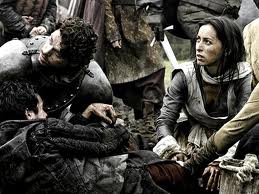
Robb takes a liking to the Volantene Florence Nightingale named Talisa.
We met the Tickler and Roose Bolton whose sigil is the Flayed Man. We met Xaro Xhoan Daxos, one of the 13 of Qarth, (the actor played Tank as in think tank in RocknRolla.). We got a look at Qarth and Harrenhal, which didn't move in the opening credits.
Game of Thrones Week 4: True greatness means letting others do your dirty work by Charlie Jane Anders
At the top of the hour, Lord Roose Bolton cautions Robb Stark that he can't march his army down the high road. And the episode ends with a similar homily: King Stannis tells his most faithful servant, Ser Davos Seaworth the Onion Knight, that "cleaner ways don't win wars."Tyrion to Meryn Trant: "I'm not threatening the King. I'm educating my nephew. Bronn, the next time Ser Meryn speaks, kill him. (pregnant pause) That was a threat. See the difference?"
Bronn to Tyrion: "There's no cure for being a cunt."
Tyrion to himself: "Lady Stark, you may survive us yet."
Peter Jackson poached season one's Mountain for the Hobbit.
"Garden of Bones" Onion recap (for experts)
(plus good comments)
"Garden of Bones" Onion recap (for newbies)
(more good comments)
Saturday, April 21, 2012

This past episode (21) of New Girl titled "Kids" had Zooey Deschanel mentioning Bridge to Terabithia* and for some reason she reminded me of the lovely actress Debra Winger with her kind blue eyes, raspy voice, and mischievious smile. (Maybe Winger could play her mother. Or Deschanel could make a remake of Legal Eagles.)
I recently saw 21 Jump Street which was created in part by DeLong's cousin Phil Lord. Jake Johnson from New Girl was in it, as was Nick Offerman. It was pretty funny. Offerman also had a bit part in the very funny Will Ferrell movie Casa di mi Padre.
For some reason Blogger force me to redesign the blog. The links on the right are messed-up and will be fixed.
----------------
* Deschanel's character Jess said it was movie that made children cry. As an adult I thought it was pretty sad. Deschanel had a supporting role playing a teacher, just as Jess is a teacher.
Remembering Christopher Hitchens by David Remnick
Birthday anniversary discussion on Charlie Rose show with Rose, James Fenton, Salman Rushie, Ian, McEwan, and Martin Amis.
Know Thy Enemy
Really, Mr. Chait, Really? by Greg Mankiw
On July 1st, Mankiw who advises Romney and was CEA Chair for George W. Bush, will be rewarded for his schoozing on behalf of the one percent* and will become chairman of the Harvard econ department.
The upside is that he'll be blogging less. For example just the other day he posted a Dilbert cartoon strip. I've always hated Dilbert with a burning passion. When ever someone likes Dilbert, it's a bad sign.
-------------
* For instance in the famous 2008 Summers econ memo to Obama, Mankiw denied to say that any stimulus was needed. And this is who Harvard choses to head their econ department?
On July 1st, Mankiw who advises Romney and was CEA Chair for George W. Bush, will be rewarded for his schoozing on behalf of the one percent* and will become chairman of the Harvard econ department.
The upside is that he'll be blogging less. For example just the other day he posted a Dilbert cartoon strip. I've always hated Dilbert with a burning passion. When ever someone likes Dilbert, it's a bad sign.
-------------
* For instance in the famous 2008 Summers econ memo to Obama, Mankiw denied to say that any stimulus was needed. And this is who Harvard choses to head their econ department?
Inflationistas*
Is Inflation a Highly Regressive tax on wages? by Dean Baker
Much Ado About Zero (Wonkish) by Krugman
In Wicksellian Terms, It Is Easier for a Central Bank to Alter the Nominal Market Rate of Interest than for It to Alter the Nominal Natural Rate of Interest: Why the Zero Lower Bound Matters by DeLong
As I see it, having high unemployment is a regressive tax on the "middle class." Government policies are structuring the market so that we have slow growth and high unemployment. Wages don't rise with productivity. Inequality rises though.
That last time wages rose with productivity was in the late '90s, something candidate Obama pointed out to BusinessWeek and the Wall Street Journal.
When the economy isn't running at capacity, the government is engineering a regressive tax on wages.
-----------
*Inflationistas want low inflation and slow growth
Is Inflation a Highly Regressive tax on wages? by Dean Baker
Much Ado About Zero (Wonkish) by Krugman
In Wicksellian Terms, It Is Easier for a Central Bank to Alter the Nominal Market Rate of Interest than for It to Alter the Nominal Natural Rate of Interest: Why the Zero Lower Bound Matters by DeLong
As I see it, having high unemployment is a regressive tax on the "middle class." Government policies are structuring the market so that we have slow growth and high unemployment. Wages don't rise with productivity. Inequality rises though.
That last time wages rose with productivity was in the late '90s, something candidate Obama pointed out to BusinessWeek and the Wall Street Journal.
When the economy isn't running at capacity, the government is engineering a regressive tax on wages.
-----------
*Inflationistas want low inflation and slow growth


Thursday, April 19, 2012
Wednesday, April 18, 2012
On Game of Thrones, everyone’s a king, and children are pawns by Charlie Jane Anders (episode 3 recap)
Monday, April 16, 2012

Alas poor Yoren! I knew him well.
(or the dragons are gone....)
"What's Dead May Never Die" Onion recap (for experts)
Good comments.
"What's Dead May Never Die" Onion recap (for newbies)
More good comments.
Sunday, April 15, 2012
Greg Mankiw hides the role of government in redistributing income upwards by Dean Baker
I watched Parks and Recreation but didn't watch the first run of 30 Rock because I had a crush on Tina Fey during her "Weekend Update" and Sarah Palin impersonation years and it's very, very weird and wrong to have a crush on a TV personality. So you shouldn't encourage it. Friedlaner is on 30 Rock and lately I've been watching the reruns which are addictive.
One of the tenets of "Kenyan Socialism" is that the U.S. is a schmoozocracy. The ruling elite would have you believe it's a meritocracy but it's not.
I See No Way to Read This from Greg Mankiw Other than as the Strongest Possible Endorsement of Obama and the Democrats by DeLong
This is no doubt how Mitt Romney and other wealthy people would like the public to see the debate. However the reality is that the government has implemented a wide range of policies that have led to a massive upward redistribution of before tax income over the last three decades. These policies have affected every corner of the market economy.I heard comedian Judah Friedlander talking on the radio about the entertainment industry and he made a very good point about those who succeed are usually good schmoozers. The context was he said that it's part of the reason why comedy films are bad these days in that people who rise to the top are often good schmoozers but not good film-makers, actors etc. He then said it's true in every industry and line of work and I agree. They are smart about schmoozing and work hard at schmoozing and then once installed have sort of an inefficent crony capitalism.
I watched Parks and Recreation but didn't watch the first run of 30 Rock because I had a crush on Tina Fey during her "Weekend Update" and Sarah Palin impersonation years and it's very, very weird and wrong to have a crush on a TV personality. So you shouldn't encourage it. Friedlaner is on 30 Rock and lately I've been watching the reruns which are addictive.
One of the tenets of "Kenyan Socialism" is that the U.S. is a schmoozocracy. The ruling elite would have you believe it's a meritocracy but it's not.
I See No Way to Read This from Greg Mankiw Other than as the Strongest Possible Endorsement of Obama and the Democrats by DeLong
Saturday, April 14, 2012

Charlie Rose had a show on the anniversary of Hitchens's birthday yesterday which included Salman Rushdie, James Fenton, Ian McEwan and Martin Amis.
They captured how generous and democratic he was socially with impeccable manners and had one of the best senses of humor around. He was also very tough and "honorable." Rushdie who is very funny, describes himself crying he was laughing so hard with Hitchens one night and McEwan said he'd get stomach cramps from all the laughter. Amis had some great anecdotes also. And Fenton was right to describe him as the spirit of '68.
Rushdie's memoir will drop Sept. 17. It's called Joseph Anton after the name he took when in hiding from Iran's supreme leader's fatwa. He derived it from the first names of two of his favorite authors, Conrad and Chekov.
HBO picked up Game of Thrones for a third season.
Friday, April 13, 2012
Tuesday, April 10, 2012


The Night Lands
(or a Song of Ice and Fire
or on HBO Sunday night is Onion knight)
Religion, theology and the supernatural figured prominently in the second show of the second sesason of Game of Thones. Rakharo could or could not enter the Dothraki afterlife. The Greyjoys uttered their religious callout-saying*: "What's Dead May Never Die" to their Drowned God. The small council pondered how do you kill a dead man. With fire apparently, replied Tyrion. He said he believes Mormont whom he met on his trip to the Wall, while Maester Pycelle said the notherners have always been superstitious. Davos Seaworth told his "True Believer" son Matthos that prayer doesn't work, but no reflection on how Melisandre the Red Priestess survived drinking the poison last episode? Melisandre tells Stannis he must give all of him to the Lord of Light in exchange for victory while Jon Snow stumbled upon the arrangement Craster has with The Others.
One thing mind-blowing about the first season what how the premiere episode had The Others arranging wildling body parts in a gnostic circle for the luckless Nightswatch ranger to find.** And then the season finale had a shot of Khal Drogo's funeral pyre which formed a gnostic circle also. And the dragon eggs hatched.
-----------------------------------
*I can't find what this is called and it's making me feel stupid (although maybe there isn't a specific word for it). It's a religious phrase automatically said in response to some other religious word or phrase, usually in unison by everyone present. I now it's done in Islam and Catholicism. In this episode, the Greyjoys are saying in response to the naming of a deceased relative.
**And then The Others quickly took the wildling body parts back (to eat?).
Monday, April 09, 2012

The Cash Nexus (or - almost - everyone has a price)
The Sellsword Bronn tells Tryion he'd kill babies for a price. Tyrion had told Slynt he had no honor something Bronn admits to. I think back to Ned telling Varys that his life wasn't so precious to him that he would dishonor it. And for Littlefinger, it's accumulate, accumulate, accumulate.
Game of Thrones Week 2: Who Watches the Watchers? by Charlie Jane Anders
"The Night Lands" (for experts) Onion recap
Many comments.
"The Night Lands" (for newbies) Onion recap
Good comments too!
The Sellsword Bronn tells Tryion he'd kill babies for a price. Tyrion had told Slynt he had no honor something Bronn admits to. I think back to Ned telling Varys that his life wasn't so precious to him that he would dishonor it. And for Littlefinger, it's accumulate, accumulate, accumulate.
Game of Thrones Week 2: Who Watches the Watchers? by Charlie Jane Anders
"The Night Lands" (for experts) Onion recap
Many comments.
"The Night Lands" (for newbies) Onion recap
Good comments too!
Sunday, April 08, 2012
Saturday, April 07, 2012
David Simon is tired of your love for The Wire
In a typically contentious New York Times interview, the guy who would probably appreciate it if we didn’t refer to him as “Wire creator” waxed crotchety over his exhaustion with all the too-late love for the show, which could have used that sort of attention when it was still on the air. Because, like the scrappy punk band that only sold a handful of records in its heyday, but now everyone is so into it, you just weren’t there, man:
Thursday, April 05, 2012
The Red Priestess
The night is dark and full of terrors,Camila Vallejo, the World’s Most Glamorous Revolutionary
but the fire burns them all away

"Embarrass the Future"? by Linda Greenhouse
The chief justice’s concurring opinion in the strip search case, only three paragraphs long, is interesting for a reason beyond what it might suggest about intramural stress. Here is the final paragraph:
“The court makes a persuasive case for the general applicability of the rule it announces. The court is nonetheless wise to leave open the possibility of exceptions, to ensure that we not ‘embarrass the future.’ ”
“Embarrass the future”? The quote, from a 1944 opinion by Justice Felix Frankfurter in a tax case, is usually offered to mean that the court shouldn’t encumber itself by declaring solutions to problems that have yet to emerge. Maybe that’s all the chief justice meant. But John Roberts is both a careful prose stylist and a man acutely conscious of his and the court’s place in history. There are so many other ways of expressing a minimalist impulse than this unconventional use of the word “embarrass” that I have to wonder whether he didn’t have in mind the prospect of institutional embarrassment, and not only in the case at hand.
Feldstein v. Lazear on the Size of the Output Gap by EconoSpeak (ProGrowthLiberal)
Lazear wants us to believe that the economy could have continued to grow by 3.4% per year since 2007QIV even though average growth was less than 2.5% for the 2001 to 2007 period. If that claim had any credence then potential real GDP would have been almost $15.3 trillion as of 2011QIV as opposed to actual real GDP being only $13.4 trillion. In other words, Lazear wants us to believe that the current GDP gap is 12%. Not that anyone should believe such nonsense but isn’t it interesting that Dr. Feldstein is worried that we may be overestimating the GDP gap.(via Thoma)
Republicans are simultaneously pushing two themes. One theme is that current Federal Reserve policy is endangering an inflationary spiral, which seems to be the concern of Dr. Feldstein. The other theme is that the Obama Administration is somehow making the recession worse, which Dr. Lazear was so happy to echo. Funny thing – these two themes appear to be contradictory.
Monday, April 02, 2012
Cold Winds Are Rising.
Briefly, three things struck me about last night's Game of Thrones season 2 opener. I liked how they used the red comet in the sky to shift scenes from Bran at Winterfell to Daenerys in the Red Wastes of Esteros to Jon Snow north of the Wall to Stannis Baratheon on Dragonstone. There was also the symmetry of the new kings standing up to their respective strong-willed mothers: Robb to Catelyn and Joffrey to Cersei. (Turns out they should heed their mothers' advice.)
Also during the small council meeting, Maester Pycelle displayed the white raven from the Citadel in Oldtown which means the maesters had determined the long summer was over and Winter is Coming. Littlefinger noted they had enough wheat for 5 years but if the winter lasted longer, well they'd have fewer peasants, of course.
For some reason this reminded me of macroeconomic policy discussion. In the United States, the Business Cycle Dating Committee of the National Bureau of Economic Research (NBER) is generally seen as the authority for dating US recessions just as the conclave of maesters date the seasons in Westeros. And it reminded me of the way elite policymakers take an "objective" view of the fates of the "small people." Fewer peasants if they didn't store enough wheat? No biggie. Transforming cyclical unemployment into long-term unemployment and degrading the nation's productive capacity with a prolonged output gap? Oh well, won't really effect our social circle, just the common people, who as Jorah Mormont said "don't care about the games the high lords play" and only "pray for rain, health and a summer that never ends."
Charlie Jane Anders recap of season 2 episode 1 "The North Remembers"
The North Remembers (for newbies) - the Onion recap
What I find myself drawn to in the books and show are the characters who have a sense of honor and goodness.** Tyrion, Ser Jorah Mormont, Ser Barristan Selmy, Davos Seaworth and Brienne Tarth. I find it compelling even if some of them might in some people's minds have too much honor (like Ned Stark and Stannis). It makes a nice contrast in a world of such cruelty. As Robert Baratheon tells Cersei, "that's all the realm is now: backstabbing and scheming and ass-licking and money-grubbing." And then with Joffrey the people get another evil, capricious dictator not unlike the "Mad King" Aerys Targaryen who the Houses Stark, Baratheon, and Arryn rebelled against (with the Lannisters coming in at the very end).
___________________
* The Hunger Games soundtrack is doing well with two bands Krugman has promoted at his blog: The Civil Wars and Arcade Fire (although Arcade Fire were already huge.) There's also Neko Case who I love and Taylor Swift who I like but feel somehow I shouldn't like. She's too pop? Too young?
** I'm also drawn to the characters who are sort of cheeky, brave, fearless-in-a-way and smart-asses like Tyrion (who isn't afraid of his sister and talks back to his father) and Oberyn Martell who fights the Mountain - Jaime to an extent but for him its almost to a fault - and Renly Baratheon in the book. In the show to me he's painted as being more resentful of his brother Robert. In the book he comes off as more devil-may care (which turns out badly for him) although I like the actor who plays him in the show.
Briefly, three things struck me about last night's Game of Thrones season 2 opener. I liked how they used the red comet in the sky to shift scenes from Bran at Winterfell to Daenerys in the Red Wastes of Esteros to Jon Snow north of the Wall to Stannis Baratheon on Dragonstone. There was also the symmetry of the new kings standing up to their respective strong-willed mothers: Robb to Catelyn and Joffrey to Cersei. (Turns out they should heed their mothers' advice.)
Also during the small council meeting, Maester Pycelle displayed the white raven from the Citadel in Oldtown which means the maesters had determined the long summer was over and Winter is Coming. Littlefinger noted they had enough wheat for 5 years but if the winter lasted longer, well they'd have fewer peasants, of course.
For some reason this reminded me of macroeconomic policy discussion. In the United States, the Business Cycle Dating Committee of the National Bureau of Economic Research (NBER) is generally seen as the authority for dating US recessions just as the conclave of maesters date the seasons in Westeros. And it reminded me of the way elite policymakers take an "objective" view of the fates of the "small people." Fewer peasants if they didn't store enough wheat? No biggie. Transforming cyclical unemployment into long-term unemployment and degrading the nation's productive capacity with a prolonged output gap? Oh well, won't really effect our social circle, just the common people, who as Jorah Mormont said "don't care about the games the high lords play" and only "pray for rain, health and a summer that never ends."
Charlie Jane Anders recap of season 2 episode 1 "The North Remembers"
(A couple of side notes: first, when Cersei makes a fuss over Littlefinger's mockingbird pin, was I the only one who went, "OMG, Littlefinger's in league with Katniss"? And second, the only pornotastic moment in the episode, in Littlefinger's brothel, involves newbie sex workers getting schooled in the art of fakery, underscoring that for Littlefinger, both knowledge and falsehood are power.)*George R.R. Martin’s A Song Of Ice And Fire by Genevieve Koski and Tasha Robinson
The North Remembers (for experts) - the Onion recap
(good comment section. Spoilers by the barrel-full.)
The North Remembers (for newbies) - the Onion recap
What I find myself drawn to in the books and show are the characters who have a sense of honor and goodness.** Tyrion, Ser Jorah Mormont, Ser Barristan Selmy, Davos Seaworth and Brienne Tarth. I find it compelling even if some of them might in some people's minds have too much honor (like Ned Stark and Stannis). It makes a nice contrast in a world of such cruelty. As Robert Baratheon tells Cersei, "that's all the realm is now: backstabbing and scheming and ass-licking and money-grubbing." And then with Joffrey the people get another evil, capricious dictator not unlike the "Mad King" Aerys Targaryen who the Houses Stark, Baratheon, and Arryn rebelled against (with the Lannisters coming in at the very end).
___________________
* The Hunger Games soundtrack is doing well with two bands Krugman has promoted at his blog: The Civil Wars and Arcade Fire (although Arcade Fire were already huge.) There's also Neko Case who I love and Taylor Swift who I like but feel somehow I shouldn't like. She's too pop? Too young?
** I'm also drawn to the characters who are sort of cheeky, brave, fearless-in-a-way and smart-asses like Tyrion (who isn't afraid of his sister and talks back to his father) and Oberyn Martell who fights the Mountain - Jaime to an extent but for him its almost to a fault - and Renly Baratheon in the book. In the show to me he's painted as being more resentful of his brother Robert. In the book he comes off as more devil-may care (which turns out badly for him) although I like the actor who plays him in the show.
Wednesday, March 28, 2012

Three things struck me. One is how they emphasize the feminist nature of the strong female characters, maybe because fantasy fans are typically male. Secondly, how one of the creators said he wanted it to be like past HBO shows the Sopranos and Deadwood with many characters (but no mention of the Wire.) And thirdly, one of the creators mentioned how the show entered into discussion of contemporary politics. My guess is he was referring to the way Obama was played by Republicans over, say, the debt ceiling and how Ned Stark was played by Cersei and Littlefinger. Lefty/liberal critics of Obama say he was naive to believe his opponents would negotiate in good faith. Maybe so but part of the reason Obama was elected was his appeal to patriotic, post-partisanship (neither red states nor blue states but one America, etc.) Just as Ned Stark was loved and respected as a leader, friend, husband, brother and father for his appeal to a code of honor and loyalty.
Tuesday, March 27, 2012
Alan Beattie, Archon of the Shrill: Selections from His "Who’s in Charge Here?" by DeLong
Book extract: Who’s in Charge Here?: The problem is not the international monetary or economic system as such. It is that economic policy was run badly within that system…. Financial regulators and central banks were far too nonchalant about the huge amount of borrowing that was going on, and the ever more exotic financial assets that were being created to facilitate it. Governments in economies such as the UK and USA watched huge housing booms take off, financed by those incomprehensible financial instruments, and cheered them on their way…. But there was nothing inevitable about making these mistakes. Nothing in the global economic system forced the USA to run a hopelessly dispersed regulatory system that allowed financial institutions to escape proper scrutiny…. No one compelled a gang of countries in Continental Europe to yoke their disparate economies together in a badly designed currency union that encouraged asset bubbles in the periphery fueled by reckless lending by banks in the centre.
Some argue that the crisis was inevitable because the big emerging markets, particularly China, by persisting in intervening in the foreign exchange markets to hold down their own currencies, were in effect shovelling huge amounts of money at the rich world…. But the mistakes of countries on the receiving end were avoidable without changing the system – indeed, some countries have largely avoided them. Countries where governments exercised proper control over their banks, such as Canada and Australia, have been much more stable. Not a single major Canadian financial institution failed during the crisis….
The current predicament of the world economy is all the more poignant because it is unnecessary. This is a political and ideological crisis, not a technocratic one. Authorities could have done, and could still do, a lot to prevent their economies sliding back into recession and financial chaos. That they are not doing so is not just because of a lack of political will. It is also because significant numbers of voters and politicians have learnt precisely the wrong lessons from previous episodes and are determined to make similar mistakes all over again.
Monday, March 26, 2012

Ben Bernanke's Eeyore Strategy by Yglesias
Charles Evans and friends on the Odyssean strategy
Circumstances will tempt the FOMC to renege on these promises precisely because the policy rule describes its preferred behavior. Hence this kind of forward guidance resembles Odysseus commanding his sailors to tie him to the ship's mast so that he can enjoy the Sirens' music.And a little meta-humor in the first footnote! Very David Foster Wallacian.
Bloggers in St. Louis by Mark Thoma
Krugman Nails It! Problem Is Crony Capitalism, Not Free Market Fundamentalism by Dean Baker
Krugman Nails It! Problem Is Crony Capitalism, Not Free Market Fundamentalism by Dean Baker
Bernanke gave a talk to the National Association for Business Economists.
In addition to the heavy toll on workers and families, he noted that “Because of its negative effects on workers’ skills and attachment to the labor force, long-term unemployment may ultimately reduce the productive capacity of our economy.”
...Mr. Bernanke said Monday that structural unemployment may have increased in recent years, but that high unemployment was mostly cyclical.
“The continued weakness in aggregate demand is likely the predominant factor,” he said. “Consequently, the Federal Reserve’s accommodative monetary policies, by providing support for demand and for the recovery, should help, over time, to reduce long-term unemployment as well.”
Mr. Bernanke outlined several reasons for this conclusion. He said that people who lost work recently had not increased their advantage in finding new jobs over the long-term unemployed, as might be expected if the latter group were languishing because they lacked relevant skills. And he noted that hiring generally remained weak across the economy, again suggesting that the lack of new hiring had broad causes rather than industry-specific roots.
Sunday, March 25, 2012
Lessons from the Great Canadian Slump by Krugman
A prolonged Output Gap does not necessarily entail deflation or falling inflation/disinflation.
A Bailout by Another Name by Gretchen Morgenson
Morgenson discusses Peter DeMarco and principle writedowns and differs from people I usually agree with. She feels to take up a number of issues like aren't taxpayers served by an economy growing at potential with no output gap? It is giving money to banks but it is also helping people deleverage by getting out from under underwater mortgages. Perhaps there would be some way for the banks to help pay, but I doubt the Republicans who control the House would go for it.
The Age of the Shadow Bank Run by Tyler Cowen
Cowen notes the success of the post-World Years II with FDIC preventing bank runs but suggest doing something similar today would create morale hazard. Basically he's anti-regulation. Weird aporia of a liberatarian.
A prolonged Output Gap does not necessarily entail deflation or falling inflation/disinflation.
A Bailout by Another Name by Gretchen Morgenson
Morgenson discusses Peter DeMarco and principle writedowns and differs from people I usually agree with. She feels to take up a number of issues like aren't taxpayers served by an economy growing at potential with no output gap? It is giving money to banks but it is also helping people deleverage by getting out from under underwater mortgages. Perhaps there would be some way for the banks to help pay, but I doubt the Republicans who control the House would go for it.
The Age of the Shadow Bank Run by Tyler Cowen
Cowen notes the success of the post-World Years II with FDIC preventing bank runs but suggest doing something similar today would create morale hazard. Basically he's anti-regulation. Weird aporia of a liberatarian.
Saturday, March 24, 2012
Friday, March 23, 2012
Confessed 4 Life
Bridget Regan replies to Seeker costar Craig Horner: "Sad I can't be there with you!"
Horner: "Seeker Fans, I will be visiting WonderCon in Anaheim California March 17th and 18th from 12pm till 3:30pm..."
Bridget Regan replies to Seeker costar Craig Horner: "Sad I can't be there with you!"
Horner: "Seeker Fans, I will be visiting WonderCon in Anaheim California March 17th and 18th from 12pm till 3:30pm..."
Bernanke Denies Fed Rate Policy Caused Housing Bubble
Most evidence suggests the Federal Reserve‘s policy of low interest rates in the early 2000s didn’t cause the recent housing bubble, Chairman Ben Bernanke said Thursday in slides prepared for a college lecture.
While some have argued the Fed’s low interest rates in the early 2000s contributed to the U.S. housing collapse, international examples and the timing of the bubble show otherwise, Bernanke said Thursday in slides for the second of his four lectures at George Washington University this month.
For example, house prices rose sharply in the United Kingdom in the same time period, even though the U.K. had tighter monetary policy than the U.S., Bernanke wrote. He also noted housing prices began to pick up in the late 1990s before the Fed began cutting interest rates and rose sharply after the central bank began tightening.
Thursday, March 22, 2012
Tuesday, March 20, 2012
Monday, March 19, 2012
Why Democrats Have a Problem With Young Voters by Rich Perlstein
My politics of optimism and hope still casts its lot with the Democrats — in the optimistic hope that the dying embers of its status as the party of our better angels, one that took risks for social justice, can still be fanned into a flame. But I'm an old man, born in 1969. I can't really blame someone born in 1991 for not buying the idea that the Democrats were once a party that often took political risks for social justice and can be again. Why should they believe me? They've never seen it in their lifetimes.
What's This "We" Jazz, White Man? Robert Samuelson Edition by Dean Baker
Robert Samuelson endorses the fatalistic, old-timey Mellon view of busts that the rottenness of economy needs to be purged.
Samuelson links to this review of 21 books on the crisis and this review of 16 scholarly papers (by Gary Gorton).
Bernanke endorsed Gorton's work on the rise of the shadow banking system.
"Four years after the onset of the financial crisis — in March 2008 Bear Stearns was rescued from failure — we still lack a clear understanding of the underlying causes."
Wow, it sure doesn't seem very hard to me. The Reagan-Volcker policies of the early 80s broke the link between productivity growth and wage growth for ordinary workers. This meant that demand growth did not necessarily keep pace with output potential as had been true earlier in the post-war period, since higher wages would quickly translate into higher consumption.
That created an environment which opened a door to speculative bubbles. In the 90s it was the stock bubble which drove growth, primarily by pushing saving rates to then record lows. In the last decade it was the housing bubble which drove growth, both by creating a building boom and also by pushing saving rates even lower as bubble generated home equity led to a consumption boom.
None of this story is new. I was writing about how the stock bubble was driving the economy in the 90s and how the housing bubble was driving the economy as early as 2002. And, I gave the historical picture in Plunder and Blunder: The Rise and Fall of the Bubble Economy.
But, folks like Robert Samuelson would rather pretend that the whole story is a great mystery rather than contemplate the possibility that the economic instability of the last decade had its roots in a pattern of growth that was built on redistributing income from ordinary workers to the most highly paid workers and corporate profits.Kenyan Socialism endorses this narrative with some additions.
Robert Samuelson endorses the fatalistic, old-timey Mellon view of busts that the rottenness of economy needs to be purged.
Samuelson links to this review of 21 books on the crisis and this review of 16 scholarly papers (by Gary Gorton).
Bernanke endorsed Gorton's work on the rise of the shadow banking system.
Saturday, March 17, 2012
Why Conservatives Are Still Crazy After All These Years by Rick Perlstein
On Goldman Executive Greg Smith's Brave Departure by Matt Taibbi
On Goldman Executive Greg Smith's Brave Departure by Matt Taibbi
Friday, March 16, 2012
Thursday, March 15, 2012
When Populism is Sound by Simon Johnson
(via Dean Baker)
Yes the elite's lap dogs in the media try to define it as being somehow demagogic and when politicians appeal to the least common denominator.
(via Dean Baker)
Yes the elite's lap dogs in the media try to define it as being somehow demagogic and when politicians appeal to the least common denominator.
Wednesday, March 14, 2012
Muddled Economic Picture Muddles The Political One, Too by David Leonhardt
Face-ripping for fun & profit by Doug Henwood
Greg Smith's open letter to Goldman Sachs
Capitalism, 2012 by Tom Friedman
Face-ripping for fun & profit by Doug Henwood
Greg Smith's open letter to Goldman Sachs
It makes me ill how callously people talk about ripping their clients off. Over the last 12 months I have seen five different managing directors refer to their own clients as “muppets,” sometimes over internal e-mail. Even after the S.E.C., Fabulous Fab, Abacus, God’s work, Carl Levin, Vampire Squids? No humility? I mean, come on. Integrity? It is eroding. I don’t know of any illegal behavior, but will people push the envelope and pitch lucrative and complicated products to clients even if they are not the simplest investments or the ones most directly aligned with the client’s goals? Absolutely. Every day, in fact.(links in original)I like that he links to Matt Taibbi's Vampire Squid Rolling Stone article.
Capitalism, 2012 by Tom Friedman
We also need a grand bargain between employers, employees and government — à la Germany — where government provides the incentives for employers to hire, train and retrain labor.
Friedman makes no mention of the housing bubble fiasco. My guess is that Capitalism 2012 will bring us repeat this time without bailouts unless the Republican party truly does fall apart.We can’t have any of these bargains, though, without a more informed public debate. The “big thing that’s missing” in U.S. politics today, Bill Gates said to me in a recent interview, “is this technocratic understanding of the facts and where things are working and where they’re not working,” so the debate can be driven by data, not ideology.
Tuesday, March 13, 2012
Monday, March 12, 2012

The New Republic’s New Boss by Lizzie Widdicombe
Hughes appears to be a certified liberal, much to the relief of most of the magazine’s staff, alumni, and readers. Though he has been involved in some forms of activism—he ran the social media operation for the 2008 Obama campaign, and his significant other, Sean Eldridge, is the former political director of the same-sex marriage advocacy group Freedom To Marry—his comments on the direction of the magazine have been non-ideological, heavier on tech-world jargon than political talking points. On the phone from the airport, he spoke of “meeting thoughtful, intelligent people in the media space,” “integrating platforms,” and “mission-driven startups.” His reading includes both the Huffington Post and The Economist. “I wouldn’t say I’m a political junkie in the way that some people are,” he said. “I try to read about political issues of the day, but also cultural criticism, good books, and good music.” His past year’s reading included biographies of Katharine Graham and Henry Luce.
Saturday, March 10, 2012
Recovery Winter?
Why Job Growth Is Likely to Slow by David Leonhardt
Why do economists expect growth to slow? The warm winter has probably pulled some spending forward into the last few months and will reduce spending in coming months, says Joshua Shapiro, an economist at MFR Inc. in New York. Rising oil prices also play a role. So does the continuing debt overhang, which makes a sustained recovery difficult.
None of these forecasts should be taken as gospel, of course. Maybe the gross domestic product numbers are wrong and will be revised upward in coming months, as government economists receive more data about the economy’s condition. Maybe the recent job gains will lead to a surge in confidence that lifts spending above expected levels.
But the most likely path includes a slowdown in job growth. It’s easy to forget that on a day with a jobs report as positive as this one.
My colleagues Binyamin Appelbaum and Annie Lowrey have each written recent articles with more details on the predicted slowdown.And:
On Friday, Macroeconomic Advisers, one of the most closely watched forecasting firms, reduced its estimate of economic growth in the current quarter to an annual rate of 1.8 percent, from 2 percent. And 1.8 percent growth does not generally lead to very strong job growth. In the fourth quarter of last year, by comparison, the economy grew 3 percent.
...
Sure enough, most forecasters do expect job growth to slow. Barclays Capital expects 200,000 jobs a month for the rest of the year. IHS Global Insight forecasts a slowdown to 180,000 jobs a month. Macroeconomic Advisers says it will slow to 140,000 jobs a month in the final three quarters of this year.
“We don’t get anything like the booming labor market with 300,000 jobs,” said Laurence H. Meyer, senior managing director of Macroeconomic Advisers and former Federal Reserve governor. “It would take much stronger growth than we have to do that.”
Calculated Risk is more upbeat:As a benchmark, the economy needs to create roughly 125,000 jobs a month to keep up with population growth.
There are reasons to expect better job growth overall this year compared to 2011. Last year was negatively impacted by the tsunami, bad weather, high oil prices and the debt ceiling debate. We can't predict the weather, and oil prices are high again - but hopefully there will be no natural disasters this year, and also no threats of defaulting on the debt.
Plus residential investment (new home sales and housing starts) has made the bottom turn, and even with a sluggish housing recovery, residential investment will add to economicgrowth in 2012. Also, the employment losses from state and local governments will probably end mid-year. As the BLS noted:
Government employment was essentially unchanged in January and February. In 2011, government lost an average of 22,000 jobs per month.
EmploymentThe February job market: not bad by recent standards by Doug Henwood
Another positive report was the ISM services survey that indicated faster expansion in February. Negatives included a larger trade deficit, an increase in initial weekly unemployment claims, and - of course - falling house prices in January.
DeLong has spoken highly of Macroeconomic Advisors, but Calculated Risk's outlook is persuasive. Although those betting on the downside have usually been right these past few years.
Consensus, Dissensus and Economic Ideas: The Rise and Fallof Keynesianism During the Economic Crisis by Henry Farrell and John Quiggin
Crooked Timber post
(via Thoma)
Crooked Timber post
(via Thoma)
Friday, March 09, 2012
Keynan Socialism is Progressive.
Simon Johnson on the Cato putsch:
Simon Johnson on the Cato putsch:
"In historical terms, Professors Acemoglu and Robinson see the progressive era at the beginning of the 20th century, including the development of countervailing power for the government against powerful private business interests, as an essential part of what has gone right in the United States of America."(via Thoma)
Thursday, March 08, 2012
Wednesday, March 07, 2012
Tuesday, March 06, 2012
Do you "believe" in rational expectation (important) by Scott Sumner
Is he saying that if the Fed had lowered rates by .50 or more in December 2007 things might not have been so bad?
As Sumner points out, the January 2001 and September 2007 Fed cuts caused short term rates to decline and long term rates to rise as well as a stock market rally. In December 2007, the Fed cut rates by .25:
Is he saying that if the Fed had lowered rates by .50 or more in December 2007 things might not have been so bad?
As Sumner points out, the January 2001 and September 2007 Fed cuts caused short term rates to decline and long term rates to rise as well as a stock market rally. In December 2007, the Fed cut rates by .25:
The fed funds futures showed a 58% chance of a 1/4 point cut and a 42% chance of a 1/2 point cut. The more than two percent fall in US equity indices after the 1/4 cut was announced implied a 5% swing in US equity prices hinged on the Fed decision. And foreign markets seemed to respond almost equally strongly–implying that the Fed’s decision destroyed well over a trillion dollars in shareholder equity worldwide.They kept cutting after but it didn't help as Bear Stearns was bailed out in March 2008. Maybe the system was such a house of cards that it didn't matter how much the Fed cut. Maybe if they cut more and bailed out Lehman and everyone else, there wouldn't have been a panic? But we wouldn't have had Dodd-Frank.
What about the jobs report this coming Friday?
DeLong reports:
Ryan Avent believes Fed will stand pat.
Dean Baker pointed to an ignored, disappointing durable goods order report.
DeLong reports:
Morgan Stanley Still Expects QE3 This Year: Morgan Stanley continues to think the Federal Reserve will provide more stimulus via bond buying this year, even as improving economic data have led many in the market to think the sun may be setting on that particular strategy. “For some time, our call has been that the Federal Reserve will undertake additional balance-sheet action in the first half of 2012,” writes Vincent Reinhart, an economist with the bank and a former top-level Fed staffer. He argues it’s most likely the Fed will act to expand its balance sheet via Treasury and mortgage bond buying — in market parlance, QE3 — at either the April or June Federal Open Market Committee, and that the ultimate size of the program could tack on $500 billion to $700 billion onto what is currently a $2.9 trillion balance sheet…. Officials won’t wish to be seen starting a high-profile action in the thick of the presidential campaign. Also, he reckons growth will still be too weak, and inflation will be falling short of the Fed’s 2% target.
The recent improvement in economic news, especially on the jobs front, will increasingly be seen as a head fake, the Morgan Stanley economist said. “We share the view that the fillip to economic growth associated with a restocking of inventories is fading and that real GDP growth will slow notably in the current quarter,” Reinhart said. “Anxiety-inducing headlines that the economy is losing steam will be conducive to Fed action.”China is weakening with a real estate market that has turned. DeLong reported slow growth in first quarter (where did he get that?)
Ryan Avent believes Fed will stand pat.
Dean Baker pointed to an ignored, disappointing durable goods order report.
Monday, March 05, 2012
States of Depression by Krugman
Economics in the Crisis by Krugman
Economics in the Crisis by Krugman
Worse yet, the consequences were not limited to the acolytes of freshwater economics. Quite a few economists responded to the bitter warfare between schools of thought by running away from business cycle issues in general. I know whereof I speak: when Robin Wells and I began writing our principles of economics textbook, the general view was that you should focus on long-run growth, and relegate things like recessions and recoveries to a brief section at the end. Why? Because focusing on the long run was safer, less likely to get the committees that choose textbooks riled up.
Sunday, March 04, 2012
Onion's A.V. Club's Charcters we most love to hate:
And Onion vet Tasha Robinson mentions Cersei.
Season Two photos with new characters: Davos Seaworth, Melisandre, Stannis Baratheon, Balon Greyjoy, and Brienne.
Genevieve Koski
Joffrey Baratheon from the A Song Of Ice And Fire books and Game Of Thrones television series is the worst kind of twerp: a twerp with power. Entitled, insecure, venal, and violent, he can always be counted on—with prodding from his equally contemptible mother—to make decisions that benefit few besides himself and his immediate family, a quality that makes for a piss-poor king, but a grade-A villain. (Just ask the Starks.) Jack Gleeson’s portrayal of the young king in the TV series is perfectly sniveling, aided in no small part by Gleeson’s naturally haughty-looking, oh-so-slappable face. For anyone who’d like to watch Joffrey getting slapped for 10 minutes straight:
And Onion vet Tasha Robinson mentions Cersei.
Season Two photos with new characters: Davos Seaworth, Melisandre, Stannis Baratheon, Balon Greyjoy, and Brienne.
Counter Cyclical Tradition versus the Treasury View
Economic Models and Economic Predictions by Krugman
Economic Models and Economic Predictions by Krugman
Full Employment: A Force Against Rising Inequality and Stagnant Incomes by Jared Bernstein
Full employment (i.e. tight labor markets) is one of the main policy goals of Kenyan Socialism.
Full employment (i.e. tight labor markets) is one of the main policy goals of Kenyan Socialism.
Subscribe to:
Posts (Atom)