Tuesday, July 15, 2014

Trade

Coppola agrees on the problem with Baker.

"The US trade deficit is pretty intractable largely because the two major surplus countries - China and Germany - do not have currencies that float with respect to the USD. Germany uses the Euro, which does float, but the Euro is persistently undervalued relative to fundamentals in Germany because of the presence of weaker countries in the union. If the currency cannot adjust, then neither the trade deficit nor the capital surplus can correct unless unit labour costs fall, which means very significant falls in wages and employment costs. This is what is happening in the Eurozone periphery: it has not happened in the US thus far because of the US's willingness to borrow and the world's willingness to lend to it. 

However, there is a cost. As Philip Booth points out, China will not be able to suppress inflation forever if its currency is under-valued. Germany, too, faces high inflation relative to others in the Eurozone if its economy is  out of equilibrium: the ECB's tight money policies keep German inflation below 2%, but this forces weaker countries into outright deflation. "

Makes sense as ruling class policy: keep the labor market loose and increase the capital share and incentivize Germany to ally with us against Russia and to pay off China.

And yet she sees Baker's solution as unlikely: "This is why devaluing the dollar would not necessarily reduce the US's trade deficit, as Dean Baker thinks: China would simply adjust the yuan to maintain its desired exchange value, and Germany would tighten fiscal policy to stop a fiscal deficit developing as a consequence of a falling trade surplus in a low-demand economy. The only way to resolve the currency problem is for China to allow the yuan to float and Germany to abandon austerity. Hell might freeze over first. "

Inflation should be building in Germany and China.

Monday, July 14, 2014

positive outlook

Here’s why Larry Summers is wrong about secular stagnation by David Beckworth


Steve Liesman Embarrasses Rick Santelli On CNBC


the Great Clusterfuck and deflation

DEPARTMENT OF "WTF?!" CHRIS HOUSE ON TRADITIONAL MACROECONOMIC MODELS AND THE GREAT RECESSION by DeLong

Unemployment, aggregate demand, and search/matching by Nick Rowe

I don't quite understand it, but Krugman says Keynesians expected more deflation/disinflation from the aggregate demand shocks in the U.S. and Japan. (What about Europe?) What if QE explains it?

Neoclassical and New Keynesian models seem to be poorly with distributional issues. Maybe it was something to do with that.

Nadine Gordimer


Nadine Gordimer, Novelist Who Took on Apartheid, Is Dead at 90


The Constition

The U.S. Constitution was created to form a government that wouldn't devolve into a tyranny along the lines of the monarchies of contemporary Europe.

But the more conservative of the framers were worried about the mob and wanted to put checks on the majority.

As Piketty's K21 and the last 40 years shows we should be more concerned about the opposite problem, the ability and tendency for the power and wealth of the minority to self-replicate, reinforce and grow - metastasize - at the expense of the majority.

Watch John Oliver completely destroy the idea that hard work will make you rich
The facts about economic inequality in America are pretty staggering. The top 1 percent of Americansbrings home close to 20 percent of income. Income inequality is the highest it's been since 1928. And Pew found that by a 60 to 36 percent margin, Americans believe they live in a country with a system that unfairly favors the wealthy. 
So the big question is: Why do Americans allow this to happen?

The answer, in John Oliver's estimation, is the American sense of optimism. He notes that a shockingpercentage of Americans feel the economic system unfairly favors the wealthy, but still believe that they will be wealthy if they put in the hard work. 
"I can clearly see this game is rigged, which makes it so sweet when I win this thing," Oliver says.

Sunday, July 13, 2014

Minsky

Dan Davies comment at the Slack Wire
Well, there is the problem Minsky identified, of chasing yield from prudent standards of risk-taking into ponzi schemes.

This is a really common misunderstanding of Minsky, and it's his (and Charles Kindleberger's for endorsing it) fault for selecting a needlessly and misleadingly pejorative set of names for his financial structures.

A "Ponzi" project in Minsky's terminology isn't a Ponzi scheme, and it has no built in tendency to collapse. It's just a project that, for a meaningful period after its inception, doesn't generate enough cash flow to cover interest payments and so has to increase its debt to keep going. 

So, an example of a "Ponzi" project in Minsky's terminology might be ... going to university. College students don't generate cash flow and increase their debt to cover operating expenses.

And note, of course, that the classification of projects as hedge, speculative or Ponzi depends entirely on the term of the lending. There's no necessary connection between the riskiness of a project and its financing profile. For example, building a toll road between two highly-populated cities would be very likely a Ponzi project, but it is a very low risk loan indeed (similarly, shipping finance has this characteristic). Minsky had a Financial Instability Hypothesis, not a RealInstability Hypothesis, and most of the "risky" projects that he talks about are only really risky because they are exposed to the very liquidity risk that Josh (correctly) notes is reduced in an environment of surplus liquidity. It's a real misreading of Minsky to re-profile him as a theorist of Austrian-style malinvestment.
JW Mason replies
Yes, agree completely. 
One reason Minsky introduced these distinctions was to highlight the effects of changes in financial conditions on existing balance sheet commitments. In particular, since the line between speculative and Ponzi finance depends on a unit's ability to make current interest payments, where the line falls depends on the interest rate. "A speculative financing arrangement can be transformed into a Ponzi finance scheme by a rise in interest ... if earnings are better or costs, especially interest rates, fall, Ponzi financing may be transformed into speculative financing." The idea that low rates encourage risky financial commitments implicitly assumes that interest rates are known in advance, before the commitments are made. But in the real world, the effect of interest rate changes on the riskiness of existing commitments is more important.
This is the big argument of my "Fisher dynamics" papers -- the rise in interest rates under Volcker moved the aggregate balance sheet of the US household sector from speculative to Ponzi, despite a reduction in expenditure relative to income. (Although neither Arjun or I thought of using that language -- I'll have to add it to the next version.) As DD says, if you take Minsky seriously, then a concern with financial fragility favors keeping rates low, even if that does encourage taking on more "real" risk. 
 Six days later Bruce Wilder replies (after doing research?)
Minsky was a supremely articulate man, and I am sure he chose pejorative labels, advisedly.

D^2's example of a project to build a toll road, with its heavy element of construction financing, is a terribly misleading way to present Minsky's concept of Ponzi finance. Minsky's idea is not that some possibly worthwhile investment projects are Ponzi projects, but that the overall standard for fixing leverage ratios, in financing the nominal ownership and control of business assets, can shade over time, from predominately Hedge finance to Speculative finance, as conventions and expectations are shaped by recent experience.

For Minsky, Hedge finance, Speculative Finance, and Ponzi finance were three Ideal Types, corresponding to progressively greater debt to income ratios, that is, greater leverage, and possibly representing successive stages in the dynamic capital development of an economy progressing thru a cycle.

His notion was that one or another could be said to prevail in the economy at any one point in time, as conventional standards of what constitutes shrewd, but prudent judgment in borrowing and lending evolve, with common experience and expectations. When Hedge finance predominates, the economy as a system, in Minsky's view, is likely to be resilient, and apparently self-stabilizing in response to exogenous shocks or policy interventions, like a change in policy interest rates.

Experience with such stability, however, is likely to lead to greater and successful risk-taking by bankers and entrepreneurs, taking the economy toward a state in which speculative finance predominates, there is more debt introduced into the economy and higher leverage, which may take the economy into a sustained boom, and even to a state in which Ponzi finance predominates. 

An economy in which speculative finance predominates may not be as resilient, and an economy in which a standard of Ponzi finance prevails, may be at hazard of crisis and debt-deflation.

The ownership and control of a toll road could be financed to any of the three standards -- hedge, speculative or ponzi. The ultimate point of Minsky's scheme, though, is the dynamics by which such a business could be shifted, along with the economy as a system, along a continuum from one state to the next, from the cautious conservatism of hedge finance, through a heady period in which appreciation feels like growth in revenues, to pondering disinvestment as a way to channel more of the quasi-rents to debt or equity payments.

I think the term, Ponzi finance, was very much chosen to highlight the inevitability of collapse inherent in such a standard of finance.
Hyman Minsky at Wikipedia
Minsky proposed theories linking financial market fragility, in the normal life cycle of an economy, with speculative investment bubbles endogenous to financial markets. Minsky claimed that in prosperous times, when corporate cash flow rises beyond what is needed to pay off debt, a speculative euphoria develops, and soon thereafter debts exceed what borrowers can pay off from their incoming revenues, which in turn produces a financial crisis. As a result of such speculative borrowing bubbles, banks and lenders tighten credit availability, even to companies that can afford loans, and the economy subsequently contracts....
The "hedge borrower" can make debt payments (covering interest and principal) from current cash flows from investments. For the "speculative borrower", the cash flow from investments can service the debt, i.e., cover the interest due, but the borrower must regularly roll over, or re-borrow, the principal. The "Ponzi borrower" (named for Charles Ponzi, see also Ponzi scheme) borrows based on the belief that the appreciation of the value of the asset will be sufficient to refinance the debt but could not make sufficient payments on interest or principal with the cash flow from investments; only the appreciating asset value can keep the Ponzi borrower afloat. 
If the use of Ponzi finance is general enough in the financial system, then the inevitable disillusionment of the Ponzi borrower can cause the system to seize up: when the bubble pops, i.e., when the asset prices stop increasing, the speculative borrower can no longer refinance (roll over) the principal even if able to cover interest payments. As with a line of dominoes, collapse of the speculative borrowers can then bring down even hedge borrowers, who are unable to find loans despite the apparent soundness of the underlying investments.
...
Economist Paul McCulley described how Minsky's hypothesis translates to the subprime mortgage crisis.[11] McCulley illustrated the three types of borrowing categories using an analogy from the mortgage market: a hedge borrower would have a traditional mortgage loan and is paying back both the principal and interest; the speculative borrower would have an interest-only loan, meaning they are paying back only the interest and must refinance later to pay back the principal; and the ponzi borrower would have a negative amortization loan, meaning the payments do not cover the interest amount and the principal is actually increasing. Lenders only provided funds to ponzi borrowers due to a belief that housing values would continue to increase. 
McCulley writes that the progression through Minsky's three borrowing stages was evident as the credit and housing bubbles built through approximately August 2007. Demand for housing was both a cause and effect of the rapidly expanding shadow banking system, which helped fund the shift to more lending of the speculative and ponzi types, through ever-riskier mortgage loans at higher levels of leverage. This helped drive the housing bubble, as the availability of credit encouraged higher home prices. Since the bubble burst, we are seeing the progression in reverse, as businesses de-leverage, lending standards are raised and the share of borrowers in the three stages shifts back towards the hedge borrower. 
McCulley also points out that human nature is inherently pro-cyclical, meaning, in Minsky's words, that "from time to time, capitalist economies exhibit inflations and debt deflations which seem to have the potential to spin out of control. In such processes, the economic system's reactions to a movement of the economy amplify the movement – inflation feeds upon inflation and debt-deflation feeds upon debt deflation." In other words, people aremomentum investors by nature, not value investors. People naturally take actions that expand the high and low points of cycles. One implication for policymakers and regulators is the implementation of counter-cyclical policies, such as contingent capital requirements for banks that increase during boom periods and are reduced during busts.

Stannis the Man


Stannis Baratheon was upset with Davos Seaworth when he learned that Joffrey Baratheon had died at King's Landing. He didn't have the men to take advantage of it and Davos had helped Gendry escape.

Later that day Davos was learning to read with Shireen using a book about pirates. She asked if he had been a pirate and he said no had been a smuggler, there's a distinction. He went on how Braavos didn't care about the distinction either as the Iron Bank didn't when considering those who stole from its barges loaded with loot. This gave Davos an idea. The Iron Bank wouldn't make a distinction between Stannis and Tywin/Tommen as long as they got their money. (The royal family owed the Iron Bank a lot as Tyrion found out when he became Master of Coin.) If Davos could make a better argument to them now that Joffrey is dead, perhaps they would loan them gold. Davos ultimately did by describing how Stannis cut off his fingers even though his smuggling saved Storm's End.

And so Stannis saved the Nightswatch and the North from the Wildling army even though Melisandre will now be eyeing Shireen and Mance's baby (will they drop that storyline?) And even though Roose and Ramsay Bolton rule the North.

Saturday, July 12, 2014

reach for yield

Back on the Grid and Ready to Talk Financial Oversight and Human Nature by Jared Bernstein

Liquidationism in the 21st Century by Krugman

Bill Maher on Real Time on HBO described some conservative lies as Zombie lies, they won't die, like trickle-down economics.

Krugman on the BIS:
Throughout the annual report, balance-sheet problems are treated as if they were equivalent to the kind of real structural problems the bank used to claim were at the root of our troubles. That is, they’re treated as a good reason to accept a protracted period of high unemployment as somehow natural, and to reject artificial stimulus that might alleviate the pain.

From 2011
Once, as Romer pressed for more stimulus spending, Geithner snapped. Stimulus, he told Romer, was “sugar,” and its effect was fleeting. The administration, he urged, needed to focus on long-term economic growth, and the first step was reining in the debt. 
Wrong, Romer snapped back. Stimulus is an “antibiotic” for a sick economy, she told Geithner. “It’s not giving a child a lollipop.”

euthanasia of the rentier

The Rentier Would Prefer Not to Be Euthanized by J.W. Mason
Here’s another one for the “John Bull can stand many things, but he cannot stand two percent” files. As Krugman says, there's an endless series of these arguments that interest rates must rise. The premises are adjusted as needed to reach the conclusion. (Here's another.) But what are the politics behind it? 
I think it may be as simple as this: The rentiers would prefer not to be euthanized. Under capitalism, the elite are those who own (or control) money. Their function is, in a broad sense, to provide liquidity. To the extent that pure money-holders facilitate production, it is because money serves as a coordination mechanism, bridging gaps — over time and especially with unknown or untrusted counterparties — that would otherwise prevent cooperation from taking place. [1] In a world where liquidity is abundant, this coordination function is evidently obsolete and can no longer be a source of authority or material rewards. 
More concretely: It may well be true that markets for, say, mortgage-backed securities are more likely to behave erratically when interest rates are very low. But in a world of low interest rates, what function do those markets serve? Their supposed purpose is to make it easier for people to get home loans. But in a world of very low interest rates, loans are, by definition, easy to get. Again, with abundant liquidity, stocks may get bubbly. But in a world of abundant liquidity, what problem is the existence of stock markets solving? If anyone with a calling to run a business can readily start one with a loan, why support a special group of business owners? Yes, in a world where bearing risk is cheap, specialist risk-bearers are likely to go a bit nuts. But if risk is already cheap, why are we employing all these specialists? 
The problem is, the liquidity specialists don’t want to go away. From finance’s point of view, permanently low interest rates are removing their economic reason for being — which they know eventually is likely to remove their power and privileges too. So we get all these arguments that boil down to: Money must be kept scarce so that the private money-sellers can stay in business. 
It’s a bit like Dr. Benway in Naked Lunch: *
“Now, boys, you won’t see this operation performed very often and there’s a reason for that…. You see it has absolutely no medical value. No one knows what the purpose of it originally was or if it had a purpose at all. Personally I think it was a pure artistic creation from the beginning. 
“Just as a bull fighter with his skill and knowledge extricates himself from danger he has himself invoked, so in this operation the surgeon deliberately endangers his patient, and then, with incredible speed and celerity, rescues him from death at the last possible split second…. "
Interestingly, Dr. Benway was worried about technological obsolescence too. “Soon we’ll be operating by remote control on patients we never see…. We’ll be nothing but button pushers,” etc. The Dr. Benways of finance like to fret about how robots will replace human labor. I wonder how much of that is a way of hiding from the knowledge that what cheap and abundant capital renders obsolete, is the capitalist?

EDIT: I'm really liking the idea of Larry Summers as Dr. Benway. It fits the way all the talk when he was being pushed for Fed chair was about how great he would be in a financial crisis. How would everyone known how smart he was -- how essential -- if he hadn't done so much to create a crisis to solve?

[1] Capital’s historic role as a facilitator of cooperation is clearly described in chapter 13 of Capital.
 * where Steely Dan got its name.


euthanasia of the rentier


TRYING AND FAILING TO UNDERSTAND THE 84TH BIS ANNUAL REPORT: MONETARIST, DELEVERAGING, FISCALIST, AND ??? UNDERSTANDINGS OF OUR CURRENT DILEMMAS: THE HONEST BROKER FOR THE WEEK OF JULY 5, 2014 by DeLong

The Euthanasia of the Rentier by Krugman
A commenter quotes John Maynard Keynes:
The outstanding faults of the economic society in which we live are its failure to provide for full employment and its arbitrary and inequitable distribution of wealth and incomes.
It is, of course, a perfect quote for our times, too. It comes from thelast chapter of the General Theory — a chapter that definitely bears rereading in the light of current debates.
For what Keynes describes in this chapter is, pretty much, a condition of secular stagnation — of persistently low returns on investment, in which there is a chronic oversupply of saving. He believed, in 1936, that this would be the state of affairs in the decades ahead, and was of course wrong in that belief. But he wasn’t wrong about the possibility of such a state of affairs, and since Larry Summers came out as a secular stagnationist, the view that we may well be there now has gone mainstream. 
What struck me, looking at what Keynes wrote, were his remarks on interest rates and the return to capital: low rates of interest, he suggested,
would mean the euthanasia of the rentier, and, consequently, the euthanasia of the cumulative oppressive power of the capitalist to exploit the scarcity-value of capital. 
Actually, for now at least profits remain high — but bond yields are very low. 
What Keynes didn’t say, but now seems obvious, is that the rentiers are unlikely to accept their euthanasia gracefully. And therein, I’d argue, lies the ultimate explanation of the persistent clamor for monetary tightening despite weak economies and low inflation. I’ve described on a number of occasions how tight-money advocates are constantly shifting their arguments — it’s about inflation; no, it’s about sound market functioning; no, it’s about financial stability — but always with the same bottom line: rates must rise now now now. 
Well, what I think we’re hearing is the sound of rentiers and those who, explicitly or implicitly, work for them, demanding their natural right to earn good returns even if the resource they control isn’t actually scarce anymore. They are not willing to go gently into their euthanasia.

pension funds


"The next big theft by Wall Street will be the incessant front-running with short sales of net liquidations by pension funds. "


commenter Darryl FKA Ron

Larry Page echoes Alexander Cockburn

via Econospeak

I totally believe we should be living in a time of abundance, like Peter Diamandis' book. If you really think about the things that you need to make yourself happy - housing, security, opportunities for your kids - anthropologists have been identifying these things. It's not that hard for us to provide those things. The amount of resources we need to do that, the amount of work that actually needs to go into that is pretty small. I'm guessing less than 1-percent at the moment. 
So the idea that everyone needs to work frantically to meet people's needs is just not true. I do think there's a problem that we don't recognize that. I think there's also a social problem that a lot of people aren't happy if they don't have anything to do. So we need to give people things to do. We need to feel like you're needed, wanted and have something productive to do. 
But I think the mix with that and the industries we actually need and so on are-- there's not a good correspondence. That's why we're busy destroying the environment and other things, maybe we don't need to be doing. So I'm pretty worried. Until we figure that out, we're not going to have a good outcome. 

Friday, July 11, 2014

Waldman and welfare economics

Welfare economics: housekeeping and links by Steve Randy Waldman

And he tweets a link to a blog post from the past in response to Krugman's column.

Depression is a choice by Steve Randy Waldman


stagflation and the 1970s and international macro

The Lucas critique
Permanently raising inflation in hopes that this would permanently lower unemployment would eventually cause firms' inflation forecasts to rise, altering their employment decisions. In other words, just because high inflation was associated with low unemployment under early 20th century monetary policy does not mean that high inflation should be expected to lead to low unemployment under every alternative monetary policy regime.
With hysteresis, permanently lower inflation translates into permanently higher unemployment.

Rereading Lucas and Sargent 1979 by Simon Wren-Lewis

A commenter points to Krugman's take:

Rudi Dornbusch and the Salvation of International Macroeconomics (Wonkish)

Fallacies of Immaculate Causation

Currencies, Prices, and Mike Mussa (A Bit Wonkish)

Hermetic Economic Cults (Wonkish)

Exchange Rates and Wages

New Frontiers in Economic Barbarism

History Roolz


The Bridge


AV Club reviews The Bridge "Yankee"

conservative macro

Is the Fed Behind the Curve? by Cecchetti and Schoenholtz

John Taylor believes in the concept of resource slack. As do those who argue there's no longer slack in the economy.

commenter gman:

size of bond market is much larger than stock market

CHART: The 10-Year US Treasury Note Yield Since 1790


4 percent is normal or goal of the Fed?

Actually goal is minimal inflation and unemployment.

neomonetarists

Market monetarist views are a mish-mash of the good and the silly that don’t belong together anyway by Tony Yates

Wednesday, July 09, 2014

internal transfers

Explaining Piketty: inequality and the financial crisis by France Coppola

German, Japanese and - above all - Chinese lending to the US is the so-called "savings glut" that is widely blamed for creating the financial instability that led to the financial crisis. But Piketty argues that this source of capital is tiny compared to that generated by rising inequality WITHIN the US (my emphasis):
"...this internal transfer between social groups (on the order of fifteen points of USnational income) is nearly four times larger than the impressive trade deficit the United States ran in the 2000s (of the order of four points of national income). The comparison is interesting because the enormous trade deficit, which has its counterpart in Chinese, Japanese, and German trade surpluses, has often been described as one of the key contributors to the “global imbalances” that destabilized the US and global financial system in the years leading up to the crisis of 2008. That is quite possible, but it is important to be aware of the fact that the United States’ internal imbalances are four times larger than its global imbalances. 
"So the total amount of capital available for investment in the US at this time was far larger than the imported "savings glut" caused by its trade deficit. And because the US was importing capital, all of that capital had to be invested WITHIN the US***. As I've noted already, the corporate sector was (and is) running a structural surplus. That leaves the household sector and the government sector to absorb the capital. No wonder lenders aggressively targeted those households most in need of money. They had to put that capital somewhere****, and poor households were both the easiest to lend to (because they needed the money) and gave the best returns (because they were the highest risk). Financial innovation enabled far more of this capital than usual to find its way to poorer households: the concentration of risk that would normally have limited individual lenders' exposure to poorer quality borrowers was dispersed across the globe through securitisation and amplified with derivatives.

yield curve inverting

Fed Watch: When The Fed Starts Raising Rates by Tim Duy


Tuesday, July 08, 2014

the interest rate

DeLong RTs:

Andy Harless:

"I'm somewhere between neo-Fisherite (all-powerful future policy signal in current rate) & paleo-Keynesian (policy signals useless) extremes"

Sunday, July 06, 2014

Saturday, July 05, 2014

Washington Super-Whale, Janet Yellen

NYTimes commenter:

"Central bank power really is an illusion, to some extent. In extremis, the market can trump that power..."

Harpooning Ben Bernanke by Krugman

MOBY BEN, OR, THE WASHINGTON SUPER-WHALE: HEDGE FUNDIES, THE FEDERAL RESERVE, AND BERNANKE-HATRED

by DeLong

In February 2012, a number of hedge fund traders noted one particular index--CDX IG 9--that seemed to be underpriced. It seemed to be cheaper to buy credit default protection on the 125 companies that made the index by buying the index than by buying protection on the 125 companies one by one. This was an obvious short-term moneymaking opportunity: Buy the index, sell its component short, in short order either the index will rise or the components will fall in value, and then you will be able to quickly close out your position with a large profit.

But February passed, and March passed, and April rolled in, and the gap between the price of CDX IG 9 and what the hedge fund traders thought it should be grew. And their bosses asked them questions, like: "Shouldn't this trade have converged by now?" "Have you missed something?" "How much longer do you want to tie up our risk-bearing capacity here?" "Isn't it time to liquidate--albeit at a loss?"

So the hedge fund traders began asking who their counterparty was. It seemed that they all had the same counterparty. And so they began calling their counterparty "the London Whale". They kept buying. And the London Whale kept selling. And so they had no opportunity to even begin to liquidate their positions and their mark-to-market losses grew, and the risk they had exposed their firms to grew.

So they got annoyed.

And they went public, hoping that they could induce the bosses of the London Whale to force him to unwind his possession, in which case they would profit immensely not just when the value of CDX IG 9 returned to its fundamental but by price pressure as the London Whale had to find people to transact with. And so we had 'London Whale' Rattles Debt Market, and similar stories

The London Whale was Bruno Iksil. He had been losing, and rolling double or nothing, and losing again for months. His boss, Ina Drew, took a look at his positions. They found they had a choice: they could hold the portfolio and thus go all-in, or they could fold. They could hold CDX IG 9 until maturity--make a fortune if a fewer-than-expected number of its 125 companies went bankrupt, and lose J.P. Morgan Chase entirely to bankruptcy if more did. Or they could take their $6 billion loss and go home. They could either take their losses, or sing "Luck, Be a Lady Tonight!" and bet J.P. Morgan Chase on a single crapshoot. After all, what could they do if the bet went wrong and they had to eat losses at maturity? J.P. Morgan Chase couldn't print money. So Drew stood Iksil down, and the hedge fund traders had their happy ending.

In late 2008, the Treasury bond went haywire. The interest rate on the Ten Year Nominal Treasury bond fell to 2.1% in the panic--clearly overpriced. In the late 1990s with the debt-to-annual-GDP ratio on the decline the Treasury bond had traded between 5% and 7%. In the 2000s with a weak economy the Treasury bond had traded between 4% and 5%. With the Federal debt exploding even faster than it had around 1990, it seemed to hedge fund traders very clear that the long-term fundamental value of the Ten-Year Treasury bond probably carried an interest rate of 7%, or more--and was at the very least more than 5%. So smart hedge fund traders shorted Treasuries, and waited for the Treasury Bond to return to its fundamental value.

And they ran into the widowmaker.

So they scrambled around, wondering: "Why did the interest rate on the Ten-Year Treasury peak at 4%? And why has it gone down since then? And why won't it go back to its 5%-7% fundamental." And they looked around. And they found Ben Bernanke:

The Washington Super-Whale.

He had printed-up reserve deposits, and used them to buy Treasury Bonds, and in so doing, they thought, had pushed the price of Treasuries up well beyond their fundamentals. Yet rather than easing off, taking his lumps, and letting the market "clear" he kept buying and buying and buying and buying, leaving the hedge fund traders with larger and larger and larger short positions in Treasuries that had to be carried at a loss. And every year that they carry those positions is a -2% times the size of the long leg negative entry in their cash flow.

Bruno Iksil, they thought, had been pulled up short by his boss Ina Drew's unwillingness to bet the firm and risk bankruptcy. Ben Bernanke, they thought, ought to have been pulled up short by his regard for financial stability--by his promise to keep inflation at its target, for the counterpart to J.P. Morgan Chase's bankruptcy and liquidation would be the national bankruptcy that is another episode of inflation like the 1970s. But Ben Bernanke wasn't pulled up short by the risk of inflation. He had no supervising CEO. And he dominated the Federal Open Market Committee.

But what Bernanke was doing, they thought, was as unprofessional as it would have been for Ina Drew to tell Bruno Iksil: "You turn out to have made a large directional bet that we can sell unhedged protection and profit? Let's see if you are right: let it ride!"

And so they went public with the Washington Super-Whale, as they had gone public with the London Whale. Perhaps somewhere out there was an equivalent of Jamie Dimon who could tell Bernanke that it was time to unwind the Federal Reserve's balance sheet now? Jeremy Stein, perhaps?

From my perspective, of course, the hedge fundies' analogy between the London Whale and the Washington Super-Whale is all wrong--the hedge fundies are thinking partial-equilibrium when they should be thinking general equilibrium. CDX IG 9 has a well-defined fundamental value: the payouts should each of the 125 companies go bankrupt times the chance that they will. What Bruno Iksil does does not affect that fundamental value. He can bet, and drive the price, but he cannot change the fundamental.

But the Washington Super-Whale is different.

In a healthy economy, the Ten-Year Treasury Bond does have a well-defined fundamental. When the economy is healthy enough that pricing power reverts to workers and keeping inflation from rising is job #1 for the Federal Reserve, the level of the Federal Funds rate now and in the future is pinned down by the requirement to hit the inflation target. And the fundamental of the Ten-Year Treasury Bond is then the expected value over the bond's lifetime of the future Federal Funds rate plus the appropriate ex ante duration risk premium.

But when the economy is depressed, like now? When market appetite for short-term cash at a zero interest rate is unlimited, like now? When workers have no pricing power, and so wage inflation is subdued, like now? The Federal Reserve is not J.P. Morgan Chase. It is not a highly-leveraged financial institution that must worry about holding too much duration risk. As Glenn Rudebusch once said:

Our business model here at the Fed is simple: (i) print reserve deposits that cost us 0 (OK. 0.25%/yer), (2) invest them in interest-paying bonds that we then hold to maturity, (3) PROFIT!!

And the more quantitative easing the Fed undertakes and the larger is its balance sheet the larger is the amount of money the Federal Reserve makes on its portfolio, without running any risks--as long as the economy remains depressed.

The Federal Reserve, you see, is unlike J.P. Morgan Chase: the Federal Reserve does print money.

But, the hedge fundies say: "What if the economy recovers and starts to boom? What if inflation shoots up? The Fed could loose $500 billion on its portfolio as it moves to control inflation! Why doesn't that fear that?"

The Fed does not fear that. That is what it is aiming for. The Fed is charged by law with "promot[ing] effectively the goals of maximum employment, stable prices, and moderate long term interest rates". A full-employment economy is not something to be feared but something to be welcomed. And a $500 billion mark-to-market loss on its current portfolio? The Fed has given $500 billion to the Treasury, as a present, over the past decade. It is not a profit-making private bank. It is a central bank charged with "promot[ing] effectively the goals of maximum employment, stable prices, and moderate long term interest rates".

"But," the hedgies say, "George Soros! The Bank of England held the pound sterling away from fundamentals in 1992, and George Soros bet against them and they could not maintain the parity and George Soros took them for $2 billion! Why aren't we doing the same?" Ah. But George Soros took $2 billion from the Bank of England because its political masters told it to stand down: "We will not," they said, "defend the ERM pound parity at the price of bringing on a deep recession and mass unemployment." Who do the hedgies imagine are the Fed's political masters who will tell it to shift and adopt policies that will bring on even massier unemployment? Rand Paul?

There is a reason that the trade of shorting the bonds of a sovereign issuer of a global reserve currency in a depressed economy is called "the widowmaker".

macroprudential capital controls

Monetary policy without interest rates: Evidence from France (1948 to 1973) using a narrative approach by Eric Monnet

(via Thoma)


Sweden and monetary policy


Why leaning against the wind is the wrong monetary policy for Sweden by Lars E.O. Svensson

OK, this is fairly amazing. I’ve written often about sadomonetarism among central bankers — the evident urge to find some reason, any reason, to raise interest rates despite high unemployment and low inflation. The most influential hive of this kind of thinking is the Bank for International Settlements, which for some reason commands great respect even though it offers an ever-changing rationale — inflation! Any day now! Or maybe not! Financial stability! — for its never-changing advocacy of tight money. But the place where policy makers most dramatically gave in to this urge is Sweden, where the majority at the Riksbank decided to indulge its rate-hike vice while freezing out one of the world’s leading experts on deflation risks, my friend and former colleague Lars Svensson
Well, guess what: Lars has been proved so dramatically right by events — raising rates didn’t curb rising debt, but it did push Sweden into deflation — that the Riksbank has done an abrupt U-turn, slashing rates (and overruling the governor and first deputy governor). 
Actually, the drama of this U-turn may be a very good thing, since it might convince investors that this is a real regime change.

Friedman vs. old Keynesians

Milton Friedman’s economics and political economy: an old Keynesian by Thomas Palley


Friday, July 04, 2014

low interest rates, the BIS, and Cochrane

The Rentier Would Prefer Not to Be Euthanized by J.W. Mason

John Cochrane on the Failure of Macroeconomics by David Glasner

Yellen

Transcript of Yellen and Lagarde Comments at IMF Event

Chair Yellen's press conference

BINYAMIN APPELBAUM. Binya Appelbaum, New York Times. You’ve spoken about\ the sense that the recession has done permanent damage to the economic output and you’ve reduced gradually over time your forecast of long-term growth. I am curious to know to what extent you think stronger monetary and/or fiscal policy could reverse those trends. Are we stuck with slower growth? Is there something that you can do about it? If so, what? If not, why?

CHAIR YELLEN. Well, I think part of the reason that we are seeing slower growth in potential output may reflect the fact that capital investment has been very weak during the downturn in the long recovery that we’re experiencing. So, a diminished contribution from capital formation to growth does make a negative contribution to growth. And as the economy picks up, I certainly would hope to see that contribution restored. So, I think that’s one of the factors that’s been operative. Of course, we’ve had unusually long duration unemployment. A very large fraction of those unemployed have been unemployed for more than six months. And there is the fear that those individuals find it harder to gain employment, that their attachment to the labor force may diminish over time and the networks of contacts that are—they have that are helpful in gaining employment can begin to erode over time. We could see what’s known as hysteresis, where individuals, because they haven’t had jobs for a long time, find themselves permanently outside the labor force. My hope would be that as—and my expectation is that as the economy recovers, we will see some repair of that, that many of those individuals who were long-term unemployed or those who are now counted as out of the labor force would take jobs if the economy is stronger and would be drawn back in again, but it is conceivable that there is some permanent damage there to them, to their own well-being, their family’s well-being, and the economy’s potential. 

Me: Strong monterary and/or fiscal policy can do a reverese hysteresis.

Obummer (thanks Obama!)

 Obama's greatest failure: The rapidly falling deficit by Ryan Cooper
Ever since 2009, when the recession and the stimulus package pushed the annual budget deficit to a peak of nearly $1.5 trillion, it has been falling steadily. Last year it came in at$680 billion; this year it is projected to total $492 billion
This is an absolute disaster. It is President Obama's single greatest failure, representing the fact that he, and the rest of the American government, did not adequately respond to the Great Recession. It means that millions of Americans were kept out of work, that trillions in potential output was flushed down the toilet, and that the American economy was very seriously damaged, probably permanently, for no reason at all. 
Simply keeping government employment on the Bush-era course would have directly created 1.5 million more jobs, and hundreds of thousands more through the multiplier effect, in which jobs beget jobs through increased consumer spending. Another stimulus would have had us at full employment years ago (and possibly would have even paid for itself in fiscal terms). 
Instead, we've slashed spending and fired hundreds of thousands of government workers.
Of course, the situation is not entirely Obama's fault, given the pressure he was under from all sides to lower the deficit. His major failing was threefold: underestimating how dangerous undershooting the stimulus would be (despite being warned at the time), banking on a Grand Bargain to shore up his bipartisan credentials in the run-up to the 2012 election, and failing to understand how irresistible austerity would be to Washington insiders. Think of austerity as a big shiny bag of crystal meth, and D.C. elites as a bunch of jittery speed freaks who haven't had a fix in weeks. 
As Mike Grunwald convincingly demonstrated in his book, it was "centrist" senators like Arlen Specter who negotiated the stimulus down to $800 billion for no reason. However, that Obama didn't even try to win a bigger stimulus through a much bigger ask, or implement other mechanisms like a trigger that would keep spending flowing so long as unemployment was high, demonstrates his commitment to fixing the economy was weak at best. 
Because after the stimulus was passed, Obama pivoted immediately to austerity, trying repeatedly to strike a Grand Bargain with Republicans. It was only total GOP intransigence that repeatedly saved our threadbare social insurance programs from being slashed.
For my money, the crazed bipartisan panic over the budget deficit that swept the political class in 2010 is the singlemost contemptible political event of the Obama era. 
But as the unemployment rate has inched down with agonizing slowness, Obama and the Democratic Party have continued to implicitly rate deficit reduction as more important than jobs. The White House always trumpets proudly the latest deficit figures. Their jobs proposals are always deficit neutral. And they regard insinuations that ObamaCare might increase the deficit as the gravest slander
Despite the absolute intellectual collapse of austerity as an economic program, it continues to hold cultural hegemony over most of the American elite. As with meth, the damage is immediate and staggering, but they just can't quit. It's well past time Democrats stopped enshrining deficit reduction as the most important policy goal.

Thursday, July 03, 2014

positive outlook

A BOFFO JOBS REPORT, BUT PUZZLES LINGER BY JOHN CASSIDY

Is this the jobs recovery we’ve been looking for? by Matt O'Brien

Yellen

Yellen talked up macroprudential policy and smacked down critics led by John Taylor who has yet to respond.

Apropos Piketty, macroprudential policy controls interest rates and returns that wealthier, more connected investors and savers can earn. The Fed funds rate is linked more to everyone else.


Corporations as people

The Corporate Congress bad timeline moves closer.

A Bad Coincidence: The Hobby Lobby SCOTUS Decision And the 50th Anniversary Of The Civil Rights Act by Barkley Rosser
This one is so bad you might think somebody made it up. So, prior to the Civil Rights Act 50 years ago, many segregationists in the South defended their conduct on religious grounds, indeed this was used to justify slavery itself, that Africans were descended from Ham who was cursed in Genesis for having shamed his father Noah by not covering him up when he had too much to drink. Barry Goldwater opposed the Act precisely on libertarian grounds of business owners ought to be free to serve whom or whomever they choose on whatever grounds. The Civil Rights Act said no, you cannot refuse people service on the basis of their race. 
So, now with this latest SCOTUS decision we have "closely held corporations" being allowed to not provide insurance coverage for birth control if it violates the corporation's religious views, with the personhood of corporations being extended to new lengths. Heck, given the weirdly arbitrary definition of this, that not more than five people own more than 50% of the stock, why not just say all of them can do so? I mean, how do we know who the heck is making the decisions in these outfits? At least with a single proprietorship, we think we do know, but even they were not allowed religious exemptions to choose not to serve African Americans. 
Of course, as Justice Ginsburg warned in her dissent, who noticed the parallel with the Civil Rights Act, we now have a bunch of groups run by religiously oriented businesses demanding the right to fire gay people. This is getting even closer to what the Civil Rights Act was all about. I am sorry that Martin Luther King, Jr. and LBJ are probably rolling over in their graves on this one.

Intertubes and Ignatieff

GEOPOLITICS: THE IGNATIEFF WHO CRIED "WOLF!!": EQUITABLE GROWTH: THURSDAY FOCUS FOR JULY 3, 2014

At least he has a good take on Stiglitz at the end. Obama's ambassador to the UN, Samantha Power, was a disciple of Ignatieff's.

The best thing the U.S. and Europe could do to combat the autocrats in Russia, China and Egypt, etc. would be to create prosperous, free societies that serve as examples to the peoples of those regions. (Obamacare and the recent 9-0 Supreme Court decision in favor of privacy rights are brights spots Ignatieff doesn't mention.)

I'm curious about the extent of Germany's trade in the years leading up to 1914. China depends upon the U.S. consumer market (they have a loaded water pistol pointing at our heads) and doesn't Russia depend on Europe to buy its natural resources?

The best thing would be for the Fed to target 4 percent inflation and help Europe adjust.

This is what humanitarian internationalists like Power should be in favor of. The U.S. is missing out on a trillion dollars a year in lost output since the Great Clusterfuck. Some of that could be spent on things short of war to help ameliorate the humanitarian disasters in Africa and the Middle East. If the Republican Party was defeated or neutered, China could be brought in to have more of a says at the IMF and World Bank.

What an Elizabeth Warren should run on.

Between 1948 and 1979, real median family income increased by 117.6%, while between 1979 and 2012 real median family income increased by a mere 7.8%.

Thomas Palley on Friedman.

If the thirty-year period from 1945-1975 was the “Age of Keynes”, then the thirty-year period from 1975 - 2005 can legitimately be called the “Age of Friedman”

2008 on, the "Age of Piketty?"


Wednesday, July 02, 2014

positive outlook

Maybe Lucy won't snatch the ball away this time.

1) Yellen making the right sounds. Rhetorically swats John Taylor.

"Yellen conceded that policymakers “failed to anticipate” the ensuing global financial crisis but also argued that monetary policy would have been “insufficient” to address the problems that caused it. Higher rates would not have beefed up regulation or increased the transparency of the exotic new financial instruments at the heart of the crisis -- or the firms that helped generate them.

In fact, Yellen said that raising rates would likely have caused greater unemployment, which would likely have led to more people defaulting on their debts."

2) John Williams predicts stronger growth in the 2nd half and over 3 percent the next 2 years. Could be good for the Democratic candidate in 2016.

3) Dean Baker:
Big Drop in Profit Share in First Quarter GDP
Tuesday, 01 July 2014 13:24

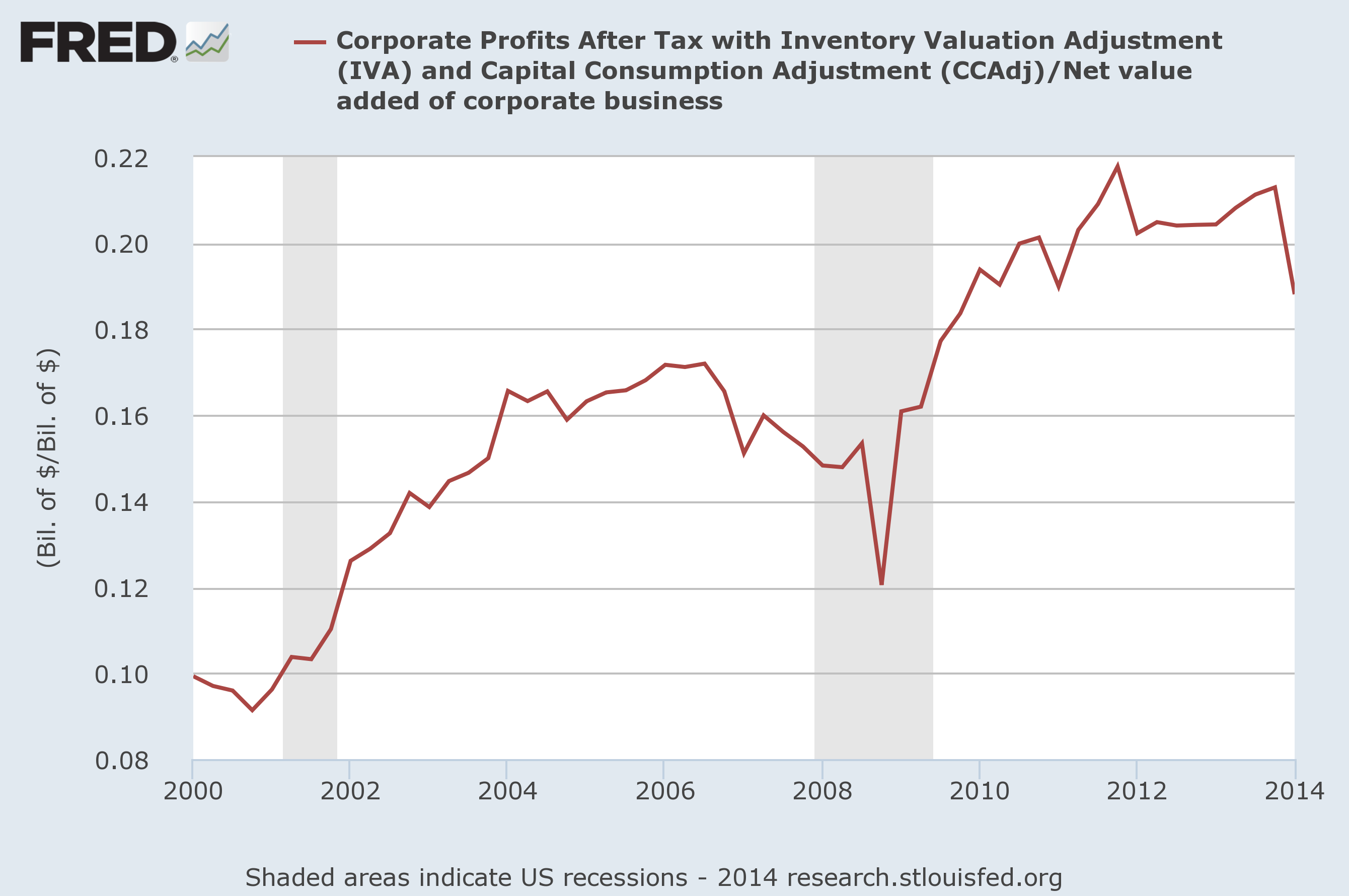
Quarterly GDP data are erratic and profit data in particular are subject to large revisions, but hey it's still worth noting a big drop in profit shares reported for the first quarter of 2014. The data released by the Commerce Department last week showed the profit share falling from just over 21 percent of net value added in the corporate sector in the last quarter of 2013 to less than 19 percent in the first quarter of 2014. Here's the picture.
corporate profits


It's too early to make much of this drop in profit shares. It is also a bit disconcerting that it is all attributable to a drop in the capital consumption adjustment, the difference between accounting depreciation and economic depreciation as measured by the Commerce Department. (In other words, the Commerce Department is showing a larger gap between what firms record for accounting purposes and the actual rate of depreciation of capital.)

Anyhow, with all the appropriate caveats, this may be the first sign that the sharp rise in profit shares in this century is being reversed, or as Gerald Ford once said, our long national nightmare is over.
And he adds in comments:

can't attach much meaning to profit share drop
written by Dean, July 02, 2014 2:53
Ideally the drop in profit shares would mean that workers are getting a share of the gains from growth, meaning higher wages. But, the data for the first quarter show the economy shrinking, which means there were no gains to be shared. So we really can't draw much from this picture yet. However, if the profit share stays down and we get decent growth the rest of this year, that would mean that workers will finally be seeing some wage growth.

Intertubes eating my comments

Krugman argues in this blog post that conservatism basiscally got their ideas through - slash the safety-net, slash taxes on high incomes, deregulation - and the result is slower growth and greater inequality.

I think a lot of the blame should go to Greenspan as well. He was loose on macroprudential policies "there's no bubble" and too tight overall. Inflation has been too low for a long time.

Greenspan, with help from Rubin, talked Clinton out of his Middle Class spending bill and fiscal stimulus, saying they would cause higher bond prices. He was talked into doing deficit reduction instead. Really Greenspan was threatening Clinton blackfmail: cut the deficit or I'll raise rates.

http://krugman.blogs.nytimes.com/2014/07/02/trick-or-tweak/

Sam Tanenhaus asks, “Can the G.O.P. Be a Party of Ideas?”

Why, no. This is another edition of simple answers to simple questions.

More specifically, the “reform conservatives” seem mainly to be offering supposedly new ideas for the sake of being seen to offer new ideas. And there isn’t much there there; can you find anything in the Tanenhaus piece that sounds like an important new idea rather than a minor tweak on the current conservative catechism? I can’t. I mean, converting federal poverty programs into bloc grants is supposed to be a major departure?

But then, the whole notion that new ideas are what politics is about is greatly overrated. Governing isn’t like selling smartphones; the underlying shape of the problems you have to confront changes quite slowly, and the basics of policy debate are quite stable.

In particular, the central policy debate in US politics hasn’t changed in decades, nor should it. Liberals want a strong social safety net, financed with relatively high taxes, especially on high incomes. Conservatives want much less of a safety net, and much lower taxes on the affluent.

Thirty-five years ago conservatives did produce a new argument — the claim that high taxes and generous benefits were producing such a drag on the economy that even lower-income Americans would be better off if we slashed all of that. And they got most of what they wanted — much lower taxes on top incomes, an end to welfare as we knew it, though not to the big middle-class programs. But growth failed to take off while inequality soared, so that the income of typical families grew much more slowly after the conservative revolution than before:

Photo

Credit EPI
So much for that big idea. Is there anything like that on the horizon? No — and it’s not clear why you should expect anything of the kind. What’s certain is that tweaking policy at the edges isn’t going to do much.

And I suspect that at some level the reform conservatives know this. The point of their proposed policy tweaks, I’d argue, is less to achieve results than to let the GOP dissociate itself from soaring inequality and stagnating incomes, without changing its fundamental policy stance. And it’s not a trick that’s likely to work.
---------

Yellen


Yellen: Monetary policy not the right tool to curb financial excesses by Ylan Q. Mui

"...Yellen argued that those weapons would likely be more effective than the blunt tool of monetary policy. To make her point, she rebutted a common criticism that the Fed primed the stage for the Great Recession by waiting too long to raise interest rates, allowing home prices to rise unabated and encouraging investors to pile on risk.

Yellen conceded that policymakers “failed to anticipate” the ensuing global financial crisis but also argued that monetary policy would have been “insufficient” to address the problems that caused it. Higher rates would not have beefed up regulation or increased the transparency of the exotic new financial instruments at the heart of the crisis -- or the firms that helped generate them.

In fact, Yellen said that raising rates would likely have caused greater unemployment, which would likely have led to more people defaulting on their debts."

How does John Taylor respond?

Supreme Court

THE TRAP IN THE SUPREME COURT’S “NARROW” DECISIONS by JEFFREY TOOBIN


Tea Party conservatives

DAVID BRAT, THE ELIZABETH WARREN OF THE RIGHT by RYAN LIZZA

Difference is Warren's ideas work, Brat's don't.


Tuesday, July 01, 2014

Plaza Accord

Plaza Accord

Background

Between 1980 and 1985 the dollar had appreciated by about 50% against the Japanese yen, Deutsche Mark, French Franc and British pound, the currencies of the next four biggest economies at the time.[citation needed] This caused considerable difficulties for American industry but at first their lobbying was largely ignored by government. The financial sector was able to profit from the rising dollar, and a depreciation would have run counter to Ronald Reagan's administration's plans for bringing down inflation. A broad alliance of manufacturers, service providers, and farmers responded by running an increasingly high profile campaign asking for protection against foreign competition.

Major players included grain exporters, car producers, engineering companies like Caterpillar Inc., as well as high-tech companies including IBM and Motorola. By 1985, their campaign had acquired sufficient traction for Congress to begin considering passing protectionist laws. The prospect of trade restrictions spurred the White House to begin the negotiations that led to the Plaza Accord.[1][2]

The justification for the dollar's devaluation was twofold: to reduce the U.S. current account deficit, which had reached 3.5% of the GDP, and to help the U.S. economy to emerge from a serious recession that began in the early 1980s. The U.S. Federal Reserve System under Paul Volcker had halted the stagflation crisis of the 1970s by raising interest rates, but this resulted in the dollar becoming overvalued to the extent that it made industry in the U.S. (particularly the automobile industry) less competitive in the global market.
Effects[edit]

Devaluing the dollar made U.S. exports cheaper to purchase for its trading partners, which in turn allegedly meant that other countries would buy more American-made goods andservices.

The exchange rate value of the dollar versus the yen declined by 51% from 1985 to 1987. Most of this devaluation was due to the $10 billion spent by the participating central banks.[citation needed] Currency speculation caused the dollar to continue its fall after the end of coordinated interventions. Unlike some similar financial crises, such as the Mexican and the Argentine financial crises of 1994 and 2001 respectively, this devaluation was planned, done in an orderly, pre-announced manner and did not lead to financial panic in the world markets. The Plaza Accord was successful in reducing the U.S. trade deficit with Western European nations but largely failed to fulfill its primary objective of alleviating the trade deficit with Japan. This deficit was due to structural conditions that were insensitive to monetary policy, specifically trade conditions.

The manufactured goods of the United States became more competitive in the exports market but were still largely unable to succeed in the Japanese domestic market due to Japan's structural restrictions on imports.

The recessionary effects of the strengthened yen in Japan's export-dependent economy created an incentive for the expansionary monetary policies that led to the Japanese asset price bubble of the late 1980s. The Louvre Accord was signed in 1987 to halt the continuing decline of the U.S. dollar.

The signing of the Plaza Accord was significant in that it reflected Japan's emergence as a real player in managing the international monetary system. Yet it is postulated[3] that it contributed to the Japanese asset price bubble, which ended up in a serious recession, the so-called Lost Decade.


Intertubes

My comments are being eaten in the blogosphere. Perhaps I'm being blocked but I don't think so. Anyhow I'll save/copy my mental regurgitations here so they don't simply vanish into the aether.

commenter Darryl FKA Ron:
[The return to capital tax incentives created by a dividends tax credit equal to the lesser of the issuers taxes paid on the dividends amount or the full amount of ordinary income taxes owed on the dividends by its recipient was an old idea going back to 1913 until the Republicans rescinded it in 1954. During the New Deal era this incentive to hold rather than trade speculatively or sell out to the first good proffer that beat the market was enhanced temporarily by higher capital gains tax rates and longer holding term requirements for discounting. 
First two LBOs happened in 1955, the year after the dividends tax credit was permanently (had been done 1936-1939, before Congress understood why it was instituted with the income tax in 1913) rescinded.]


macro history and the paleo Keynesian straw man

A comment on Kling on Remembering the 1970s by Robert Waldmann

The Leftovers, scapegoats, and inflation

The World’s Central Banker by DeLong

AV Club reviews the The Leftovers: “Pilot”

The Fed needs to target 4 percent inflation or else we'll get the scapegoating of foreigners. If 2 percent of the population disappeared, there'd be an economic boom as labor supply would meet demand and the Fed would have to raise rates.

Saturday, June 28, 2014

stagflation

Not a monetary phenomenon by Steve Randy Waldman

What Happened to the Phillips Curve ? by Robert Waldmann

Continuum


AV Club reviews Continuum: “Last Minute”: A terrific finale caps off a terrific, series-redefining year


Franz Ferdinand was shot 100 years ago today


Archduke Ferdinand was assassinated

yadda yadda yadda

smokestacks over Auschwitz, mushroom clouds over Hiroshima and Nagasaki

Friday, June 27, 2014

Colbert

funny interview with Paul Rudd


K21

THE FOUR BIG VALID ISSUES PEOPLE HAVE WITH THOMAS PIKETTY'S GRAND ARGUMENT: OVER AT EQUITABLE GROWTH: FRIDAY FOCUS FOR JUNE 27, 2014 by DeLong


San Francsico

Oh I wish I lived in or near San Francisco:

Last year, Writers With Drinks brought you the special event, "An Evening of Uncomfortable Sex Talk." Now, we bring you "An Evening of Oversharing About Money"!

When: Saturday, July 12, from 7:30 PM to 9:30 PM, doors open 6:30 PM
Who: J. Bradford DeLong, Carol Queen, Farhad Manjoo, Frances Lefkowitz and Charlie Jane Anders
How much: $5 to $20, all proceeds benefit the Center for Sex and Culture.
Where: The Make Out Room, 3225 22nd. St., San Francisco


Tuesday, June 24, 2014

macro

Wages, compensation, investment returns (more or less) and debt contracts are set with certain asssumptions about inflation and price levels. When inflation changes, so does the amount of money flowing in these relationships. The original contract didn't have this change in inflation in mind so someone benefits because of public policy. Will inflation-indexing become more prevalent (like worker profit-sharing?)

Lately the problem has been slow recoveries after recessions. Recessions reset these contracts. Before it was the Fed that would set off recessions. Now it's the bursting of bubbles and balance sheet recessions.

The Fed relays new needed demand via the banks and profitable investments (although lowering interest rates makes governments' borrowing cheaper.) The government relays new demand via spending (and it can temporarily cut taxes).