Movie about the Clash in the works
Just the other a day an employee at the local used book store in my neighborhood was shocked when Mick Jones and Paul Simonon entered the store, browsed and asked if they had a certain book. They were playing with Gorillaz who were performing at a local music venue that night.
Saturday, December 04, 2010
Coen Brothers' True Grit remake coming soon
With a sly hipness that is the trademark of Joel and Ethan Coen, a billboard just outside the Melrose Avenue gate at Paramount Pictures promotes their next film, "True Grit," with a promise: "Retribution. This Christmas."It's funny but is it "hipness"?
But other film devotees were less charmed, particularly when they viewed "True Grit" through the filter of Vietnam-era politics and Wayne’s conservative principles -- which he had said were illustrated by a scene in which Cogburn shoots a rat after demonstrating the futility of trying to treat it under due process of law. (The new film has no such moment.)
Writing in The New Yorker, Penelope Gilliatt complained of the movie’s "very right-wing and authoritarian tang." She was particularly put off by the frontier stoicism, which she described as "near-Fascist admiration for a simplified physical endurance of pain"
In The New Republic, Stanley Kaufman said of Mr. Portis’s novel, "Although it was short it was overlong by about a third." The film’s director, Henry Hathaway, he described as "an old workhorse" who "hasn’t had a new idea since the beginning of his career"
President Richard M. Nixon, for whom Wayne had campaigned, apparently felt otherwise, if a snippet of conversation caught by his Oval Office taping system in February 1971 is any measure. Greg Cumming, an archivist with the Nixon Library, said that the audio quality of the tape was bad, but that he could make out Nixon’s discussing "True Grit: with his chief of staff, H. R. Haldeman. They talk of someone’s having gone "out in a blaze of glory," according to Mr. Cumming.
Of course, Wayne went on to make about 10 or so more films, including the 1975 sequel "Rooster Cogburn," before his death in 1979.
The Coens said they only dimly recalled having seen the earlier movie when they were young, and they did not watch it in preparing their own. "We didn’t do our homework," Ethan Coen said.
Joel Coen said they were drawn to the underlying book a few years ago after he had "re-read it out loud to my kid."1969 trailer:
Friday, December 03, 2010
Sewell Chan on the Fed data dump
From December 2007 to October 2008, the Fed opened swap lines with foreign central banks, allowing them to temporarily trade their currencies for dollars to relieve pressures in their financial markets.
The European Central Bank drew the most heavily on these currency arrangements, the records show, but nine other central banks also made use of them: Australia, Denmark, England, Japan, Mexico, Norway, South Korea, Sweden and Switzerland.
Monday, November 29, 2010
The Spanish Prisoner by Krugman
But problems were developing under the surface. During the boom, prices and wages rose more rapidly in Spain than in the rest of Europe, helping to feed a large trade deficit. And when the bubble burst, Spanish industry was left with costs that made it uncompetitive with other nations.
Now what? If Spain still had its own currency, like the United States -- or like Britain, which shares some of the same characteristics -- it could have let that currency fall, making its industry competitive again. But with Spain on the euro, that option isn’t available. Instead, Spain must achieve "internal devaluation": it must cut wages and prices until its costs are back in line with its neighbors.
And internal devaluation is an ugly affair. For one thing, it’s slow: it normally take years of high unemployment to push wages down. Beyond that, falling wages mean falling incomes, while debt stays the same. So internal devaluation worsens the private sector’s debt problems.
What all this means for Spain is very poor economic prospects over the next few years. America’s recovery has been disappointing, especially in terms of jobs -- but at least we’ve seen some growth, with real G.D.P. more or less back to its pre-crisis peak, and we can reasonably expect future growth to help bring our deficit under control. Spain, on the other hand, hasn’t recovered at all. And the lack of recovery translates into fears about Spain’s fiscal future.
Friday, November 26, 2010
Wednesday, November 24, 2010
Lands of Ice and Ire by Krugman
Iceland versus Ireland; heterodox versus orthodox.
Iceland versus Ireland; heterodox versus orthodox.
What’s going on here? In a nutshell, Ireland has been orthodox and responsible -- guaranteeing all debts, engaging in savage austerity to try to pay for the cost of those guarantees, and, of course, staying on the euro. Iceland has been heterodox: capital controls, large devaluation, and a lot of debt restructuring -- notice that wonderful line from the IMF, above, about how "private sector bankruptcies have led to a marked decline in external debt". Bankrupting yourself to recovery! Seriously.
And guess what: heterodoxy is working a whole lot better than orthodoxy.
Tuesday, November 23, 2010
Monday, November 22, 2010
Dean Baker: Robert Samuelson Does the Big Lie, Big Time
Competent budget analysts know that the long-term budget problem is a health care cost problem. If U.S. per person health care costs were comparable to those in any other wealthy country, we would be looking at huge projected surpluses not deficits. Because health care costs are rising rapidly in the private sector, it means that the public sector programs that pay for these benefits (most important Medicare and Medicaid) also have rapidly rising costs.
If Medicare and Medicaid are lumped together with any other programs then the combination of Medicare, Medicaid, and the other program will be the cause of the deficit. For example, the categories of Medicare, Medicaid, and foreign aid explain the vast majority of the projected increase in the deficit over the next quarter century. Similarly, the combination of Medicare, Medicaid, and school lunch programs also explains the vast majority of the projected increase in the deficit over the next quarter century.
Robert Samuelson throws in Social Security as the third program so that he can tell readers:
"America's budget problem boils down to a simple question: How much will we let programs for the elderly displace other government functions."
Social Security does not in any honest way since it is fully financed over the period in question by the designated Social Security tax. But Samuelson does not feel bound by such details.
Of course there are easy ways to prevent health care costs from bankrupting the country, most obviously by taking advantage of the lower cost health care available in other countries. But, Samuelson never discusses such possibilities, focusing exclusively on cutting benefits on which the vast majority of retirees depend.via Yglesias, Joe Klein on the Pain Caucus's focus on "fiscal resposibility":
here is, for example, Glenn Hubbard, who was featured on the New York Times op-ed page recently in defense of the deficit commission, describing the problem this way: "We have designed entitlements for a welfare state we cannot afford." This is the same Glenn Hubbard who served as George W. Bush’s chief economic adviser when Dick Cheney was saying that "Reagan proved deficits don’t matter." One imagines that if Hubbard was so concerned about deficits, he might have resigned in protest from an Administration dedicated to creating them. But, no, he’s here to speak truth to the powerless -- to the middle-class folks whose major asset, their home, was trashed by financial speculators, thereby wrecking their retirement plans and creating the consumer implosion we’re now suffering. Hubbard is telling them they now have to take yet another hit, on their old-age pensions and health insurance, for the greater good.
Sunday, November 21, 2010
Professor predicts Obama will win in 2012 because economy will be better.
Paul Barrett reviews "All the Devils Are Here: The Hidden History of the Financial Crisis." by Bethany McLean and Joe Nocera.
Barrett writes
Bernanke and Krugman point to the global savings glut rather than the Fed's policy of keeping rates low after the dot-com crash of 2000 as the source of the housing bubble which took on a life its own once it had momentum.
His model forecasts real annualized growth in gross domestic product of 3.69 percent for the first three quarters of 2012. A survey of leading economists by Blue Chip Economic Indicators shows an average forecast of 3.2 percent growth in real G.D.P. in 2012, while the Congressional Budget Office estimates 3.4 percent. Plug either of these estimates into his election algorithm and the result is the same: President Obama wins.He believes the Fed will keep policy stimulative.
Paul Barrett reviews "All the Devils Are Here: The Hidden History of the Financial Crisis." by Bethany McLean and Joe Nocera.
Others have illuminated facets of the crisis in more depth. John Cassidy’s "How Markets Fail" explained the economic history and theory with greater sophistication. Gillian Tett’s "Fool’s Gold" offered a journey into one investment bank, J. P. Morgan, and a close look at how it helped create a financial instrument, the credit derivative, that amplified risk rather than minimizing it. "In Fed We Trust," by David Wessel, took the reader behind the scenes in Washington, where politicians and regulators missed all the warning signs. For their part, McLean and Nocera concentrate on the basics and bring them together in brisk, well-organized chapters.I've read Cassidy's book and Wessel's book, but need to get Tett's.
Barrett writes
Another public quarrel McLean and Nocera bring into focus is the esoteric debate about Federal Reserve monetary policy. Ben S. Bernanke, the chairman of the Federal Reserve, has pushed interest rates practically to zero to try to stimulate growth and reduce an unemployment rate that currently hovers near 10 percent. Dissenters from this policy, like Thomas M. Hoenig, the president of the Kansas City Federal Reserve Bank, warn that Bernanke is repeating the mistake of his predecessor, Greenspan, who employed similar measures to combat the recession that followed the dot-com crash of 2000.There are two different issues about Greenspan. His approach to regulation and his approach to interest rates. Hoenig and Barrett erroneously conflate the two.
Bernanke and Krugman point to the global savings glut rather than the Fed's policy of keeping rates low after the dot-com crash of 2000 as the source of the housing bubble which took on a life its own once it had momentum.
Saturday, November 20, 2010
Depression Economics in a Nutshell by Brad DeLong
Second is excess demand for liquid cash money.
Historically, we have had three types of excess demand for finance that have produced big downturns in economies.In 2002 there was an excess demand for bonds and so logically there was less demand for currently produced goods and services. Brad doesn't say it, but that was in the aftermath of the Tech Bubble crash. He writes that in 2008 there wasn't excess demand for bonds because they are still cheap. They would be expensive if there was an increased demand.
Second is excess demand for liquid cash money.
It is possible to tell when there is monetarist downturn: since everybody is trying to build up their stocks of liquid cash money, everybody is selling their other financial assets and thus their prices--stocks, bonds, whatever--and all their prices are low. That is not the kind of downturn we have today: today the prices of some financial assets--the liabilities of credit-worthy governments, for example--are very high.Third is an excess demand for safety after the housing bubble popped and the ensuing panic.
We conclude that the excess demand in financial markets right now on the part of investors is an excess demand for safety: for high quality AAA-rated assets for people that hold in their portfolios. Prices of risky financial assets are low--there is no excess demand for them. Prices of safe financial assets are high--there is an excess demand for them.
Thus businesses and households have cut back on their spending on currently-produced goods and services as they all have concluded: "We don’t have enough safe assets in our portfolios. We need to stop spending so much until we build up our holdings of safe assets to a higher level." And the fact that they cannot do so because there is a shortage of safe assets in the economy is what is keeping us wedged in this current situation of high unemployment and low capacity utilization.
Where did this excess demand for safe assets come from?
It came as a consequence of the deregulation of finance and of the securitization of mortgages, from the housing bubble and the crash, from the fact that then it turned out that investment banks that had created brand new derivative securities based on mortgages had not originated-and-distributed them but had, to a remarkable and astonishing degree, originated and kept them. They were supposed to sell off all the pieces o[f] real estate risk in small bundles to savers all over the world. They did not.
Thursday, November 18, 2010

Federal Reserve Bank defends QE2. by Sewell Chan
The Republicans who signed the letter were the Senate minority leader, Mitch McConnell of Kentucky; Senator Jon Kyl of Arizona; Representative John A. Boehner of Ohio, who is in line to become the House speaker in January; and Representative Eric Cantor of Virginia, the No. 2 House Republican. They emphasized that the Fed should be insulated from political pressure but also said the central bank "should be open to receiving input and data from a wide range of sources."
However, the letter was more moderate in tone than recent complaints voiced by other Republican critics, like Representatives Mike Pence of Indiana, the chairman of the House Republican Conference, and Kevin Brady of Texas, who is in line to lead a subcommittee on trade.
By contrast, in the Fed’s corner on Wednesday was Thomas J. Donohue, president of the United States Chamber of Commerce, which poured money into the midterm campaigns to defeat Democrats.
"The Fed has over many, many, many years been particularly helpful to this government and to this country in dealing with financial crises, and by the way, they always make money on it," Mr. Donohue told reporters, referring to the fact that the Fed each year turns over to the government the profit it makes as a byproduct of its investments. "We’re hopeful that the Fed’s judgments turn out to be very positive for job creation and economic expansion."
Mr. Donohue suggested that some of the criticism of Mr. Bernanke had gone too far, praising Mr. Bernanke as a scholar of the Depression and saying, "We must maintain the independence of the Fed and be very, very careful not to louse that up on Capitol Hill:"
The Beatings Will Continue Until Morale Improves
Irish Officials Acknowledge Need for Aid in Debt Crisis.
Ireland: a Textbook Example of the Dangers of Balanced Budgets and Fiscal Responsibility by Dean Baker
OECD sees global recovery slowing
Irish Officials Acknowledge Need for Aid in Debt Crisis.
Ireland: a Textbook Example of the Dangers of Balanced Budgets and Fiscal Responsibility by Dean Baker
OECD sees global recovery slowing
January 7th panel in Denver at the AEA Annual Meeting
Panel Moderator: John Quiggin (University of Queensland, Australia)
Brad DeLong (University of California-Berkeley) Lessons for Keynesians
Tyler Cowen (George Mason University) Lessons for Libertarians
Scott Sumner (Bentley University) A defense of the Efficent Markets Hypothesis
James K. Galbraith (University of Texas-Austin) Mainstream economics after the crisis
Wednesday, November 17, 2010

Wikipedia entry on "duel" and dueling.
Isaac Asimov relates a joke in his Treasury of Humor (1971) that claims that Otto von Bismarck challenged Rudolf Virchow to a duel. As the challenged party had the choice of weapons, Virchow chose two sausages, one of which had been infected with cholera. Bismarck is said to have called off the duel at once.
One Way to Trim Deficit: Cultivate Growth by David Leonhardt
Krugman blogs:
Krugman blogs:
As Catherine Rampell points out, this is the lowest level of core inflation ever.
But I have a question here: why do economic forecasters keep predicting a near-time rise in core inflation, even though they are also predicting high unemployment? The Survey of Professional Forecasters now predicts average unemployment of 8.7 percent in 2012, which would seem to be a recipe for continuing disinflation and quite possibly deflation; but the same forecasters predict a noticeable rise in core inflation over the next two years:
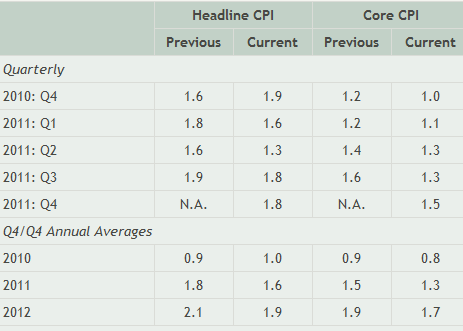
Meanwhile in Europe, the debt crisis resurfaces. Dean Baker blogs:I don’t really understand this, except as a fundamental unwillingness to face up to the Nipponization of the US economy.
Ireland is in the headlines these days as its government struggles with insolvency. Remarkably, none of the news stories remember to point out that Ireland was a model of fiscal responsibility in the years leading up to its current disaster. Not only did it balance its budget, Ireland ran large budget surpluses in the 5 years preceding its collapse in 2008. Its peak surplus in 2006 was 2.9 percent of GDP, the equivalent of a surplus of roughly $420 billion in the United States.
Like the deficit hawks in the United States, Ireland's political leaders ignored the country's massive housing bubble, the collapse of which sank its economy. It is interesting to note that, while Ireland's background to the deficit crisis is generally ignored, news reports on Greece's financial difficulties routinely referred to its large budget deficits in the years leading up to the crisis.And yet here we are in the US talking about deficits and the Catfood Commission.
Tuesday, November 16, 2010

Philly Fed revises downwards. I bet the economy does better than this but it's just a hunch.
(via DeLong, via Atrios)
Under Attack, Fed Officials Defend Buying of Bonds by Sewell Chan
Bernanke and the Fed have been attacked by China, Germany etc., Greenspan and conservative letter writing economists.
Yglesias directs us to this by Greg Mankiw. He didn't sign the letter, nor did Mark Zandi. Both have gone up in my book. Greenspan seems to have reverted to form after admitting he was wrong about self-regulating banks.
Tim Duy writes:
(via Mark Thoma)Bottom Line: In general, the retail sales report was good news, as it is another indicator that drives a stake into the heart of the double-dip story. But keep in mind that the data continues to illustrate the good cop, bad cop conflict in the economy. Policymakers should be concerned about the distance between new trends and old, lest they risk falling into the trap of diminished expectations, believing that 9% unemployment should be the new normal. Market participants, however, may simply be content with confirmation that the foundation for ongoing corporate revenue growth remains secure.
Krugman responds to fellow columnist David Brooks:
Brooks is a member of my "rogues gallery."
So David Brooks claims that
The economic approach embraced by the most prominent liberals over the past few years is mostly mechanical. The economy is treated like a big machine; the people in it like rational, utility maximizing cogs. The performance of the economic machine can be predicted with quantitative macroeconomic models.I protest, on several grounds.
First, it’s conservative economists who insist that people are always rational and utility-maximizing; liberal economists are the ones willing to invoke bounded rationality, animal spirits, etc.. The whole salt-water fresh-water split was about which you were going to believe: the assumption of perfect maximization, or your own lying eyes. And the Keynesians were the ones who preferred to believe their eyes.
Second, David would have us believe that the Obama people were misled by their excessive faith in models. But we actually know what happened when the stimulus was being discussed: the modelers, who said that we needed something much bigger, were dismissed in favor of gut feelings about market psychology.
David Brooks: Math is Hard, Just Give Money to Rich People by Dean BakerThe truth is that we would have been much better off if Obama et al had relied on old-fashioned hydraulic Keynesianism.
Brooks is a member of my "rogues gallery."
Subscribe to:
Posts (Atom)